Ferrous Sulphate in Water Treatment: What It Does and When It Makes Sense
A technical operational guide exploring the coagulation and reduction chemistry of ferrous sulphate in potable and industrial process water treatment.
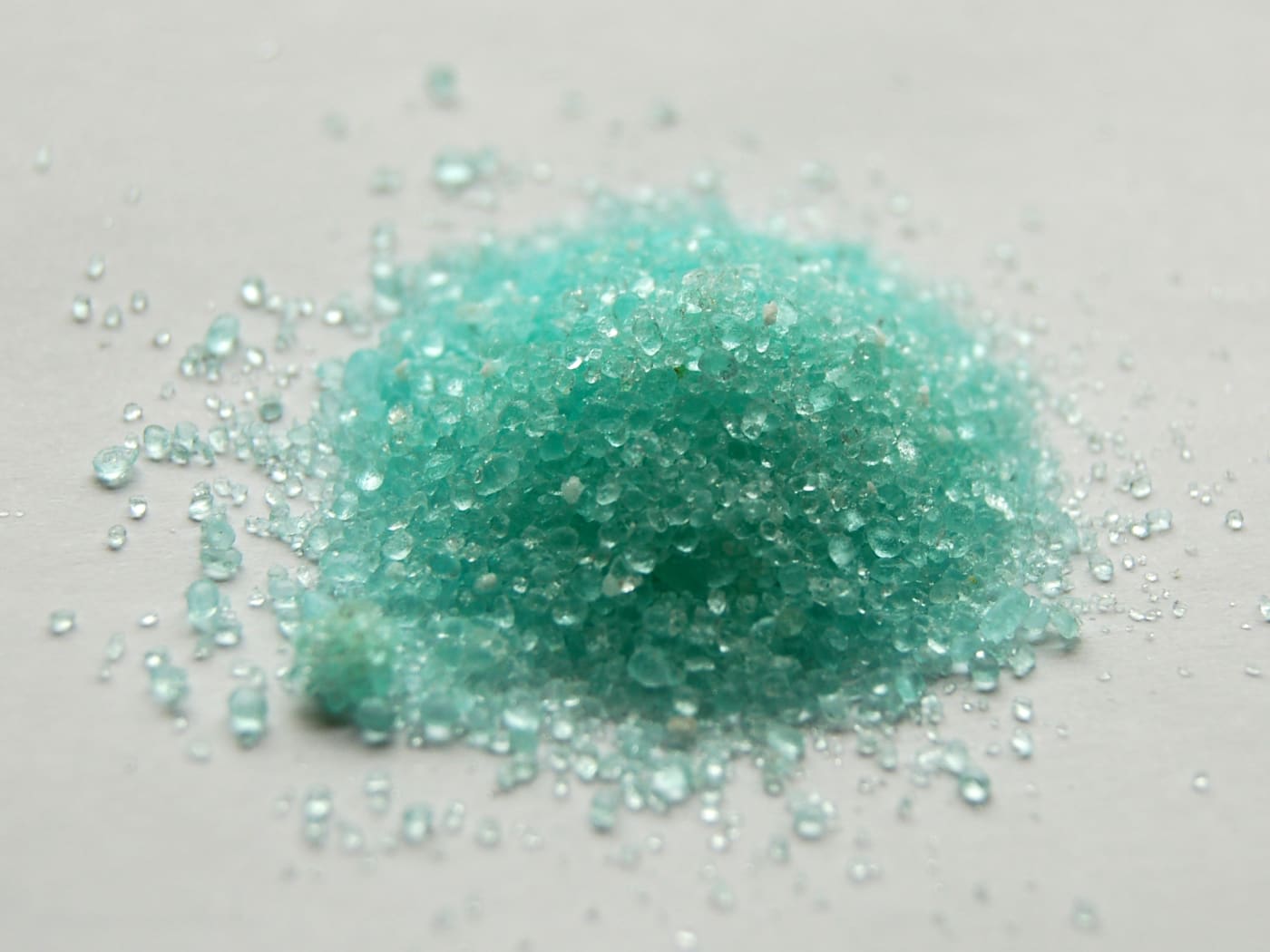
Crystalline structure of Ferrous Sulphate Heptahydrate (FeSO₄·7H₂O), CAS 7782-63-0.
Quick Answer — Ferrous Sulphate in Water Treatment: What It Does and When It Makes Sense
In water treatment, Ferrous Sulphate Heptahydrate supplies divalent iron (Fe²⁺) which oxidizes to trivalent iron (Fe³⁺) upon aeration or alkaline exposure, forming dense ferric hydroxide flocs that sweep turbidity and precipitate dissolved phosphorus. Dosing typically ranges between 10 and 60 mg/L as FeSO₄·7H₂O, but must be determined via site-specific jar testing due to varying raw water alkalinity and pH.
An engineering operational guide explaining coagulation mechanisms, oxidation requirements, and dosing calculations for ferrous sulphate in water treatment.
Key Facts
- •Requires oxygen or chlorine to convert Fe²⁺ to insoluble Fe³⁺ hydroxide flocs.
- •Consumes raw water alkalinity, often necessitating lime or caustic soda pH buffering.
- •Precipitates dissolved orthophosphate as insoluble iron phosphate complexes.
- •Optimal performance requires jar testing to prevent dissolved iron carryover into distribution networks.
Primary Use Cases
The Dual Role of Iron(II) in Water Chemistry
Unlike ferric salts (such as ferric chloride or ferric sulphate) which arrive already in the trivalent oxidation state, ferrous sulphate introduces divalent iron (Fe²⁺). In raw water clarification, Fe²⁺ alone does not form immediate flocs at neutral pH. It must first undergo oxidation to Fe³⁺, which then hydrolyzes rapidly into dense, gelatinous amorphous ferric hydroxide flocs (Fe(OH)₃):
4Fe²⁺ + O₂ + 10H₂O → 4Fe(OH)₃↓ + 8H⁺
When properly controlled, dosing Ferrous Sulphate Heptahydrate 98% Min creates heavy, fast-settling flocs that settle up to 25% faster than conventional aluminium sulfate flocs.
Alkalinity Consumption and pH Control
As demonstrated in the hydrolysis equation, the oxidation and precipitation of ferrous iron releases hydrogen ions (H⁺), consuming natural bicarbonate alkalinity in the raw water. For every 1 mg/L of FeSO₄·7H₂O dosed, approximately 0.36 mg/L of alkalinity (as CaCO₃) is consumed. In soft, low-alkalinity surface waters (such as highland streams in the Aberdares or Mount Kenya catchments), co-dosing with hydrated lime (calcium hydroxide) or soda ash is essential to keep the flocculation pH between 7.5 and 8.5.
Phosphorus Removal via Ferrous Precipitation
In municipal wastewater lagoons and effluent polishing basins across East Africa, phosphorus is a strictly regulated parameter under NEMA guidelines to prevent eutrophication in Lake Victoria, Lake Naivasha, and the Athi River basin. Divalent iron reacts with orthophosphate to form vivianite-type insoluble salts (Fe₃(PO₄)₂·8H₂O), which settle readily into primary or secondary sludge.
The Golden Rule: Dosing Must Be Established by Jar Testing
There is no single universal dosing rate for ferrous sulphate. Over-dosing leaves unoxidized dissolved Fe²⁺ in the clarifier overflow, which oxidizes downstream in distribution pipes to produce reddish-brown tap water and customer complaints. Under-dosing leaves colloidal turbidity in suspension. Operators must execute standardized 6-paddle jar tests, varying coagulant dose, aeration rate, and pH buffer, before establishing automated dosing setpoints.
Learn about treating complex effluent streams: Ferrous Sulphate for Wastewater & Industrial Effluent.
Understand the reaction mechanisms of nutrient removal: Ferrous Sulphate and Phosphate Removal Chemistry.
Article Frequently Asked Questions
Related Categories
Chemicals Mentioned in This Guide

Ferrous Sulfate Heptahydrate 98% Min
Ferrous Sulphate Heptahydrate 98% Min (FeSO₄·7H₂O, CAS 7782-63-0) is an industrial-grade iron(II) salt supplied in 25…
CAS 7782-63-0 · Industrial Grade · Crystal

ATMP (50%)
ATMP (50%) supplied by Kiki's Industrial Chemicals Ltd in 200kg drum. Ideal for Water treatment chemicals.
50% · Standard Packaging

Activated Carbon Coal / wood base for Industrial Use (Activated Carbon)
Activated Carbon (Coal / wood base) supplied by Kiki's Industrial Chemicals Ltd in 25kg bag across Kenya and East…
Technical Grade · Powder

Activated Carbon Granular / Powder (Water Purification CTC 45-60)
Activated Carbon Granular / Powder (Water Purification CTC 45-60) supplied by Kiki's Industrial Chemicals Ltd in 25kg…
Water Purification CTC 45-60 · Standard Packaging
Related Technical Guides & Insights
View all →How to Read a Ferrous Sulphate COA Before Buying
A quality control guide on analyzing Certificates of Analysis for Ferrous Sulphate. How to audit assay, insolubles, free acid, heavy metals, and batch traceability.
Chemical SafetyHow to Store Ferrous Sulphate Heptahydrate in Kenya’s Warehouse Conditions
Practical warehouse engineering advice for storing Ferrous Sulphate Heptahydrate in tropical and high-altitude East African climates. Moisture control, palletizing, and FIFO rotation.
Industrial ApplicationsIndustrial Ferrous Sulphate: Applications Beyond Water Treatment
Discover the diverse industrial uses of ferrous sulphate heptahydrate beyond water clarification: agricultural iron chlorosis remediation, cement chromium reduction, synthetic pigment manufacturing, and textile dyeing mordants.