Pyrite Oxidation Chemistry: How Iron Disulphide Generates Ferrous Sulphate
Comprehensive biogeochemical guide explaining the multi-stage oxidation kinetics of pyrite (FeS₂), chemical reaction pathways, microbial catalysis, and why natural copperas beds were replaced by industrial synthesis.

Quick Answer — Pyrite Oxidation Chemistry: How Iron Disulphide Generates Ferrous Sulphate
Pyrite oxidation is a complex multi-stage biogeochemical reaction where iron disulphide (FeS₂, cubic iron sulphide) reacts with atmospheric oxygen, water, and dissolved ferric ions to produce aqueous ferrous sulphate (FeSO₄) and sulphuric acid (H₂SO₄). The reaction begins abiotically when exposed pyrite contacts dissolved oxygen: 2 FeS₂ + 7 O₂ + 2 H₂O → 2 Fe²⁺ + 4 SO₄²⁻ + 4 H⁺. Once acidity drops below pH 3.5, acidophilic chemolithoautotrophic bacteria (principally Acidithiobacillus ferrooxidans and Leptospirillum ferrooxidans) accelerate the oxidation of ferrous iron (Fe²⁺) to ferric iron (Fe³⁺) by up to 100,000-fold. The generated ferric ions then act as a far more aggressive oxidant than molecular oxygen, attacking the pyrite crystal lattice directly: FeS₂ + 14 Fe³⁺ + 8 H₂O → 15 Fe²⁺ + 2 SO₄²⁻ + 16 H⁺. Historically, this natural weathering formed the basis of 'copperas beds' in 16th–19th century Europe, where weathered pyritic shale was leached with rainwater and crystallised into green vitriol. In modern chemical manufacturing, this uncontrolled environmental reaction is superseded by precise acid dissolution of refined iron scrap and titanium dioxide co-product recovery.
Pyrite oxidation is the biogeochemical degradation of iron disulphide mineral crystals under aerobic conditions, yielding dissolved ferrous iron, sulphate ions, and hydronium ions.
Key Facts
- •Primary Reactant: Iron disulphide (FeS₂, pyrite, brass-yellow isometric crystal)
- •Initiation Reaction: 2 FeS₂ + 7 O₂ + 2 H₂O → 2 Fe²⁺ + 4 SO₄²⁻ + 4 H⁺ (produces aqueous FeSO₄)
- •Biological Catalyst: Acidithiobacillus ferrooxidans accelerates Fe²⁺ to Fe³⁺ oxidation by 100,000x
- •Propagation Mechanism: Ferric iron (Fe³⁺) directly cleaves disulphide bonds: FeS₂ + 14 Fe³⁺ + 8 H₂O → 15 Fe²⁺ + 2 SO₄²⁻ + 16 H⁺
- •Historical Application: 16th-century 'copperas beds' leached weathered pyritic mudstones to crystallize green vitriol
- •Modern Industrial Reality: Natural pyrite runoff is unviable for commercial supply due to heavy metal impurities and low purity; modern supply uses controlled acid digestion
Biogeochemical Mechanisms of Pyrite Weathering
Pyrite (FeS₂)—commonly known as 'fool's gold' due to its metallic luster and pale brass-yellow hue—is the most ubiquitous sulphide mineral in the Earth's crust. It occurs within igneous, metamorphic, and sedimentary rocks, particularly as fine framboidal nodules in coal seams and organic-rich black shales. In undisturbed subterranean strata devoid of atmospheric oxygen, pyrite remains stable for hundreds of millions of years. However, when geological uplift, excavation, tunnel boring, quarrying, or commercial mining exposes pyrite to the atmosphere and meteoric water, a spontaneous cascade of oxidative reactions begins.
The complete oxidation of pyrite into aqueous ferrous sulphate and sulphuric acid proceeds through four distinct, interdependent geochemical reaction stages: an abiotic initiation stage, a biological propagation stage, a ferric-driven mineral dissolution stage, and a secondary precipitation stage.
The Four Reaction Stages of Pyrite Oxidation
Understanding the exact stoichiometric steps reveals how ferrous sulphate (FeSO₄) is generated in enormous quantities in both natural weathering zones and mine workings:
- Stage 1: Primary Abiotic Oxidation by Molecular Oxygen. Under neutral to moderately acidic conditions (pH > 4.5), atmospheric oxygen dissolved in water directly attacks the pyrite crystal surface. The overall stoichiometry is: 2 FeS₂ + 7 O₂ + 2 H₂O → 2 Fe²⁺ + 4 SO₄²⁻ + 4 H⁺. For every mole of pyrite oxidized, one mole of aqueous ferrous sulphate is released alongside two equivalents of hydrogen ions (H⁺), initiating rapid acidification of the pore water.
- Stage 2: Abiotic Oxidation of Ferrous to Ferric Iron. In solution, the dissolved ferrous ions (Fe²⁺) undergo oxidation by dissolved oxygen: 4 Fe²⁺ + O₂ + 4 H⁺ → 4 Fe³⁺ + 2 H₂O. At neutral pH, this reaction proceeds relatively quickly, but as the water acidifies below pH 4.0, the abiotic oxidation of Fe²⁺ becomes rate-limiting, slowing down substantially.
- Stage 3: Microbial Bio-Catalysis by Chemolithotrophic Bacteria. In natural environments, when pH falls below 3.5, specialized acidophilic bacteria—chiefly Acidithiobacillus ferrooxidans, Leptospirillum ferrooxidans, and Acidiphilium species—colonize the mineral surfaces. These microorganisms derive metabolic energy by enzymatically oxidizing Fe²⁺ to Fe³⁺ using dissolved oxygen as an electron acceptor. Biological catalysis accelerates the Fe²⁺ oxidation rate by 100,000 to 1,000,000 times compared to abiotic rates, flooding the solution with dissolved ferric ions (Fe³⁺).
- Stage 4: Ferric Iron Attack on Pyrite (The Autocatalytic Cycle). Once dissolved ferric iron is abundant in acidic water, Fe³⁺ replaces molecular oxygen as the primary oxidant of pyrite. Because the standard reduction potential of the Fe³⁺/Fe²⁺ couple (+0.77 V) exceeds that of oxygen under acidic conditions, ferric attack is extraordinarily rapid: FeS₂ + 14 Fe³⁺ + 8 H₂O → 15 Fe²⁺ + 2 SO₄²⁻ + 16 H⁺. Notice that one FeS₂ molecule produces 15 Fe²⁺ ions, driving an exponential self-sustaining chain reaction.
The Key Takeaway for Industrial Chemists: Pyrite oxidation yields a solution rich in ferrous sulphate (FeSO₄) and sulphuric acid (H₂SO₄). If oxygen is restricted or the solution remains strongly acidic (pH < 2.0), iron remains stably in the divalent ferrous state (Fe²⁺), which can crystallize out as melanterite (FeSO₄·7H₂O).
Acid Rock Drainage (ARD) vs. Historical Copperas Production
In modern environmental engineering, uncontrolled pyrite oxidation is known as Acid Rock Drainage (ARD) or Acid Mine Drainage (AMD). AMD creates severe ecological damage in mining regions because the resulting effluent combines extreme acidity (pH 1.5–3.0) with toxic concentrations of dissolved heavy metals (arsenic, lead, copper, cadmium, nickel) leached from associated sulphide ores.
Historically, however, before synthetic chemical plants existed, pyrite oxidation was intentionally cultivated to manufacture commercial iron sulphate. From the 16th through the 19th centuries in Britain (particularly Tankerton, Dorset, and the Isle of Wight) and Continental Europe, industrial 'copperas works' operated large outdoor 'beds':
- Miners collected pyritic nodules ('pyrites' or 'brass lumps') from coastal cliffs and coal seams, heaping them into huge shallow beds lined with impervious clay.
- Rainfall and atmospheric oxygen weathered the pyrites over periods of three to five years, naturally leaching out dark green solutions of crude ferrous sulphate and sulphuric acid.
- The acidic leachate was channeled into lead cisterns, loaded with scrap scrap iron to neutralize free sulphuric acid and reduce any ferric iron back to ferrous, and boiled down to crystallize commercial 'green vitriol' for wool dyeing, leather tanning, and black ink manufacture.
Why Modern Industry Abandoned Pyrite Weathering
Despite its historical importance, no modern chemical producer manufactures technical or commercial-grade Ferrous Sulphate Heptahydrate from natural pyrite weathering beds or AMD runoff. Several critical technical and economic factors drove this total transition:
- Heavy Metal Contamination: Natural pyrite invariably contains isomorphic substitutions of toxic trace elements—arsenic (arsenopyrite), lead (galena), copper (chalcopyrite), and cadmium. Commercial water treatment and agricultural regulations strictly limit heavy metals (As ≤ 2 ppm, Pb ≤ 20 ppm, Cd ≤ 2 ppm). Extracting food, feed, or water-grade iron sulphate from AMD runoff requires prohibitively expensive multi-stage precipitation and chelating purification.
- Uncontrolled Kinetic Rates: Pyrite weathering requires years to complete and depends on ambient rainfall, microbial population kinetics, and seasonal temperatures, making continuous batch manufacturing impossible.
- Economic Efficiency of Industrial By-Products: The sulphate-process titanium dioxide industry generates millions of tonnes of pure, concentrated, and heavy-metal-controlled ferrous sulphate solution annually as a direct co-product (copperas), rendering natural leaching completely uncompetitive.
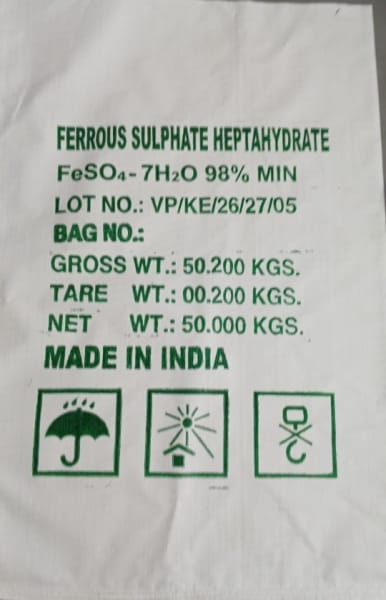
Procurement Assurance: KIKI'S Industrial Chemicals supplies laboratory-certified, high-purity Ferrous Sulphate Heptahydrate 98% Min (Net Wt 50.000 kg, Gross Wt 50.200 kg) manufactured under rigorous ISO 9001 quality controls (Kaiser Exports, Lot VP/KE/26/27/05). Every batch is verified free of harmful heavy metal contaminants, guaranteeing regulatory compliance for East African industrial effluent treatment, cement manufacturing, and agricultural applications.
Article Frequently Asked Questions
Related Categories
Related Industries
Related Applications
Chemicals Mentioned in This Guide
Ferrous Sulfate Heptahydrate 98% Min
Ferrous Sulphate Heptahydrate 98% Min (FeSO₄·7H₂O, CAS 7782-63-0) is an industrial-grade iron(II) salt supplied in 50…
CAS 7782-63-0 · Industrial Grade · Crystal

Ferrous sulphate monohydrate Fe: 30%min 25kg bags Technical Grade for Industrial & Commercial Use (Ferrous sulphate monohydrate Fe: 30%min 25kg bags)
Ferrous sulphate monohydrate Fe: 30%min 25kg bags (Technical Grade) supplied by Kiki's Industrial Chemicals Ltd in 25kg…
Technical Grade · Powder

ABS/LAS 80% for Industrial Use (ABS/LAS)
ABS/LAS (80%) supplied by Kiki's Industrial Chemicals Ltd in 25kg bags across Kenya and East Africa.
Technical Grade · Powder

ATMP (50%)
ATMP (50%) supplied by Kiki's Industrial Chemicals Ltd in 200kg drum. Ideal for Water treatment chemicals.
50% · Standard Packaging
Related Technical Guides & Insights
View all →Where Does Ferrous Sulphate Come From? Natural Sources, Industrial Chemistry & Commercial Production
Comprehensive origin guide explaining the geochemical formation of natural iron sulphates, the distinction between minerals and commercial chemicals, and primary industrial manufacturing pathways.
Product OverviewsHow Is Ferrous Sulphate Heptahydrate Manufactured? Industrial Processes & Quality Control
Comprehensive process engineering breakdown of commercial Ferrous Sulphate Heptahydrate production: steel pickling acid recovery, titanium dioxide co-product crystallisation, and QA standards.
Product OverviewsNatural Ferrous Sulphate Minerals: Melanterite, Rozenite & Crystal Geochemistry
Comprehensive mineralogical examination of natural iron sulphate species—melanterite, rozenite, and szomolnokite—their crystal chemistry, hydration equilibria, and why commercial industry relies on manufactured salts.
Product OverviewsThe Iron Ore Connection: Hematite, Magnetite & Industrial Ferrous Sulphate Pathways
Technical analysis explaining why iron oxide ores (hematite and magnetite) cannot directly yield ferrous sulphate, the thermodynamic reduction to metallic steel, and how steel pickling and ilmenite processing create commercial FeSO₄.