Natural Ferrous Sulphate Minerals: Melanterite, Rozenite & Crystal Geochemistry
Comprehensive mineralogical examination of natural iron sulphate species—melanterite, rozenite, and szomolnokite—their crystal chemistry, hydration equilibria, and why commercial industry relies on manufactured salts.

Quick Answer — Natural Ferrous Sulphate Minerals: Melanterite, Rozenite & Crystal Geochemistry
Natural ferrous sulphate minerals are secondary geological species formed primarily through the low-temperature weathering and hydration of iron sulphides. The primary natural mineral equivalent of commercial ferrous sulphate heptahydrate is Melanterite (FeSO₄·7H₂O), a monoclinic mineral that forms delicate sea-green, emerald-green, or pale blue crystalline crusts, stalactites, and fibrous aggregates. When environmental relative humidity drops below approximately 60%, melanterite spontaneously loses three molecules of water of crystallization to form Rozenite (FeSO₄·4H₂O, the tetrahydrate), transforming from translucent green crystals into an opaque white or chalky-pink dehydration powder. Under higher temperatures or arid conditions, further dehydration yields Szomolnokite (FeSO₄·H₂O, the monohydrate). These natural minerals are never mined commercially because their extreme water solubility causes them to dissolve instantly in precipitation, they oxidize rapidly into ferric minerals (copiapite, jarosite, goethite) when exposed to air, and they occur only as thin efflorescent crusts rather than massive geological ore bodies. Commercial industries instead rely on synthesized technical-grade Ferrous Sulphate Heptahydrate 98% Min packed in moisture-barrier bags.
Melanterite and rozenite are hydrous iron(II) sulphate minerals belonging to the melanterite group and rozenite group respectively, representing natural crystallographic forms of FeSO₄·nH₂O.
Key Facts
- •Melanterite: Natural FeSO₄·7H₂O, monoclinic crystal system, hardness 2.0 Mohs, specific gravity 1.898
- •Rozenite: Natural FeSO₄·4H₂O (tetrahydrate), chalky white efflorescent dehydration product of melanterite
- •Szomolnokite: Natural FeSO₄·H₂O (monohydrate), stable under lower humidity and elevated ambient temperatures
- •Hydration Equilibrium: Melanterite spontaneously dehydrates to rozenite at 25°C when relative humidity falls below ~58%
- •Oxidation Sequence: In open air, Fe²⁺ oxidizes to Fe³⁺, forming yellow-brown copiapite, jarosite, and goethite
- •Commercial Implication: Natural deposits are unmineable; commercial industry requires synthetic crystals sealed in 50 kg moisture-barrier bags
The Mineralogy of Natural Iron Sulphates
In mineralogy, iron sulphate does not exist as a single uniform rock. Rather, it belongs to an intricate family of secondary hydrated sulphate minerals that form when primary iron minerals (especially pyrite, FeS₂, and pyrrhotite, Fe₁₋ₓS) undergo oxidation in damp, sheltered subterranean environments. Because these minerals are exceptionally soluble in water and chemically sensitive to moisture variations, they are termed 'efflorescent sulphate minerals'—crystallizing as ephemeral blooms, stalactites, and encrustations on the walls of mine adits, cave galleries, and sheltered volcanic fumaroles.
The iron(II) sulphate hydration series includes three primary species:
- Melanterite (FeSO₄·7H₂O): The heptahydrate mineral. Melanterite crystallizes in the monoclinic crystal system (space group P2₁/c). It exhibits a vitreous to silky luster, a sea-green to sky-blue color, very low Mohs hardness of 2.0 (easily scratched by a fingernail), and a specific gravity of 1.898. Its crystal structure consists of octahedral [Fe(H₂O)₆]²⁺ complexes linked by sulfate tetrahedra [SO₄]²⁻ and an additional uncoordinated water molecule held by hydrogen bonding.
- Rozenite (FeSO₄·4H₂O): The tetrahydrate mineral. Named after Polish mineralogist Zygmunt Rozen, this monoclinic mineral (space group P2₁/n) forms as an efflorescent dehydration product of melanterite. It appears as snow-white, chalky, or pale pink pulverulent crusts and fibrous botryoidal nodules with a dull earthy luster.
- Szomolnokite (FeSO₄·H₂O): The monohydrate mineral. Named after its type locality in Szomolnok (now Smolník, Slovakia), szomolnokite crystallizes in the monoclinic system (space group C2/c) and forms yellow-brown, grey-white, or tan microcrystalline aggregates that are significantly more thermally and chemically stable than melanterite.
Crystal Geochemistry and Dehydration Equilibria
The relationship between melanterite and rozenite represents a classic geochemical hydration-dehydration equilibrium governed strictly by temperature and ambient relative humidity (RH). At 25°C (standard room temperature), the thermodynamic phase boundary between melanterite and rozenite occurs at a critical water vapor activity of approximately 0.58 (58% RH):
- High Humidity (RH > 60%): Melanterite (FeSO₄·7H₂O) is thermodynamically stable, maintaining its vitreous, pale green crystal transparency.
- Dry Air (RH < 55%): Melanterite undergoes spontaneous efflorescence, releasing three water molecules per formula unit into the atmosphere: FeSO₄·7H₂O(s) ⇌ FeSO₄·4H₂O(s) + 3 H₂O(g). The crystal surfaces become cloudy, develop white fissures, and eventually crumble into a chalky rozenite powder.
- Elevated Temperatures (> 64°C): Melanterite decomposes progressively through tetrahydrate and monohydrate phases, completely losing its coordinated water lattice at 300°C to yield white anhydrous FeSO₄.
Why This Matters for Chemical Handling: This exact geochemical equilibrium explains why commercial Ferrous Sulphate Heptahydrate must be stored in heavy-duty polyethylene-lined bags. If exposed to dry, hot warehouse air, industrial heptahydrate effloresces into a dull whitish powder, losing crystal moisture while concentrating elemental iron.
Natural Minerals vs. Commercial Technical Chemicals
A frequent point of confusion among procurement officers and students is why mining companies do not simply mine melanterite ore deposits instead of building multi-million-dollar chemical synthesis plants. The geological reality makes mining natural melanterite impossible:
- Dissolution by Rainwater: Melanterite has a water solubility of approximately 29.5 g/100 mL at 25°C. Any natural surface deposit is instantly dissolved and washed away by the first seasonal rainfall, preventing the accumulation of thick, mineable sedimentary beds.
- Atmospheric Oxidation: In the open air, divalent iron (Fe²⁺) in melanterite oxidizes rapidly to trivalent iron (Fe³⁺), converting the mineral into complex basic ferric sulphates such as copiapite, jarosite, coquimbite, and ultimately insoluble goethite (rust).
- Heavy Metal Co-Precipitation: Natural melanterite readily incorporates divalent zinc (forming zinc-melanterite / somairite), copper (forming pisanite / boothite), and magnesium in solid solution, making natural specimens chemically heterogeneous and unsuitable for strict industrial specifications.
Commercial Standard: Technical Grade 98% Min
To overcome the instabilities and impurities of natural minerals, the global chemical industry manufactures synthetic Ferrous Sulphate Heptahydrate 98% Min under strict thermodynamic conditions. In this process, mother liquors are filtered, vacuum-crystallised, and centrifuged under inert or controlled environments, producing uniform monoclinic crystals of FeSO₄·7H₂O with guaranteed assay purity.
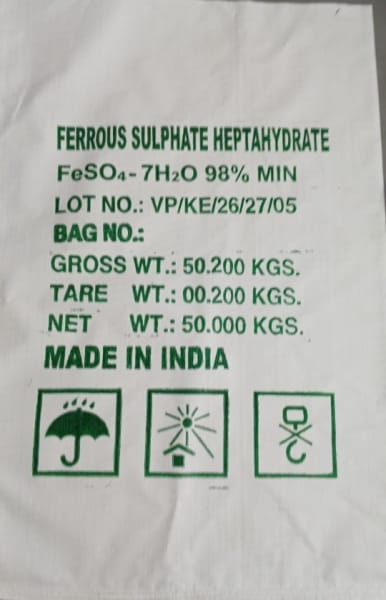
KIKI'S Industrial Chemicals supplies premium technical-grade Ferrous Sulphate Heptahydrate (CAS 7782-63-0) manufactured by Kaiser Exports (Ahmedabad, Gujarat, India, Lot VP/KE/26/27/05). Every shipment is packaged in 50 kg heavy-duty woven polypropylene bags with heat-sealed polyethylene inner liners (Gross Wt: 50.200 kg, Net Wt: 50.000 kg, Tare: 0.200 kg) to completely halt atmospheric moisture exchange, efflorescence, and oxidation.
Article Frequently Asked Questions
Related Categories
Related Industries
Related Applications
Chemicals Mentioned in This Guide
Ferrous Sulfate Heptahydrate 98% Min
Ferrous Sulphate Heptahydrate 98% Min (FeSO₄·7H₂O, CAS 7782-63-0) is an industrial-grade iron(II) salt supplied in 50…
CAS 7782-63-0 · Industrial Grade · Crystal

Ferrous sulphate monohydrate Fe: 30%min 25kg bags Technical Grade for Industrial & Commercial Use (Ferrous sulphate monohydrate Fe: 30%min 25kg bags)
Ferrous sulphate monohydrate Fe: 30%min 25kg bags (Technical Grade) supplied by Kiki's Industrial Chemicals Ltd in 25kg…
Technical Grade · Powder

ABS/LAS 80% for Industrial Use (ABS/LAS)
ABS/LAS (80%) supplied by Kiki's Industrial Chemicals Ltd in 25kg bags across Kenya and East Africa.
Technical Grade · Powder

ATMP (50%)
ATMP (50%) supplied by Kiki's Industrial Chemicals Ltd in 200kg drum. Ideal for Water treatment chemicals.
50% · Standard Packaging
Related Technical Guides & Insights
View all →Where Does Ferrous Sulphate Come From? Natural Sources, Industrial Chemistry & Commercial Production
Comprehensive origin guide explaining the geochemical formation of natural iron sulphates, the distinction between minerals and commercial chemicals, and primary industrial manufacturing pathways.
Product OverviewsHow Is Ferrous Sulphate Heptahydrate Manufactured? Industrial Processes & Quality Control
Comprehensive process engineering breakdown of commercial Ferrous Sulphate Heptahydrate production: steel pickling acid recovery, titanium dioxide co-product crystallisation, and QA standards.
Product OverviewsPyrite Oxidation Chemistry: How Iron Disulphide Generates Ferrous Sulphate
Comprehensive biogeochemical guide explaining the multi-stage oxidation kinetics of pyrite (FeS₂), chemical reaction pathways, microbial catalysis, and why natural copperas beds were replaced by industrial synthesis.
Product OverviewsThe Iron Ore Connection: Hematite, Magnetite & Industrial Ferrous Sulphate Pathways
Technical analysis explaining why iron oxide ores (hematite and magnetite) cannot directly yield ferrous sulphate, the thermodynamic reduction to metallic steel, and how steel pickling and ilmenite processing create commercial FeSO₄.