Where Does Ferrous Sulphate Come From? Natural Sources, Industrial Chemistry & Commercial Production
Comprehensive origin guide explaining the geochemical formation of natural iron sulphates, the distinction between minerals and commercial chemicals, and primary industrial manufacturing pathways.

Quick Answer — Where Does Ferrous Sulphate Come From? Natural Sources, Industrial Chemistry & Commercial Production
Ferrous Sulphate comes from two distinct realms: nature and industrial manufacturing. In nature, it forms as secondary geological efflorescence minerals (primarily Melanterite, FeSO₄·7H₂O) created when iron disulphide minerals (pyrite and marcasite, FeS₂) undergo weathering and oxidation in the presence of atmospheric oxygen and moisture. However, commercial Ferrous Sulphate Heptahydrate 98% Min is NOT mined from geological rock deposits because natural melanterite is highly water-soluble, fragile, and geographically dispersed. Instead, virtually 100% of commercial ferrous sulphate is produced through controlled industrial chemical processes: primarily (1) as a recovered co-product from the sulphate-process manufacturing of titanium dioxide (TiO₂) pigment from ilmenite ore, and (2) by dissolving steel scrap or spent steel pickling liquors in sulphuric acid, followed by filtration, vacuum concentration, controlled cooling crystallization, and centrifugal separation.
The origin of ferrous sulphate encompasses both natural geochemical weathering of iron sulphides into hydrated sulphate minerals and industrial synthesis via acid dissolution and co-product crystallization.
Key Facts
- •Natural Mineral Form: Melanterite (FeSO₄·7H₂O), a delicate sea-green efflorescent mineral
- •Geological Precursor: Oxidation of pyritic minerals (FeS₂) in weathering zones and gossans
- •Why Not Mined: Highly soluble in rainwater and oxidizes rapidly to ferric minerals in open air
- •Primary Industrial Route 1: Co-product recovery from titanium dioxide (TiO₂) sulphate processing (copperas)
- •Primary Industrial Route 2: Dissolution of steel scrap/mill scale in sulphuric acid (steel pickling recovery)
- •Commercial Purity: Industrial crystallization yields 98.0% minimum assay with ~19.7% elemental iron
Primary Use Cases
A fundamental question frequently asked by procurement officers, engineers, and students is: 'Where does ferrous sulphate actually come from?' Is it quarried from the earth like limestone? Is it synthesized entirely from petrochemicals? Or is it recovered from industrial processes? The answer lies at the intersection of natural geochemistry and industrial chemical engineering.
1. The Natural Geochemical Origin: Pyrite Weathering
In the Earth's crust, iron and sulphur rarely occur together naturally as simple hydrated sulphates. Instead, they are locked within primary sulphide minerals formed in deep hydrothermal veins, magmatic intrusions, and sedimentary shales. The most abundant of these is pyrite (FeS₂, iron disulphide), along with its orthorhombic polymorph marcasite.
When geological uplifting or mining activity exposes pyritic rock strata to atmospheric oxygen and groundwater, an exergonic oxidation sequence is initiated:
2FeS₂ + 7O₂ + 2H₂O → 2Fe²⁺ + 4SO₄²⁻ + 4H⁺
This reaction produces an aqueous solution rich in dissolved ferrous iron (Fe²⁺) and sulphate ions (SO₄²⁻). In arid microclimates, sheltered rock overhangs, cave walls, and abandoned mine workings, this solution evaporates, causing hydrated iron(II) sulphate minerals to crystallize as natural mineral efflorescences—most prominently Melanterite (FeSO₄·7H₂O), Rozenite (FeSO₄·4H₂O), and Szomolnokite (FeSO₄·H₂O).
Why Commercial Ferrous Sulphate Is Not 'Mined Rock'
It is tempting to imagine that chemical suppliers quarry 'ferrous sulphate rock' directly from mines. In commercial reality, this is impossible for three physical reasons:
- Extreme Water Solubility: Melanterite dissolves instantly in water (~25.6 g/100 mL at 20°C). Any natural rain, dew, or groundwater dissolves geological surface deposits, washing them away into streams.
- Atmospheric Oxidation: When exposed to warm, dry air, natural melanterite rapidly dehydrates to white rozenite powder and oxidizes to yellow copiapite or jarosite (trivalent ferric minerals), destroying its chemical purity.
- Dispersed Occurrence: Natural hydrated iron sulphates occur as delicate millimeter-thick crusts, powdery blooms, or fragile stalactites, never as massive, mineable commercial rock seams.
2. The Industrial Manufacturing Origins
Consequently, 100% of the Ferrous Sulphate Heptahydrate traded globally and supplied in Kenya is produced through controlled industrial chemical manufacturing via two primary routes:
Route A: The Titanium Dioxide (TiO₂) Sulphate Co-Product Pathway
The largest global source of industrial ferrous sulphate is the sulphate process for manufacturing white titanium dioxide pigment (used in paints and plastics). Ilmenite sand ore (FeTiO₃) is digested with hot concentrated sulphuric acid:
FeTiO₃ + 2H₂SO₄ → TiOSO₄ + FeSO₄ + 2H₂O
The digestion liquor contains both titanyl sulphate and ferrous sulphate. To isolate the titanium, the solution is cooled in vacuum crystallizers below 15°C. Ferrous Sulphate Heptahydrate has low solubility at cool temperatures, causing massive green crystals to precipitate out (known historically as 'copperas'). The crystals are separated in basket centrifuges, washed, and dried as high-purity commercial 98% heptahydrate.
Route B: Steel Pickling Acid Recovery and Scrap Dissolution
In steel rolling mills, hot-rolled steel coils are immersed in dilute sulphuric acid baths (15%–20% H₂SO₄) to remove surface iron oxide mill scale before cold rolling:
Fe (scrap / scale) + H₂SO₄ → FeSO₄ + H₂↑
Spent pickling liquor is filtered to remove undissolved grit, concentrated under vacuum evaporation, and cooled in crystallization tanks. The resulting crystals are centrifuged, flash-dried, and packed into multi-wall industrial bags.
Commercial Quality Verification
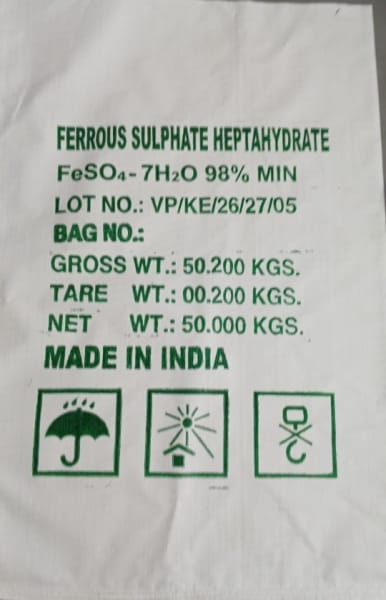
Industrial buyers in Kenya must confirm that the delivered commercial chemical meets verified specifications: minimum 98.0% FeSO₄·7H₂O assay, ≥19.7% elemental iron, water-insoluble matter ≤0.05%, and lead (Pb) ≤20 ppm. KIKI'S Industrial Chemicals supplies certified industrial-grade material in 50 kg heavy-duty woven polypropylene bags with heat-sealed polyethylene inner moisture liners (Net Wt 50.000 kg, Gross Wt 50.200 kg, Kaiser Exports India, Lot VP/KE/26/27/05, marked NBO) with continuous stock in Nairobi.
Article Frequently Asked Questions
Related Categories
Related Industries
Related Applications
Chemicals Mentioned in This Guide
Ferrous Sulfate Heptahydrate 98% Min
Ferrous Sulphate Heptahydrate 98% Min (FeSO₄·7H₂O, CAS 7782-63-0) is an industrial-grade iron(II) salt supplied in 50…
CAS 7782-63-0 · Industrial Grade · Crystal

Ferrous sulphate monohydrate Fe: 30%min 25kg bags Technical Grade for Industrial & Commercial Use (Ferrous sulphate monohydrate Fe: 30%min 25kg bags)
Ferrous sulphate monohydrate Fe: 30%min 25kg bags (Technical Grade) supplied by Kiki's Industrial Chemicals Ltd in 25kg…
Technical Grade · Powder

ABS/LAS 80% for Industrial Use (ABS/LAS)
ABS/LAS (80%) supplied by Kiki's Industrial Chemicals Ltd in 25kg bags across Kenya and East Africa.
Technical Grade · Powder

ATMP (50%)
ATMP (50%) supplied by Kiki's Industrial Chemicals Ltd in 200kg drum. Ideal for Water treatment chemicals.
50% · Standard Packaging
Related Technical Guides & Insights
View all →How Is Ferrous Sulphate Heptahydrate Manufactured? Industrial Processes & Quality Control
Comprehensive process engineering breakdown of commercial Ferrous Sulphate Heptahydrate production: steel pickling acid recovery, titanium dioxide co-product crystallisation, and QA standards.
Product OverviewsPyrite Oxidation Chemistry: How Iron Disulphide Generates Ferrous Sulphate
Comprehensive biogeochemical guide explaining the multi-stage oxidation kinetics of pyrite (FeS₂), chemical reaction pathways, microbial catalysis, and why natural copperas beds were replaced by industrial synthesis.
Product OverviewsNatural Ferrous Sulphate Minerals: Melanterite, Rozenite & Crystal Geochemistry
Comprehensive mineralogical examination of natural iron sulphate species—melanterite, rozenite, and szomolnokite—their crystal chemistry, hydration equilibria, and why commercial industry relies on manufactured salts.
Product OverviewsThe Iron Ore Connection: Hematite, Magnetite & Industrial Ferrous Sulphate Pathways
Technical analysis explaining why iron oxide ores (hematite and magnetite) cannot directly yield ferrous sulphate, the thermodynamic reduction to metallic steel, and how steel pickling and ilmenite processing create commercial FeSO₄.