Safe Handling, Storage & Transport of Corrosive Acids and Strong Alkalis in Factory Environments
Engineering guide to storing, handling, and transporting corrosive acids and alkalis in Kenya. Secondary containment, PPE selection, and road transit safety.
Quick Answer — Safe Handling, Storage & Transport of Corrosive Acids and Strong Alkalis in Factory Environments
Safe handling, storage, and road transport of corrosive acids (Class 8) and strong alkalis in Kenya requires four foundational engineering controls: (1) Complete physical segregation between acids and alkalis to prevent violent exothermic neutralization reactions, (2) Impervious secondary containment bunding engineered to retain 110% of the largest tank capacity or 25% of total aggregate volume, (3) Mandatory chemical-specific PPE (neoprene/nitrile gauntlets, face shield, vapor respirators), and (4) UN-certified dangerous goods road transit compliance along the Northern Corridor.
Corrosive chemicals (Class 8 Dangerous Goods) are liquids or solids that cause irreversible destruction of human skin tissue and severely corrode metallic structural materials.
Key Facts
- •Mixing concentrated Sulfuric Acid (98%) and Caustic Soda (50%) in an unvented drain causes instantaneous boiling and steam explosion with temperatures exceeding 140°C.
- •Secondary containment bunds must be constructed with chemically resistant coatings (acid-resistant epoxy or vinyl-ester lining); bare concrete is rapidly dissolved by mineral acids.
- •Emergency drench showers and eyewash stations must deliver certified 15-minute continuous tempered water flushing under ANSI Z358.1 standards.
In manufacturing environments across Nairobi's Industrial Area, Athi River, Thika, and Mombasa, corrosive raw materials are handled daily in massive volumes.
A tanker discharges 20,000 liters of Sulfuric Acid 98% into an acid storage farm. A forklift operator moves pallets of Caustic Soda Flakes into a soap saponification hall. A maintenance technician connects a dosing line to an IBC of Hydrochloric Acid 33%.
These materials make modern industry possible. But they are unforgiving.
A single cracked valve, a damaged hose clamp, or an improper decanting procedure can cause irreversible chemical eye damage, severe skin burns, or a catastrophic exothermic warehouse fire.
Establishing rigorous engineering controls and safe operating procedures for Class 8 Corrosives is the highest priority for factory management.
---
1. The Core Hazard: Acids vs Alkalis in the Body
Chemical burns from acids and alkalis destroy tissue through completely different biochemical mechanisms:
A. Mineral Acids (Hydrochloric, Sulfuric, Nitric)
Mechanism: Coagulative Necrosis.
Acids denature and coagulate cellular proteins, forming a thick, leathery "eschar" (coagulated protein crust). This crust acts as a partial physical barrier that limits acid penetration into deeper subcutaneous layers (with the exception of Hydrofluoric Acid).
B. Strong Alkalis (Caustic Soda, Caustic Potash)
Mechanism: Liquefactive Necrosis.
Alkalis saponify cell membrane lipids and dissolve cellular proteins, turning living tissue into a slippery liquid. Alkalis do not form a protective crust; they continue penetrating deeper into skin, muscle, and optical nerves for hours until thoroughly diluted with water.
Clinical Reality: Alkali burns (Caustic Soda) are clinically more dangerous and deceptive than acid burns. An alkali splash may feel merely slippery for the first thirty seconds before massive deep-tissue destruction occurs.
---
2. Secondary Containment & Bunding Engineering
Chemical storage tanks, IBC totes, and drum clusters must be protected by engineered secondary containment bunds.
Key Engineering Rules:
1. The 110% Capacity Rule: The bund wall volume must equal at least 110% of the largest tank or 25% of total combined volume (whichever is greater).
2. Chemical Resistant Lining: Bare concrete is rapidly dissolved by mineral acids. Bund walls and floors must be coated with high-build acid-resistant vinyl-ester, novolac epoxy, or chemical polyurethane.
3. Segregation of Incompatibles: Never place acids and alkalis in the same bund. If both tanks rupture during a catastrophic event (such as an earthquake or fire), the resulting violent neutralization boiling will launch boiling corrosive liquor over the bund walls.
4. Zero Gravity Drains: Never install an open drain pipe in a chemical bund floor. Water accumulation (rainwater) must be inspected, pH-tested, and evacuated using a manually controlled portable sump pump.
---
3. Safe Decanting & Transfer Protocols
Most chemical accidents occur during manual transfer between bulk storage and processing vessels.
Safe Transfer Checklist:
Use Dedicated Chemical Drum Pumps: Use pneumatic double-diaphragm pumps (PTFE/PVDF wetted bodies) or electric polypropylene drum pumps.
Prohibit Manual Tipping: Never balance 200L drums on wooden blocks to pour manually. Use certified hydraulic drum lifters and drum cradles equipped with safety drip trays.
Inspect Hoses & Flange Guards: Equip all pressurized chemical transfer hoses with PTFE flange spray shields* to prevent high-pressure jetting in the event of gasket failure.
---
4. Personal Protective Equipment (PPE) Selection Matrix
Generic domestic gloves and cotton overalls provide zero protection against concentrated industrial chemicals.
Chemical Substance — Recommended Glove Material — Eye & Face Protection — Body Protection — Respiratory Filter
Sulfuric Acid 98% — Heavy Neoprene / Butyl Gauntlets — Full Face Shield + Goggles — Acid-Resistant PVC/Neoprene Suit — Acid Mist / Vapor (Type B)
Hydrochloric Acid 33% — Nitrile (Heavy) / Neoprene — Full Face Shield + Goggles — Heavy PVC Apron & Sleeves — Inorganic Acid Gas (Type B/E)
Nitric Acid 68% — Butyl Rubber ONLY (Nitrile degrades) — Full Face Shield + Goggles — Full Acid Splash Suit — Nitrogen Oxides (NOx / Type B)
Caustic Soda 50% / Flakes — Heavy Nitrile / Neoprene — Full Face Shield + Goggles — Heavy Rubber Apron & Boots — Alkaline Dust / Mist (Type P3)
---
5. Emergency Eyewash & Safety Shower Protocols (ANSI Z358.1)
- In the event of a chemical splash, seconds determine whether an operator suffers a minor irritant burn or permanent blindness:
- 10-Second / 15-Meter Travel Distance: Safety showers and eyewashes must be located on the same level, reachable within 10 seconds of uninhibited walking from any chemical hazard.
- 15-Minute Continuous Flushing: Eyewashes must deliver at least 1.5 L/min and showers 75.7 L/min of clean, tepid water ($16^circ ext{C} - 38^circ ext{C}$) for a full 15 minutes.
- Weekly Testing: Run eyewash stations for 3 minutes every Monday morning to purge stagnant rust and sediment from supply lines.
---
6. Summary: Culture Precedes Safety
Equipment, bund walls, and PPE matrices are only as effective as the daily safety culture of your factory team.
Train operators continuously, enforce the mandatory use of protective gear on every shift, maintain clean emergency shower paths, and source industrial chemicals in certified UN-rated packaging from authorized distribution partners.
Article Frequently Asked Questions
Related Industries
Related Applications
Chemicals Mentioned in This Guide

Sulfuric Acid ( Sulphuric Acid 98% ) (Tech / Battery Grade 98% min)
Sulfuric Acid ( Sulphuric Acid 98% ) (Tech / Battery Grade 98% min) supplied by Kiki's Industrial Chemicals Ltd in 35kg…
CAS 7664-93-9 · Technical Grade · Liquid

Hydrochloric Acid ( Muriatic Acid 31% - 35% ) (Tech Grade Pickling & pH Control)
Hydrochloric Acid ( Muriatic Acid 31% - 35% ) (Tech Grade Pickling & pH Control) supplied by Kiki's Industrial…
Tech Grade Pickling & pH Control · Standard Packaging
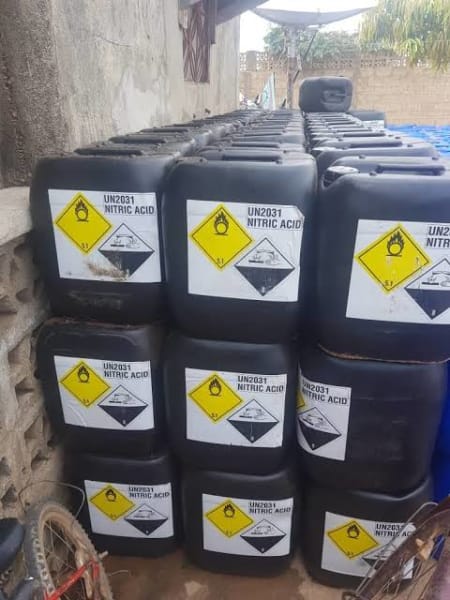
Nitric Acid 68% (Industrial Acid Pickling & Cleaning)
Nitric Acid 68% (Industrial Acid Pickling & Cleaning) supplied by Kiki's Industrial Chemicals Ltd in 35kg / 280kg…
Industrial Acid Pickling & Cleaning · Standard Packaging

Caustic Soda (Flakes, Pearls) (99% min)
Caustic Soda (Flakes, Pearls) (99% min) supplied by Kiki's Industrial Chemicals Ltd in 25kg bag. Ideal for Textile…
CAS 1310-73-2 · 99% min · Standard Packaging
Related Technical Guides & Insights
View all →Caustic Soda (Sodium Hydroxide) Flakes vs Pearls vs Liquid: Specification & Sourcing Guide
Compare Caustic Soda 99% flakes, micro-pearls, and 50% liquid lye for soap manufacturing, dairy CIP, and water treatment across Kenya and East Africa.
Chemical SafetyIndustrial Chemical Storage Compatibility, Secondary Containment & Safety Protocols in Kenya
How to organize industrial chemical warehouses in Kenya. Chemical compatibility matrices, segregation distances, bunding, and NEMA safety rules.
Water TreatmentCoagulants & Flocculants in Industrial Effluent & Wastewater Treatment: PAC, Alum & Polyacrylamide
Engineering guide to PAC, Alum, Ferric Chloride, and Polyacrylamide flocculants for industrial effluent treatment and NEMA discharge compliance in Kenya.