Ferrous Sulphate in Sludge Conditioning: Improving Dewatering and Cake Solids
Engineering guide on conditioning biological and chemical wastewater sludge with Ferrous Sulphate Heptahydrate and lime to enhance filtration rates and maximize filter press cake dryness.

Quick Answer — Ferrous Sulphate in Sludge Conditioning: Improving Dewatering and Cake Solids
Ferrous Sulphate conditions wastewater sludge by neutralizing negative colloidal charges on microbial cell walls and extracellular polymeric substances (EPS), releasing bound gel water into free water. When dosed alongside hydrated lime (Ca(OH)₂), iron(II) oxidizes into insoluble ferric hydroxides that form a rigid, incompressible mineral skeleton within the sludge matrix. This skeleton prevents filter cloth blinding and dramatically lowers the Specific Resistance to Filtration (SRF), increasing plate-and-frame filter press cake solids from 15%–18% up to 35%–45% dry solids.
Inorganic chemical sludge conditioning utilizes iron salts and lime to alter the physical-chemical structure of municipal and industrial sludges, converting gelatinous slurries into rapidly filterable cakes.
Key Facts
- •Mechanism: Releases extracellular bound water and builds an incompressible mineral matrix
- •Dosing Chemistry: Typically paired with hydrated lime at a 1:2 to 1:3 ratio (FeSO₄:lime)
- •Cake Dryness Improvement: Increases filter press cake solids from ~18% to over 35% dry matter
- •Filtration Rate: Reduces Capillary Suction Time (CST) by up to 80%, speeding dewatering cycles
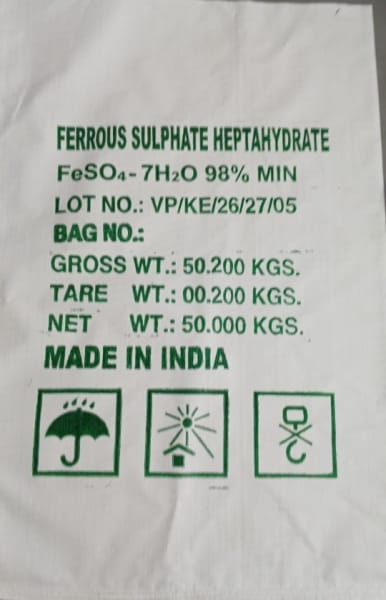
- •Packaging: 50 kg heavy-duty PE-lined bags (Kaiser Exports India, Lot VP/KE/26/27/05) from KIKI'S Nairobi
Primary Use Cases
Municipal wastewater treatment plants and industrial effluent facilities across East Africa produce millions of cubic meters of gelatinous biological and chemical sludge annually. Waste activated sludge (WAS) and anaerobic digester sludge consist largely of hydrated microbial cells bound by extracellular polymeric substances (EPS)—complex matrices of polysaccharides, proteins, and humic substances that trap up to 85% of total sludge water as immobilized 'bound water' that cannot be removed by simple mechanical filtration.
Mechanism of Inorganic Conditioning
Chemical conditioning with Ferrous Sulphate Heptahydrate fundamentally transforms this gelatinous sludge structure through two complementary chemical mechanisms:
- Charge Neutralization: Hydrated Fe²⁺ cations neutralize the predominantly negative electrical surface charges (zeta potential) of the microbial EPS, collapsing the repulsive energy barrier and allowing micro-particles to coagulate into compact aggregates, liberating trapped interstitial water.
- Skeletal Matrix Formation: When dosed with hydrated lime (Ca(OH)₂), the pH rises above 10.0, rapidly converting iron into dense ferric hydroxide (Fe(OH)₃) and calcium carbonate micro-crystals. This forms a porous, rigid 'mineral skeleton' between microbial cells. Under mechanical compression in a filter press, this rigid skeleton maintains open drainage channels, preventing the sludge cake from collapsing into an impermeable slime that blinds filter cloths.
Dosing Protocols and Operational Ratios
Standard industrial practice doses Ferrous Sulphate first, followed by hydrated lime slurry with high-energy rapid mixing:
- Ferrous Sulphate Dose: 3% to 8% dry FeSO₄·7H₂O basis on dry sludge solids (DS).
- Hydrated Lime Dose: 10% to 25% dry Ca(OH)₂ basis on dry sludge solids.
This chemical pairing yields significant operational benefits: Capillary Suction Time (CST) typically drops from over 120 seconds down to under 25 seconds, while the Specific Resistance to Filtration (SRF) drops by two orders of magnitude.
Filter Press Performance and Sludge Transport Economics
In industrial facilities operating recessed plate-and-frame filter presses—such as beverage factories in Nairobi, tanneries in Athi River, and textile mills in Thika—conditioning with ferrous sulphate and lime achieves filter cake dryness of 35% to 45% total solids, compared to just 15% to 20% achievable with organic polymers alone. In Kenya, where sludge disposal and transport to designated NEMA landfill sites is charged on total wet mass, increasing cake dryness from 18% to 36% cuts haulage disposal fees by exactly 50%.
KIKI'S Industrial Chemicals supplies Ferrous Sulphate Heptahydrate 98% Min in 50 kg heavy-duty woven polypropylene bags (Net Wt 50.000 kg, Kaiser Exports India, Lot VP/KE/26/27/05) with dedicated technical support for industrial dewatering plants in Kenya.
Article Frequently Asked Questions
Related Categories
Related Industries
Related Applications
Chemicals Mentioned in This Guide
Ferrous Sulfate Heptahydrate 98% Min
Ferrous Sulphate Heptahydrate 98% Min (FeSO₄·7H₂O, CAS 7782-63-0) is an industrial-grade iron(II) salt supplied in 50…
CAS 7782-63-0 · Industrial Grade · Crystal

Polyacrylamide 89% min for Industrial Use (Polyacrylamide)
Polyacrylamide (89% min) supplied by Kiki's Industrial Chemicals Ltd in 25kg bag across Kenya and East Africa.
Technical Grade · Powder

Ferrous sulphate monohydrate Fe: 30%min 25kg bags Technical Grade for Industrial & Commercial Use (Ferrous sulphate monohydrate Fe: 30%min 25kg bags)
Ferrous sulphate monohydrate Fe: 30%min 25kg bags (Technical Grade) supplied by Kiki's Industrial Chemicals Ltd in 25kg…
Technical Grade · Powder
Related Technical Guides & Insights
View all →Ferrous Sulphate for Hexavalent Chromium Reduction in Industrial Effluent
Two-stage chemical engineering guide for tannery and electroplating effluent operators on using Ferrous Sulphate Heptahydrate to reduce toxic Cr(VI) to Cr(III) and precipitate total chromium below NEMA limits.
Industrial ApplicationsFerrous Sulphate Uses: 50 Applications and Where They Make Commercial Sense
Comprehensive industrial reference categorizing 50 applications of Ferrous Sulphate Heptahydrate across water treatment, agriculture, cement manufacturing, chemical synthesis, and metallurgy in East Africa.
Guides & How-TosFerrous Sulphate Heptahydrate 98%: What Buyers in Kenya Need to Know Before Ordering
A comprehensive procurement guide for industrial chemical buyers in Kenya. Understand the difference between 98% compound purity and elemental iron, packaging standards, COA parameters, and regional sourcing options.