Ferrous Sulphate for Hexavalent Chromium Reduction in Industrial Effluent
Two-stage chemical engineering guide for tannery and electroplating effluent operators on using Ferrous Sulphate Heptahydrate to reduce toxic Cr(VI) to Cr(III) and precipitate total chromium below NEMA limits.

Quick Answer — Ferrous Sulphate for Hexavalent Chromium Reduction in Industrial Effluent
Treating toxic hexavalent chromium (Cr VI) in industrial effluent requires a rigorous two-stage chemical process: (1) Stage 1 (Acidic Reduction): Effluent pH is adjusted to 2.0–3.0 using sulphuric acid. Ferrous Sulphate Heptahydrate is dosed at a stoichiometric ratio of 3 moles of Fe²⁺ per mole of Cr(VI) (approx. 16 kg of FeSO₄·7H₂O per kg of Cr VI), monitored via ORP to reduce yellow, highly toxic Cr(VI) to trivalent Cr(III): 3Fe²⁺ + HCrO₄⁻ + 7H⁺ → 3Fe³⁺ + Cr³⁺ + 4H₂O. (2) Stage 2 (Alkaline Precipitation): Caustic soda or hydrated lime is dosed to elevate pH to 8.5–9.2, precipitating chromium and iron as mixed insoluble hydroxides: Cr³⁺ + 3OH⁻ → Cr(OH)₃↓ and Fe³⁺ + 3OH⁻ → Fe(OH)₃↓. Clarification easily brings total effluent chromium below NEMA's 1.0 mg/L discharge standard.
Chemical chromium reduction is a redox and precipitation sequence that converts highly soluble, carcinogenic hexavalent chromium into insoluble, non-hazardous trivalent chromium hydroxide precipitates.
Key Facts
- •Stage 1 pH: Strictly maintained between 2.0 and 3.0 for rapid reduction kinetics
- •Stage 2 pH: Raised to 8.5 to 9.2 for complete hydroxide precipitation
- •Stoichiometric Requirement: 16 kg of Ferrous Sulphate Heptahydrate per kg of Cr(VI) (operational: 18–22 kg)
- •ORP Control: Reaction is complete when ORP drops below +280 mV at pH 2.5
- •NEMA Discharge Limit: Total Chromium must be < 1.0 mg/L (Third Schedule, Water Quality Regulations)
Primary Use Cases
In Kenya's specialized industrial clusters—such as the leather tanning estates along the Athi River industrial corridor and metal electroplating facilities in Nairobi and Mombasa—discharging untreated heavy metal effluent is strictly regulated under NEMA's Environmental Management and Co-ordination (Water Quality) Regulations. Hexavalent chromium (Cr VI, present as chromate CrO₄²⁻ and dichromate Cr₂O₇²⁻) is a potent carcinogen, cellular mutagen, and toxic water contaminant. Because Cr(VI) is completely soluble across standard pH ranges, it cannot be removed by simple alkaline precipitation; it must first be chemically reduced to trivalent chromium (Cr III).
Stage 1: Acidic Chemical Reduction
The reduction of Cr(VI) by bivalent iron is intensely pH-dependent. At neutral or alkaline pH, the reaction is sluggish and incomplete. Industrial effluent treatment plants (ETPs) operate a continuous two-stage reaction sequence:
In the reduction tank, effluent pH is depressed to 2.0–3.0 using concentrated sulphuric acid (H₂SO₄). A 10% solution of Ferrous Sulphate Heptahydrate is introduced with high-shear mechanical agitation:
3Fe²⁺ + HCrO₄⁻ + 7H⁺ → 3Fe³⁺ + Cr³⁺ + 4H₂O
Bivalent iron donates three electrons per chromium atom, converting soluble yellow Cr(VI) into green trivalent Cr³⁺ while oxidizing itself to ferric iron (Fe³⁺). In automated plants, an Oxidation-Reduction Potential (ORP) probe controls chemical feed: as Cr(VI) is consumed, the ORP reading drops from >500 mV down to +250 to +300 mV, signaling complete reduction.
Stage 2: Alkaline Precipitation and Flocculation
The reduced effluent overflows into the neutralization and precipitation tank, where caustic soda (NaOH) or hydrated lime (Ca(OH)₂) is dosed to elevate pH to 8.5–9.2:
Cr³⁺ + 3OH⁻ → Cr(OH)₃↓
Fe³⁺ + 3OH⁻ → Fe(OH)₃↓
At pH 8.8, chromium hydroxide achieves minimum solubility (< 0.05 mg/L). Crucially, the co-precipitating ferric hydroxide flocs act as a natural coagulant aid, entrapping the fine chromium hydroxide particles and forming dense, rapidly settling flocs that drop cleanly in secondary clarifiers.
Stoichiometry, Dosing Ratios, and NEMA Compliance
Stoichiometrically, reducing 1 kg of Cr(VI) requires 3.22 kg of elemental iron, corresponding to approximately 16.0 kg of commercial 98% Ferrous Sulphate Heptahydrate. In industrial wastewater containing background organics, a safety factor of 1.2 to 1.4 is applied, requiring 18 to 22 kg of FeSO₄·7H₂O per kg of hexavalent chromium.
With proper clarifier retention and polymer dosing (0.5–1.0 ppm anionic polyacrylamide), total chromium in treated discharge drops below 0.5 mg/L, comfortably exceeding the NEMA statutory ceiling of 1.0 mg/L total chromium.
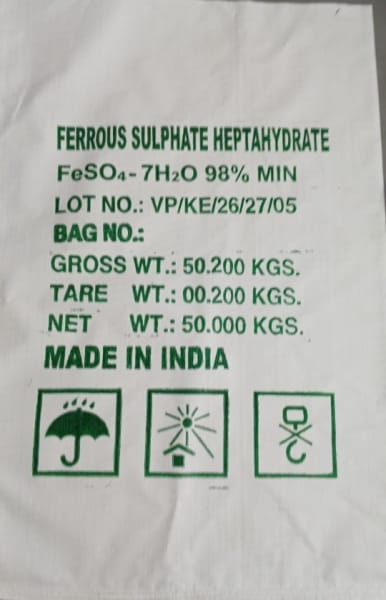
KIKI'S Industrial Chemicals supplies bulk Ferrous Sulphate Heptahydrate 98% Min in 50 kg heavy-duty woven polypropylene bags with heat-sealed polyethylene inner moisture liners (Net Wt 50.000 kg, Kaiser Exports India, Lot VP/KE/26/27/05, marked NBO) with same-day Nairobi delivery to Athi River and industrial zones.
Article Frequently Asked Questions
Related Categories
Related Industries
Related Applications
Chemicals Mentioned in This Guide
Ferrous Sulfate Heptahydrate 98% Min
Ferrous Sulphate Heptahydrate 98% Min (FeSO₄·7H₂O, CAS 7782-63-0) is an industrial-grade iron(II) salt supplied in 50…
CAS 7782-63-0 · Industrial Grade · Crystal

Caustic Soda (Flakes, Pearls) (99% min)
Caustic Soda (Flakes, Pearls) (99% min) supplied by Kiki's Industrial Chemicals Ltd in 25kg bag. Ideal for Textile…
CAS 1310-73-2 · 99% min · Standard Packaging

Ferrous sulphate monohydrate Fe: 30%min 25kg bags Technical Grade for Industrial & Commercial Use (Ferrous sulphate monohydrate Fe: 30%min 25kg bags)
Ferrous sulphate monohydrate Fe: 30%min 25kg bags (Technical Grade) supplied by Kiki's Industrial Chemicals Ltd in 25kg…
Technical Grade · Powder
Related Technical Guides & Insights
View all →Ferrous Sulphate in Sludge Conditioning: Improving Dewatering and Cake Solids
Engineering guide on conditioning biological and chemical wastewater sludge with Ferrous Sulphate Heptahydrate and lime to enhance filtration rates and maximize filter press cake dryness.
Industrial ApplicationsFerrous Sulphate Uses: 50 Applications and Where They Make Commercial Sense
Comprehensive industrial reference categorizing 50 applications of Ferrous Sulphate Heptahydrate across water treatment, agriculture, cement manufacturing, chemical synthesis, and metallurgy in East Africa.
Guides & How-TosFerrous Sulphate Heptahydrate 98%: What Buyers in Kenya Need to Know Before Ordering
A comprehensive procurement guide for industrial chemical buyers in Kenya. Understand the difference between 98% compound purity and elemental iron, packaging standards, COA parameters, and regional sourcing options.