Why Ferrous Sulphate Turns Brown: Oxidation, Moisture and Storage
Understand the chemistry of iron(II) to iron(III) oxidation. Learn why ferrous sulphate crystals change from pale green to brown, and how to assess usability.
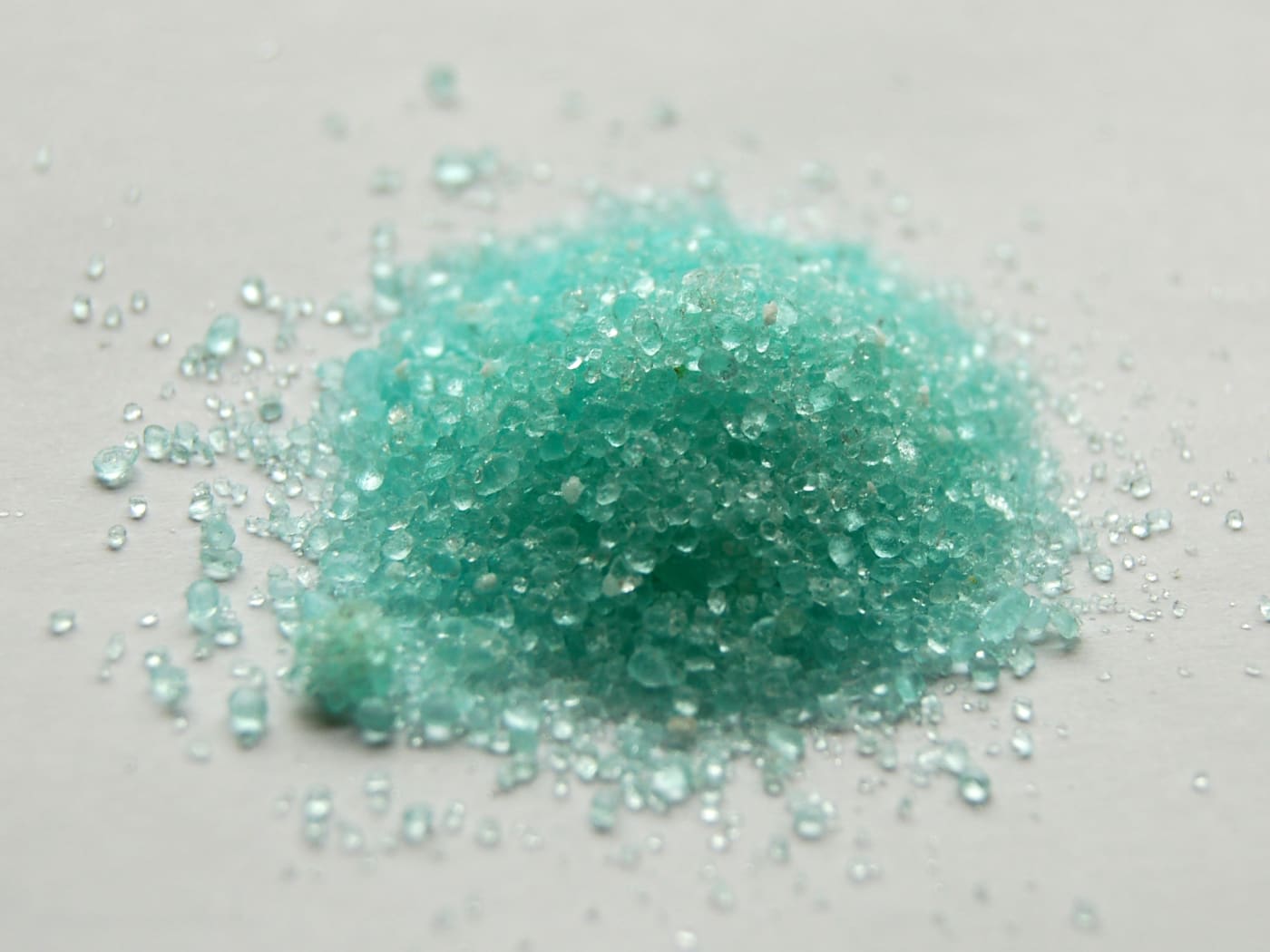
Crystalline structure of Ferrous Sulphate Heptahydrate (FeSO₄·7H₂O), CAS 7782-63-0.
Quick Answer — Why Ferrous Sulphate Turns Brown: Oxidation, Moisture and Storage
Ferrous Sulphate turns brown when exposed to atmospheric oxygen and moisture, causing divalent iron (Fe²⁺) to oxidize into trivalent iron (Fe³⁺). This forms a yellowish-brown coating of basic ferric sulfate (Fe(OH)SO₄) and ferric hydroxide (Fe(OH)₃). While slightly weathered material remains usable for general coagulation, heavily oxidized material loses its reducing capacity for Fenton oxidation and chromium reduction.
A diagnostic chemical degradation guide explaining the oxidation thermodynamics and functional implications of iron(II) sulfate weathering.
Key Facts
- •Color transition from sea-green to rust-brown indicates oxidation of Fe²⁺ to Fe³⁺.
- •Chemical reaction: 4FeSO₄ + O₂ + 2H₂O → 4Fe(OH)SO₄.
- •Surface oxidation does not always render the core chemical unusable.
- •Severely oxidized material loses active reducing power required for Fenton and Cr(VI) reduction.
Primary Use Cases
The Chemistry of the Green-to-Brown Transformation
Fresh, high-purity ferrous sulphate heptahydrate is celebrated for its pale blue-green or sea-green crystalline luster. However, plant operators frequently discover that bags stored over several months exhibit patches of yellow, brown, or rusty orange coloration on the crystal surfaces. Understanding the underlying chemistry helps determine whether the material is still fit for purpose.
At KIKI'S Industrial Chemicals, our Ferrous Sulphate Heptahydrate 98% Min is packaged in sealed virgin liners to halt atmospheric oxidation before delivery.
The Oxidation Mechanism
The transformation is governed by spontaneous atmospheric redox kinetics. Divalent iron in aqueous film on the crystal surface readily transfers an electron to atmospheric oxygen:
4FeSO₄ + O₂ + 2H₂O → 4Fe(OH)SO₄↓
The resulting basic iron(III) sulfate, known mineralogically as fibroferrite or copiapite-type phases, is insoluble and distinctly yellowish-brown. In high humidity, further hydrolysis yields hydrated ferric oxide (rust):
Fe(OH)SO₄ + H₂O → Fe(OH)₃↓ + H₂SO₄
Is Brown Ferrous Sulphate Still Usable?
The practical impact of browning depends entirely on your process requirements:
- Standard Water Coagulation: If the material is used for turbidity removal in raw water, slight surface oxidation is largely harmless. In fact, ferric iron (Fe³⁺) is an active coagulant itself. The total iron remains available to form hydroxide flocs.
- Phosphorus Precipitation: Trivalent iron precipitates orthophosphate effectively as FePO₄. Slightly oxidized material can be used, provided insoluble sediment does not foul dosing valves.
- Fenton's Oxidation & Chromium Reduction: Here, browning is a critical failure. These applications depend strictly on the reducing capability of Fe²⁺. If the material has oxidized to Fe³⁺, it cannot donate the electrons needed to reduce hexavalent chromium or catalyze hydrogen peroxide into hydroxyl radicals.
- Agricultural Foliar Sprays: Oxidized material contains insoluble ferric hydroxides that precipitate in spray tanks, clogging nozzle tips and reducing leaf absorption.
Protect chemical stock from ambient humidity: How to Store Ferrous Sulphate Heptahydrate in Kenya Warehouses.
Explore the underlying redox chemistry: Ferrous Sulphate vs Ferric Sulphate Chemistry.
Article Frequently Asked Questions
Related Categories
Chemicals Mentioned in This Guide

Ferrous Sulfate Heptahydrate 98% Min
Ferrous Sulphate Heptahydrate 98% Min (FeSO₄·7H₂O, CAS 7782-63-0) is an industrial-grade iron(II) salt supplied in 25…
CAS 7782-63-0 · Industrial Grade · Crystal

ABS/LAS 80% for Industrial Use (ABS/LAS)
ABS/LAS (80%) supplied by Kiki's Industrial Chemicals Ltd in 25kg bags across Kenya and East Africa.
Technical Grade · Powder

ATMP (50%)
ATMP (50%) supplied by Kiki's Industrial Chemicals Ltd in 200kg drum. Ideal for Water treatment chemicals.
50% · Standard Packaging

ATMP 50% for Industrial Use (ATMP)
ATMP (50%) supplied by Kiki's Industrial Chemicals Ltd in 200kg drums across Kenya and East Africa.
Technical Grade · Liquid
Related Technical Guides & Insights
View all →Where to Buy Industrial Chemicals in Kenya: The Definitive B2B Procurement & Quality Verification Guide
The definitive B2B procurement guide to sourcing industrial, food-grade, and water treatment chemicals in Kenya. Sourcing hubs, KEBS standards, COAs, and how Kiki's Industrial Chemicals delivers reliable supply.
Industrial & Water ChemicalsIndustrial Acids in Kenya: Hydrochloric Acid 33% (Muriatic), Oxalic Acid & Formalin Guide
Source Hydrochloric Acid 33% (22° Bé), Oxalic Acid 99.6%, and Formalin 37% in Kenya. Technical guide to metal pickling, boiler descaling, and leather processing.
Mining & Industrial ChemicalsMining Chemicals in Kenya: Flotation Xanthates (SIPX, SIBX, PAX) & Sulfide Mineral Extraction Guide
Source certified flotation xanthates (SIPX, SIBX, PAX) in Kenya. Technical guide to sulfide mineral extraction, collector selectivity, and gold ore recovery.