Industrial Detergent Raw Materials in Kenya: Formulating with LABSA 96%, SLES 70% & Alkaline Builders
Source high-active LABSA 96%, SLES 70%, and alkaline builders in Kenya. Chemical guide to surfactant neutralisation, salt curves, and liquid soap formulation.
Quick Answer: Industrial Detergent Raw Materials in Kenya: Formulating with LABSA 96%, SLES 70% & Alkaline Builders
Industrial detergent manufacturing in Kenya relies on a balanced surfactant triad: Linear Alkylbenzene Sulphonic Acid (LABSA 96%, CAS 68584-22-5) as the primary anionic foaming workhorse, neutralized with Caustic Soda (NaOH) to form active sodium alkylbenzene sulfonate; Sodium Lauryl Ether Sulfate (SLES 70%, CAS 68891-38-3) for flash-foaming, grease cut, and skin mildness; and Cocoamidopropyl Betaine (CAPB) or CDEA for foam stabilization. Formulations are fortified with alkaline builders such as Sodium Metasilicate (liquid grease saponification) and STPP (water softening) and thickened via the sodium chloride (NaCl) ionic salt curve.
Industrial detergent raw materials comprise anionic, non-ionic, and amphoteric surfactants, alkaline saponifiers, sequestrants, hydrotropes, and rheology modifiers engineered to emulsify oils, disperse particulates, and prevent soil redeposition in institutional laundry, industrial degreasing, and household hygiene products.
Key Facts
- •The Neutralisation Ratio: 1.0 kg of 96% LABSA requires exactly 0.133 kg of 99% pure Caustic Soda (or 0.266 kg of 50% lye) to reach a skin-safe, chemically stable neutral pH of 7.0–8.0; under-neutralized slurry remains acidic and phase-separates, while over-neutralized slurry turns cloudy and harsh.
- •SLES 70% Dissolution Law: Never pour water into raw 70% SLES paste, which triggers an un-stirrable, rubbery hexagonal gel phase (the 'gel trap'); always add SLES gradually into warm water (40°C–50°C) under high-shear vortex agitation.
- •The Salt Viscosity Curve: Viscosity peaks around 1.5%–2.5% industrial vacuum salt (NaCl); overdosing salt beyond the peak collapses the worm-like surfactant micelles, turning viscous gel into watery, clouded liquid.
- •Packaging Standards: LABSA 96% in 210kg plastic drums; SLES 70% in 170kg or 220kg wide-mouth plastic drums; Sodium Metasilicate in 25kg woven bags.
In a commercial cleaning chemical compounding facility off Baba Dogo Road in Ruaraka, Nairobi, the 5,000-litre stainless steel compounding vessel on Platform 1 has come to a complete halt.
Inside the open tank, three metric tonnes of an institutional multi-surface degreaser and commercial laundry detergent have transformed into a curdled, cloudy, opaque mass with the consistency of cottage cheese.
The compounding supervisor stands over the vessel with a stainless steel paddle, visibly frustrated.
"We followed the batch card to the letter," the supervisor insists to the plant technical chemist. "Fifteen percent active surfactant. We weighed the LABSA 96%, added the caustic soda lye, dumped the SLES 70% paste, and then dissolved twenty kilos of vacuum industrial salt for viscosity. By the time the salt went in, the whole tank separated into two layers—thick white curd on top, and watery brown liquid on the bottom."
The technical chemist takes a glass sample jar, dips it into the top phase, and tests it with a calibrated digital pH probe. The readout stabilizes at pH 4.8.
"Your pH is 4.8," the chemist says, shaking his head. "Your batch card called for a 1:1 caustic neutralization, but nobody titrated the incoming raw materials. Your caustic soda lye was exposed to open air in the store and absorbed moisture and atmospheric carbon dioxide, dropping its true strength. You only neutralized sixty percent of the LABSA. The rest remained free un-neutralized sulfonic acid. When you added the SLES and the salt into that acidic slurry, the acid protonated the ether sulfate, salted out the surfactant micelles, and phase-separated three tonnes of finished product."
He sets the beaker on the lab bench.
"We don't dump this batch—we can salvage it by slowly titrating dilute 30% caustic soda under high-shear mixing until the pH reaches 7.8, which will re-solubilize the sulfonic acid into sodium alkylbenzene sulfonate. But going forward, every operator must understand the stoichiometry of neutralization, the physics of SLES dissolution, and the limits of the salt viscosity curve. Here is the operational science of industrial detergent compounding."
---
The Big Three: Core Surfactants in Industrial Cleaning
Every modern liquid and powder cleaning detergent manufactured in Kenya—from hand dishwashing liquids and institutional hospital disinfectants to heavy industrial vehicle wash and laundry slurries—depends on a balanced synergy of three surfactant classes:
- Anionic Workhorse (LABSA 96% + NaOH): High detergency, heavy soil removal, particulate dispersion, low cost per active unit.
- Flash-Foam & Grease Cut (SLES 70%): High foaming, rapid wetting, hard-water tolerance, skin mildness.
- Alkaline Builders (Sodium Metasilicate & STPP): Saponifies fats, buffers pH, sequestrates water hardness (Ca²⁺/Mg²⁺), prevents redeposition.
---
1. Linear Alkylbenzene Sulphonic Acid (LABSA 96%): The Neutralisation Stoichiometry
Linear Alkylbenzene Sulphonic Acid (R-C₆H₄-SO₃H, CAS 68584-22-5) is the primary workhorse surfactant of global and Kenyan detergent manufacturing. It is a dense, viscous, dark brown liquid containing a minimum of 96.0% active matter and less than 1.5% free sulfuric acid (H₂SO₄).
The Chemistry of Neutralisation:
Raw LABSA is an aggressive, corrosive organic acid (pH < 1.5) that has zero detergency in its acidic state. To become an active detergent, it must be neutralized with an alkali—most commonly Caustic Soda (NaOH) or Triethanolamine (TEA):
R-C₆H₄-SO₃H + NaOH longrightarrow R-C₆H₄-SO₃⁻Na⁺ + H₂O + Heat
The average molecular weight of commercial LABSA is approximately 326 g/mol, while sodium hydroxide is 40 g/mol.
Stoichiometric Ratio = rac{40}{326} imes rac{0.96}{0.99} approx mathbf{0.133 kg NaOH (100% pure) per 1.0 kg LABSA 96%}
Critical Operational Rules for Neutralisation:
- Never add dry Caustic Flakes directly into concentrated LABSA: The reaction is intensely exothermic. Local superheating will boil the water, carbonizing the surfactant into a black, tarry sludge with a strong burnt odor.
- The Dilution Rule: Pre-dissolve the caustic soda in clean water to produce a 20% to 30% lye solution and allow it to cool to below 35°C.
- The Target pH Window: Feed the caustic lye into the diluted LABSA under continuous agitation until the pH reaches 7.0 to 8.5.
- - Below pH 6.5: Residual sulfonic acid causes formulation instability, product thinning, and phase separation.
- - Above pH 9.0: The product becomes harsh, caustic, attacks skin keratin, and causes premature fading in colored textiles.
At Kiki's Industrial Chemicals, our technical team works alongside commercial formulators and institutional cleaning manufacturers across Kenya, verifying surfactant active percentages and optimizing neutralization protocols.
---
2. Sodium Lauryl Ether Sulfate (SLES 70%): Overcoming the "Gel Trap"
Sodium Lauryl Ether Sulfate (C₁₂H₂₅(OCH₂CH₂)nOSO₃Na, typically n=2, CAS 68891-38-3) is supplied as a dense, translucent, high-active white-to-pale-yellow paste containing 70% pm 2% active matter.
SLES is prized because the ethylene oxide (EO) ether groups in its molecular structure impart superior water solubility, exceptional flash foaming, and remarkable tolerance to hard borehole water compared to basic sodium lauryl sulfate (SLS).
The Hexagonal "Gel Trap" Hazard
One of the most frequent compounding disasters in Kenyan soap factories occurs during SLES dilution:
When water is added to raw SLES 70%, the surfactant does not dissolve smoothly. At concentrations between 30% and 60% active matter, SLES molecules self-assemble into a rigid, liquid-crystalline hexagonal gel phase. This gel is an un-stirrable, rubber-like mass that will seize mixer blades, overload electric drive motors, and resist dissolution for hours even under boiling temperatures.
To avoid the gel trap: Never pour water on top of dense SLES paste. Instead, always add SLES 70% gradually into the total formulation water (pre-heated to 40°C – 45°C) under high-shear mechanical agitation, ensuring the paste dissolves directly into the low-concentration fluid zone.
---
3. The Science of the Salt Viscosity Curve
In commercial liquid soaps, multi-surface cleaners, and hand washes, consumers equate high viscosity with high active chemical concentration. In reality, viscosity is easily dialed in through the micellar growth curve using inexpensive industrial vacuum salt (Sodium Chloride, NaCl).
The Micelle Elongation Mechanism
In an aqueous solution of anionic surfactants (neutralized LABSA and SLES), the negatively charged headgroups (-SO₃⁻ and -OSO₃⁻) repel one another electrostatically, forcing the molecules into small, spherical micelles that slide easily past one another, yielding a thin, watery liquid.
When Sodium Chloride is introduced, the sodium cations (Na⁺) screen the electrostatic negative charges on the micelle surface:
- Spheres to Worms: Relieved of repulsive charges, the surfactant headgroups pack closer together. The spherical micelles elongate into giant, entangled, flexible worm-like micelles.
- Viscosity Surge: These entangled micellar chains form a transient three-dimensional network that traps water, causing the liquid's viscosity to surge exponentially from 50 cP (water-thin) to 3,000-5,000 cP (rich gel).
The Over-Salting Disaster:
Every surfactant formulation has an absolute salt peak (typically between 1.5% and 2.2% NaCl by total weight). If a formulator doses salt beyond this peak, the excessive electrolyte concentration dehydrates the surfactant headgroups completely. The worm-like micelles break, branching into smaller structures, and the viscosity crashes abruptly back down to water. Worse, the excess salt triggers electrolyte salting-out, causing the surfactants to precipitate as cloudy, insoluble curd.
---
4. Alkaline Builders: Sodium Metasilicate vs. STPP
Surfactants alone cannot clean heavy industrial soils, engine greases, or commercial hotel laundry. Formulations must be reinforced with inorganic alkaline builders:
| Builder Chemical | Key Chemical Function | Primary Application |
|---|---|---|
| Sodium Metasilicate (Pentahydrate / Anhydrous) | High alkaline buffering (pH 11.5 - 13.0). Rapidly saponifies animal fats and vegetable greases into soluble soaps. Provides unique corrosion inhibition for soft metals (aluminium, galvanized steel). | Heavy industrial degreasers, engine wash, vehicle chassis cleaners, automatic commercial dishwashing powders. |
| Sodium Tripolyphosphate (STPP) | Powerful calcium (Ca²⁺) and magnesium (Mg²⁺) chelating agent. Prevents water hardness scale, breaks colloidal clay soil clusters, and prevents dirt from redepositing onto laundered fabrics. | Premium commercial laundry powders, institutional hotel washroom chemicals, textile preparation scourers. |
| Soda Ash (Sodium Carbonate Dense/Light) | Economic pH builder and water softener. Precipitates calcium hardness as insoluble calcium carbonate (CaCO₃). | Powder detergents, economic laundry bars, low-cost institutional floor scrubbing powders. |
---
Technical Specifications: Prime Detergent Raw Materials
| Chemical Property | LABSA 96% (Acid Slurry) | SLES 70% (Ether Sulfate Paste) | Sodium Metasilicate (Penta) |
|---|---|---|---|
| Active Substance (Assay) | mathbf{ge 96.0%} | mathbf{70.0% pm 2.0%} | ge 28.0% Na₂O / ge 27.5% SiO₂ |
| Physical Appearance | Viscous, dark brown liquid | Translucent, white/pale paste | Free-flowing white crystalline granules |
| Unsulfonated Matter (Free Oil) | le 2.0% | N/A | N/A |
| Free Sulfuric Acid (H₂SO₄) | mathbf{le 1.50%} | N/A | N/A |
| 1,4-Dioxane Content | N/A | mathbf{le 30 mg/kg} (30 ppm) | N/A |
| pH Value | <1.5 (1% aqueous solution) | 7.0 - 9.0 (10% aqueous) | 12.0 - 13.0 (1% aqueous) |
| Water Content | le 1.0% | approx 28.0% | 41.0% - 46.0% (Hydration water) |
| Colour Character | le 30 - 50 Klett (5% sol.) | le 10 Hazen | Pure white |
| Standard Packaging | 210kg heavy-duty plastic drums | 170kg / 220kg wide-mouth drums | 25kg multi-wall woven PE bags |
---
From precision stoichiometry in the neutralization vessel to navigating the delicate physics of the salt curve, industrial cleaning manufacturing is a discipline of rigorous chemical measurement. When active surfactant percentages, builder ratios, and solution pH are properly balanced, the result is crystal-clear, high-performance cleaning products that dominate the commercial market.
Formulating institutional cleaning chemicals or scaling a commercial detergent plant? Request a bulk quotation for LABSA 96%, SLES 70%, and builders from Kiki's Industrial Chemicals Ltd.
Article Frequently Asked Questions
Chemicals Mentioned in This Guide
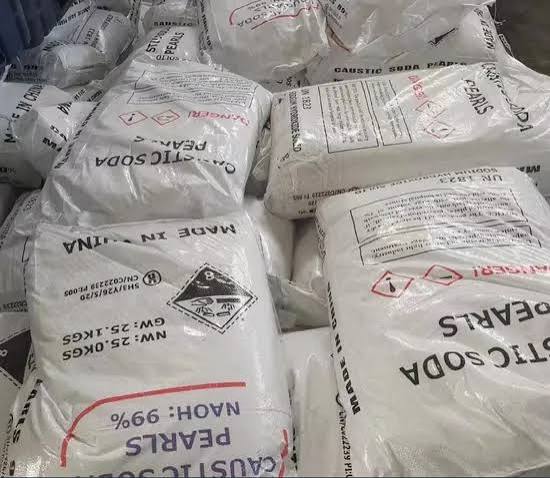
Caustic Soda Flakes /Pearls
Caustic Soda Flakes /Pearls (98.5/99% min) supplied by Kiki's Industrial Chemicals Ltd in 25kg bag. Ideal for Pulp &…
CAS 1310-73-2 · 98.5/99% min · Standard Packaging

Sodium Metasilicate Anhydrous
Sodium Metasilicate Anhydrous (49.5-51.5%) supplied by Kiki's Industrial Chemicals Ltd in 25kg bag across Kenya and…
Technical Grade · Powder

1,3-Dibromo-5,5-Dimethylhydantoin (DBDMH)
DBDMH (Tech Grade) supplied by Kiki's Industrial Chemicals Ltd in 25kg drum across Kenya and East Africa.
Technical Grade · Liquid

1-Bromo-3-Chloro-5,5-Dimethylhydantoin (BCDMH)
BCDMH (90% min) supplied by Kiki's Industrial Chemicals Ltd in 25kg drum across Kenya and East Africa.
Technical Grade · Liquid
Related Technical Guides & Insights
View all →Hydrogen Peroxide 50% in Kenya: Aseptic Packaging, Textile Bleaching & Advanced Wastewater Oxidation
Source Food-Grade Aseptic & Industrial Hydrogen Peroxide 50% in Kenya. Technical guide to carton sterilisation, textile Kier bleaching, and Fenton effluent oxidation.
Industrial & Water ChemicalsSulphuric Acid in Kenya: Industrial 98%, Battery Electrolyte & Mining Leaching Guide
Source certified Commercial 98% and Battery Grade Sulphuric Acid in Kenya. Technical guide to battery plate formation, mining leaching, dilution physics & safety.
Industrial & Water ChemicalsPolyaluminium Chloride (PAC 30%) in Kenya: Industrial Clarification, PAC vs. Alum & Water Treatment
Buy high-purity Polyaluminium Chloride (PAC 30% powder) in Kenya. Discover why water works and food factories are replacing Alum for high-turbidity clarification.