Ferrous Sulphate for Hydrogen Sulphide (H₂S) and Odour Control in Wastewater Systems
Engineering guide on using Ferrous Sulphate Heptahydrate for sulphide precipitation, odour elimination, and preventing biogenic concrete corrosion in East African sewer networks and tanneries.

Quick Answer — Ferrous Sulphate for Hydrogen Sulphide (H₂S) and Odour Control in Wastewater Systems
Ferrous Sulphate controls hydrogen sulphide (H₂S) in wastewater systems through direct chemical precipitation: dissolved ferrous iron (Fe²⁺) reacts instantly with dissolved sulphide ions (HS⁻ and S²⁻) to form an extremely insoluble black precipitate of iron(II) sulphide: Fe²⁺ + S²⁻ → FeS↓ (solubility product Ksp ≈ 6 × 10⁻¹⁹). By binding aqueous sulphides into solid FeS, ferrous sulphate eliminates the volatile dissolved H₂S gas that partitions into sewer headspaces, stopping foul rotten-egg odours and halting microbially induced concrete crown corrosion.
Sulphide precipitation using ferrous iron is an established chemical treatment method that irreversibly binds dissolved aqueous sulphides to protect municipal sewerage infrastructure and eliminate atmospheric odour.
Key Facts
- •Reaction Chemistry: Fe²⁺ + HS⁻ → FeS↓ + H⁺ (instantaneous precipitation)
- •Precipitate Insolubility: Iron sulphide (FeS) has Ksp ≈ 6 × 10⁻¹⁹, preventing sulphide release
- •Corrosion Protection: Halts sulfuric acid generation by Thiobacillus bacteria on sewer pipe crowns
- •Stoichiometric Dose: 1.75 kg of pure Fe per kg of dissolved sulphide (practical ratio: 2.0–2.5 kg Fe/kg S)
- •Dosing Form: 5% to 10% solution prepared from 50 kg bags of 98% heptahydrate
Primary Use Cases
In municipal sewerage networks and industrial effluent facilities across East Africa—notably in warm, low-gradient trunk lines in Nairobi, Mombasa, and Kisumu—anaerobic conditions trigger the microbial generation of hydrogen sulphide (H₂S). Sulphate-reducing bacteria (SRB) colonizing pipe slime layers use organic carbon to reduce dissolved sulphate into sulphide ions:
SO₄²⁻ + 2CH₂O (organic matter) → S²⁻ + 2CO₂ + 2H₂O
The generated aqueous sulphide exists in a pH-dependent equilibrium between toxic hydrogen sulphide gas (H₂S), bisulphide (HS⁻), and sulphide ions (S²⁻). In the acidic to neutral pH range of typical sewage (pH 6.5–7.5), between 20% and 60% of dissolved sulphide exists as volatile H₂S gas. When this gas escapes into the sewer headspace, it causes severe community odour complaints and is oxidized on damp concrete pipe crowns by aerobic Thiobacillus bacteria into concentrated sulphuric acid (H₂SO₄), destroying reinforced concrete sewer pipes in a phenomenon known as biogenic crown corrosion.
Mechanism of Iron Sulphide Precipitation
Dosing Ferrous Sulphate Heptahydrate provides a direct, permanent chemical solution. Bivalent iron (Fe²⁺) reacts virtually instantaneously with dissolved sulphide species to precipitate amorphous iron(II) sulphide (FeS):
Fe²⁺ + HS⁻ → FeS↓ + H⁺ (or Fe²⁺ + S²⁻ → FeS↓)
Iron sulphide is extremely insoluble across neutral to alkaline pH, with a solubility product of Ksp ≈ 6 × 10⁻¹⁹. By converting dissolved aqueous sulphide into an inert black particulate floc, the concentration of free dissolved H₂S drops to near-zero levels (< 0.1 mg/L), eliminating the driving force for gas transfer into the atmosphere.
Stoichiometry and Practical Engineering Dosing Rates
On a purely stoichiometric basis, 55.85 grams of iron (Fe) binds 32.06 grams of sulphide (S), establishing a theoretical mass ratio of 1.74 kg Fe per kg of S²⁻. Because industrial Ferrous Sulphate Heptahydrate 98% Min contains ~19.7% elemental iron, the theoretical chemical requirement is approximately 8.85 kg of FeSO₄·7H₂O per kg of sulphide.
In real-world municipal wastewater and tannery effluents, competing reactions (including carbonate and phosphate precipitation) require an operational dosing ratio of 2.0 to 2.5 kg of Fe per kg of sulphide (10 to 13 kg of FeSO₄·7H₂O per kg of S²⁻). Regular online sulphide monitoring or Draeger tube atmospheric testing allows operators to trim dosing precisely.
Strategic Dosing Locations in Sewer Networks
- Lift Stations & Pumping Mains: Dosing at the wet well of long rising mains ensures maximum contact time and prevents sulphide accumulation during long pipe residence times.
- Tannery Beamhouse Effluent Sumps: Injected directly into sulphide-bearing unhairing and washing sumps before acidification, eliminating deadly H₂S gas releases.
- Municipal Headworks & Grit Chambers: Suppresses localized odour release where high turbulence strips volatile gases into surrounding residential areas.
Comparative Advantages Over Other Treatment Chemicals
Compared to hazardous oxidants like sodium hypochlorite or hydrogen peroxide, ferrous sulphate does not create toxic chlorinated by-products and carries zero chemical explosion hazards. Compared to calcium nitrate (biological nitrate dosing), ferrous sulphate works instantly through abiotic inorganic chemistry without relying on biological lag times, and simultaneously assists downstream clarifier flocculation and phosphorus removal.
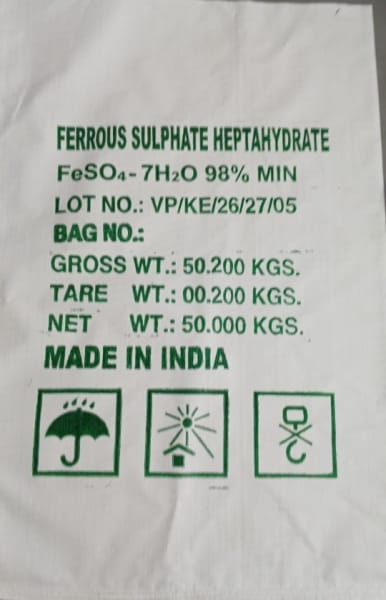
KIKI'S Industrial Chemicals supplies bulk Ferrous Sulphate Heptahydrate in 50 kg heavy-duty bags (Net Wt: 50.000 kg, Gross Wt: 50.200 kg, Kaiser Exports India, Lot VP/KE/26/27/05, marked NBO) with continuous inventory maintained in Nairobi for municipal water service providers and industrial manufacturing plants.
Article Frequently Asked Questions
Related Categories
Related Industries
Related Applications
Chemicals Mentioned in This Guide
Ferrous Sulfate Heptahydrate 98% Min
Ferrous Sulphate Heptahydrate 98% Min (FeSO₄·7H₂O, CAS 7782-63-0) is an industrial-grade iron(II) salt supplied in 50…
CAS 7782-63-0 · Industrial Grade · Crystal

Caustic Soda (Flakes, Pearls) (99% min)
Caustic Soda (Flakes, Pearls) (99% min) supplied by Kiki's Industrial Chemicals Ltd in 25kg bag. Ideal for Textile…
CAS 1310-73-2 · 99% min · Standard Packaging

Ferrous sulphate monohydrate Fe: 30%min 25kg bags Technical Grade for Industrial & Commercial Use (Ferrous sulphate monohydrate Fe: 30%min 25kg bags)
Ferrous sulphate monohydrate Fe: 30%min 25kg bags (Technical Grade) supplied by Kiki's Industrial Chemicals Ltd in 25kg…
Technical Grade · Powder
Related Technical Guides & Insights
View all →Ferrous Sulphate Uses: 50 Applications and Where They Make Commercial Sense
Comprehensive industrial reference categorizing 50 applications of Ferrous Sulphate Heptahydrate across water treatment, agriculture, cement manufacturing, chemical synthesis, and metallurgy in East Africa.
Guides & How-TosFerrous Sulphate Heptahydrate 98%: What Buyers in Kenya Need to Know Before Ordering
A comprehensive procurement guide for industrial chemical buyers in Kenya. Understand the difference between 98% compound purity and elemental iron, packaging standards, COA parameters, and regional sourcing options.