What Is Acetone? Properties, Uses and Industrial Applications in Kenya
A comprehensive technical guide to acetone (propan-2-one, CAS 67-64-1): molecular structure, physical properties, solvency parameters, industrial applications, and procurement considerations for Kenyan manufacturers.

Quick Answer — What Is Acetone? Properties, Uses and Industrial Applications in Kenya
Acetone (propan-2-one, C3H6O, CAS 67-64-1) is a clear, colourless, highly volatile organic ketone solvent featuring a boiling point of 56.05°C and complete water miscibility. In Kenya and East Africa, it is widely utilized for uncured polyester resin tool washing in fibreglass fabrication, surface degreasing in metal manufacturing, fast-evaporating solvent blending in lacquers and printing inks, and technical extraction in commercial laboratories.
Acetone (propan-2-one, CAS 67-64-1, UN 1090) is an industrial ketone solvent supplied across Kenya by KIKI'S Industrial Chemicals Ltd in 20L HDPE jerrycans and 160kg steel drums.
Key Facts
- •Chemical Identity: Simple aliphatic ketone (CH3COCH3), molecular weight 58.08 g/mol, boiling point 56.05°C, density ~0.791 g/mL at 20°C.
- •Solvent Power: Both polar and non-polar dissolving capability, making it uniquely effective for resins, natural oils, and synthetic polymers.
- •Rapid Evaporation: Relative evaporation rate of 5.6 (vs n-butyl acetate = 1.0) guarantees residue-free surface drying within seconds.
- •Safety Classification: Class 3 Flammable Liquid (UN 1090, PG II) with flash point of -18°C; requires strict ignition control and butyl rubber gloves.
Primary Use Cases
Whether you manage a fibreglass boatyard in Kilifi, an industrial coating plant in Industrial Area Nairobi, or a quality assurance laboratory in Thika, acetone is one of the most frequently specified solvents in your operation. Yet chemical procurement teams often encounter confusion regarding chemical grades, true purity benchmarks, and safe handling boundaries.
Chemical Identity and Molecular Structure of Acetone
Acetone (officially designated propan-2-one by IUPAC, and historically known as dimethyl ketone or pyroacetic ether) has the molecular formula C3H6O. Structurally written as CH3COCH3, it is the simplest representative of the aliphatic ketone family. A central carbonyl carbon (C=O) is flanked symmetrically by two methyl groups (-CH3).
This distinct molecular architecture gives acetone its exceptional solvency properties. The polar carbonyl oxygen possesses an unshared electron pair that readily participates in hydrogen bonding with polar compounds, while the two non-polar methyl groups allow it to interact favorably with non-polar organic molecules. Consequently, acetone is miscible in all proportions with water, lower alcohols, esters, aromatic hydrocarbons, and chlorinated solvents.
Key Physical and Chemical Properties
When evaluating technical specifications for process compatibility, procurement teams and chemical engineers should verify the following established physical constants:
- Boiling Point: 56.05°C (132.89°F) at standard atmospheric pressure (101.3 kPa). This modest boiling point enables rapid evaporation at ambient Kenyan temperatures.
- Liquid Density and Specific Gravity: 0.790 to 0.793 g/cm³ at 20°C. One litre of liquid acetone weighs approximately 791 grams. This means a standard 20-litre container contains approximately 15.82 kg of liquid chemical.
- Relative Evaporation Rate: Approximately 5.6 compared to n-butyl acetate (standard reference = 1.0). In practical terms, acetone flashes off surfaces roughly six times faster than butyl acetate and over twice as fast as methyl ethyl ketone (MEK).
- Flash Point and Flammability: Closed-cup flash point of -18°C (-0.4°F) and an auto-ignition temperature of 465°C. Flammable explosive limits in air range from a lower limit of 2.5% to an upper limit of 12.8% by volume.
- Vapour Density: 2.0 relative to air (air = 1.0). Acetone vapours are twice as heavy as ambient air, causing them to accumulate along floor level and into drainage sumps if cross-ventilation is deficient.
Primary Industrial Applications Across Kenyan Sectors
In Kenyan commerce and manufacturing, acetone serves distinct functional roles across five key economic sectors:
- Fibreglass and Composite Fabrication: Acetone is the primary solvent for washing uncured polyester, vinyl ester, and gelcoat resins from consolidating rollers, brushes, and mixing kettles in FRP water tank and marine manufacturing.
- Paint, Enamel and Coating Formulation: Used as an active solvent in nitrocellulose lacquers, wood stains, and industrial primers to reduce application viscosity while providing rapid initial flash-off.
- Metal Surface Preparation and Degreasing: Cleans light machining oils, protective cutting fluids, and grease from aluminum and steel components prior to welding, powder coating, or structural adhesive bonding.
- Printing and Packaging Converting: Cleans fast-drying flexographic and gravure printing inks from solvent-resistant press cylinders, anilox rolls, and ink doctor blades.
- Laboratory Extractions and Pre-Washing: Employed as a carrier solvent for plant extract analysis and a fast-drying solvent pre-wash for laboratory glassware.
Procurement Note: KIKI'S Industrial Chemicals supplies virgin industrial solvent grade acetone with a guaranteed 99.5% minimum assay and less than 0.20% moisture, packaged in heavy-duty 20-litre HDPE jerrycans and 160kg steel drums.
Article Frequently Asked Questions
Related Categories
Chemicals Mentioned in This Guide
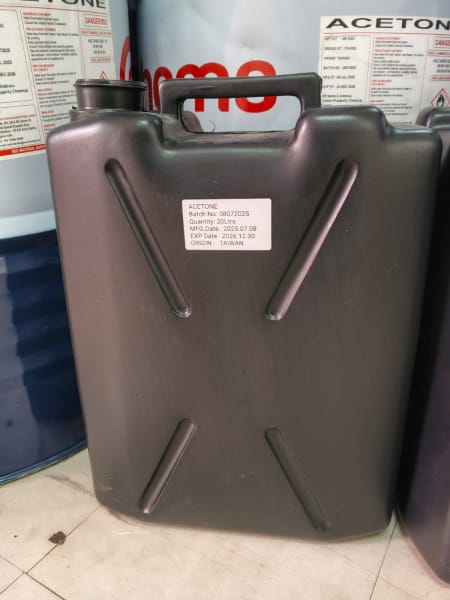
Acetone 20 Litres for Industrial and Commercial Use in Kenya
Industrial-grade Acetone in a convenient 20-litre heavy-duty HDPE jerrycan (99.5% min assay, CAS 67-64-1, UN 1090).…
CAS 67-64-1 · Industrial Solvent Grade (Virgin High-Purity) · Clear colourless volatile liquid
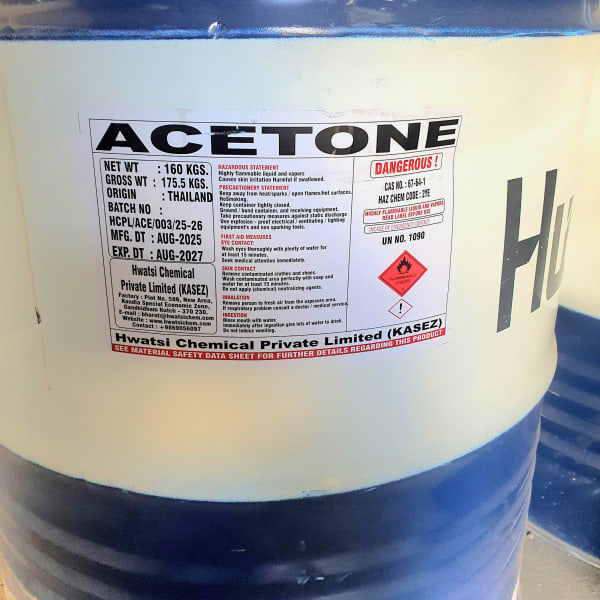
Acetone Industrial Solvent (Bulk 160kg Drums & Multi-Pack Supply)
High-purity virgin Acetone solvent (99.5% min assay, CAS 67-64-1, UN 1090) supplied in 160kg steel drums, 1,000L IBCs,…
CAS 67-64-1 · Industrial Solvent Grade (Virgin High-Purity) · Clear Colorless Volatile Liquid

ABS/LAS 80% for Industrial Use (ABS/LAS)
ABS/LAS (80%) supplied by Kiki's Industrial Chemicals Ltd in 25kg bags across Kenya and East Africa.
Technical Grade · Powder

ATMP (50%)
ATMP (50%) supplied by Kiki's Industrial Chemicals Ltd in 200kg drum. Ideal for Water treatment chemicals.
50% · Standard Packaging
Related Technical Guides & Insights
View all →Where to Buy Acetone in Nairobi, Kenya: A Practical Buyer's Guide
A practical procurement guide for sourcing industrial acetone in Nairobi, Kenya. Learn what specifications to verify, how to avoid contaminated recycled solvents, and how to evaluate suppliers.
Buying GuideAcetone 20 Litres: Who Needs This Pack Size and How to Order It in Kenya
Discover why the 20-litre acetone jerrycan is the preferred packaging for workshops, composite laminators, and maintenance teams in Kenya. Compare volume versus mass and learn how to order.
Industrial ApplicationsUsing Acetone for Fibreglass and Polyester Resin Tool Cleanup
Learn how to use industrial acetone safely and effectively for cleaning uncured polyester, vinyl ester, and gelcoat resins from fibreglass laminating tools, rollers, and spray equipment.
Industrial ApplicationsCan Acetone Be Used for Industrial Degreasing? Benefits, Limitations and Compatibility
An engineering evaluation of acetone as an industrial degreasing solvent: solvency power on machining oils, flash-off speed, residue-free drying, plastic attack vulnerabilities, and safety controls.