Can Acetone Be Used for Industrial Degreasing? Benefits, Limitations and Compatibility
An engineering evaluation of acetone as an industrial degreasing solvent: solvency power on machining oils, flash-off speed, residue-free drying, plastic attack vulnerabilities, and safety controls.

Quick Answer — Can Acetone Be Used for Industrial Degreasing? Benefits, Limitations and Compatibility
Yes, acetone is highly effective for industrial degreasing of bare ferrous and non-ferrous metals, cutting oils, swarf, and light grease. It provides instantaneous solvency, rapid flash-off (boiling point 56.05°C), and leaves zero non-volatile residue, making it ideal for pre-weld preparation and powder coating pretreatments. However, it cannot be used on solvent-sensitive plastics (such as ABS, PVC, and polycarbonate) or standard nitrile seals, and its high volatility makes it unsuitable for open, unventilated dip tanks.
Acetone (propan-2-one, CAS 67-64-1, UN 1090) is an industrial ketone solvent supplied across Kenya by KIKI'S Industrial Chemicals Ltd in 20L HDPE jerrycans and 160kg steel drums.
Key Facts
- •Unmatched Flash-Off: Relative evaporation rate of 5.6 dries metal surfaces within seconds, eliminating lengthy oven drying cycles.
- •Zero Residue Guarantee: High-purity virgin acetone (99.5% min) leaves no oily film, silicates, or surfactants that impair paint adhesion or weld purity.
- •Strict Substrate Boundaries: Safe on carbon steel, stainless steel, aluminum, brass, and copper; severely damages polystyrene, acrylic, PVC, and polyurethane.
- •Flammability Management: Closed-cup flash point of -18°C prohibits use near hot-work areas, sparks, or unrated immersion cleaning baths.
Primary Use Cases
In machine shops, structural fabrication bays, and automotive rebuild facilities across Nairobi and Athi River, degreasing is a fundamental prerequisite before welding, painting, or adhesive bonding. Maintenance engineers frequently reach for acetone because of its legendary ability to cut through shop grime and dry without leaving a trace.
However, deploying acetone as an all-purpose workshop degreaser without understanding its physical chemistry can lead to ruined components, compromised seals, and severe flammability hazards. Understanding where acetone excels and where slower hydrocarbons or aqueous degreasers are required is essential for every production manager.
The Physical Chemistry of Acetone Degreasing
Acetone is a low-molecular-weight polar aprotic solvent. Unlike non-polar petroleum solvents (such as mineral turpentine, kerosene, or white spirit) that dissolve oils primarily through dispersion forces, acetone possesses a strong dipole moment (2.88 D) combined with lipophilic methyl groups.
This dual chemical character allows acetone to rapidly penetrate and dissolve light petroleum hydrocarbons, synthetic stamping oils, soluble cutting coolants, and finger fats. Because of its low surface tension (23.3 mN/m at 20°C), acetone wets metal surfaces aggressively, penetrating micro-crevices and machined threads that viscous solvents cannot easily enter.
Key Benefits of Acetone in Precision Cleaning
When evaluated against alternative industrial cleaners, acetone offers four distinct operational advantages:
- Complete Evaporation with Zero Residue: High-purity virgin acetone evaporates completely. Unlike mineral spirits, which leave a faint paraffinic oil film, or aqueous caustic detergents, which deposit dried alkaline salts if unrinsed, acetone leaves an atomically bare substrate ready for immediate primer application.
- Rapid Flash-Off Speed: With a boiling point of 56.05°C and an evaporation rate 5.6 times faster than butyl acetate, acetone evaporates in seconds at room temperature. This eliminates bottleneck drying stages on assembly lines.
- Critical Pre-Weld and Pre-Bonding Cleanliness: Aluminum and stainless steel TIG welding requires surfaces entirely free of carbonaceous residues and moisture. Wiping joints with acetone removes rolling oils and contaminants that otherwise cause weld porosity and brittle joints.
- Effective on Fresh Synthetic Resins: Beyond petroleum greases, acetone dissolves unhardened adhesives, threadlockers, silicone release agents, and epoxy residues before cure.
Substrate Compatibility: What Acetone Attacks
The most frequent error in workshop cleaning is assuming all materials resist acetone. Acetone interacts aggressively with many polymers and elastomers:
- Compatible Metals: Completely safe on carbon steel, stainless steel (SS304/316), titanium, aluminum, brass, copper, and bronze.
- Compatible Plastics: High-density polyethylene (HDPE), polypropylene (PP), and polytetrafluoroethylene (PTFE/Teflon). These materials resist acetone indefinitely.
- Severely Attacked Plastics: Polystyrene (dissolves instantly), ABS (melts and softens), PVC (swells and loses plasticizers), Acrylic / Plexiglas (crazes and cracks), and Polycarbonate (clouds and fractures under stress).
- Elastomers and Seals: Nitrile (Buna-N), Neoprene, and Viton swell rapidly and lose tensile strength. Only Virgin PTFE, Chemraz, or Kalrez seals survive sustained acetone exposure.
Practical Limitations and Workplace Hazards
Despite its cleaning efficiency, acetone exhibits significant limitations in large-scale degreasing operations:
First, its high volatility makes acetone inefficient for cleaning heavy, caked gear grease or road tar. The solvent flashes off before the thick asphaltic matrix can dissolve, merely smearing the grease across the work piece. For heavy tar, a slower aromatic or terpene solvent is far more economical.
Second, rapid evaporative cooling can drop the metal surface temperature below the dew point, causing ambient atmospheric moisture to condense onto freshly cleaned metal. In coastal environments like Mombasa, this condensation can cause flash-rusting on bare carbon steel within minutes.
Best Practice: Apply acetone using the two-rag wipe technique. Wet the first clean lint-free cloth with acetone to dissolve the grease, and immediately follow with a dry lint-free cloth to lift the dissolved oil before the solvent flashes off. This prevents redepositing a thin oil haze onto the substrate.
Article Frequently Asked Questions
Related Categories
Chemicals Mentioned in This Guide
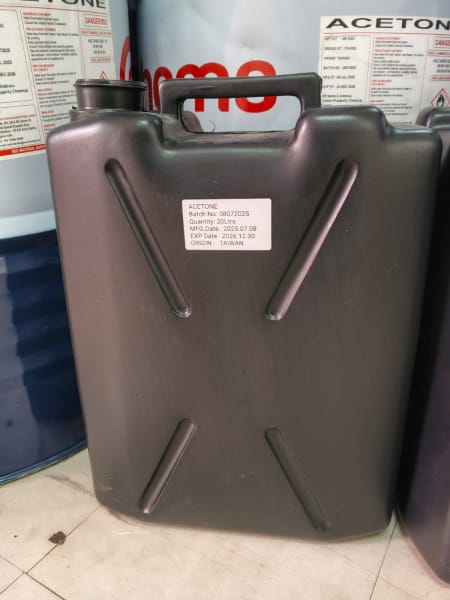
Acetone 20 Litres for Industrial and Commercial Use in Kenya
Industrial-grade Acetone in a convenient 20-litre heavy-duty HDPE jerrycan (99.5% min assay, CAS 67-64-1, UN 1090).…
CAS 67-64-1 · Industrial Solvent Grade (Virgin High-Purity) · Clear colourless volatile liquid
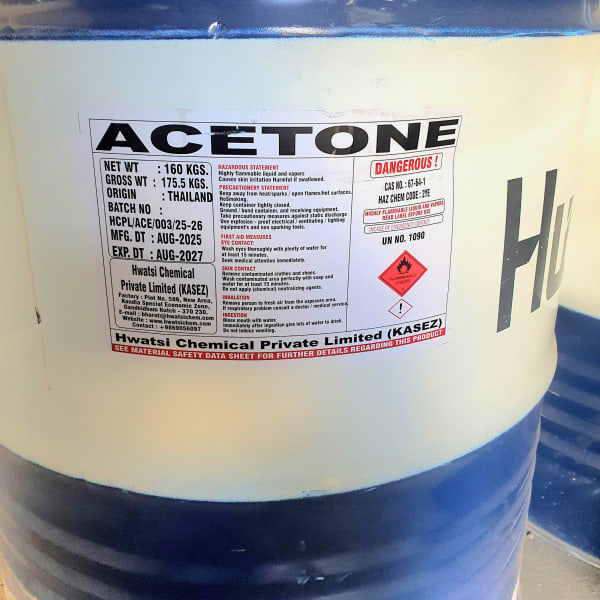
Acetone Industrial Solvent (Bulk 160kg Drums & Multi-Pack Supply)
High-purity virgin Acetone solvent (99.5% min assay, CAS 67-64-1, UN 1090) supplied in 160kg steel drums, 1,000L IBCs,…
CAS 67-64-1 · Industrial Solvent Grade (Virgin High-Purity) · Clear Colorless Volatile Liquid

ABS/LAS 80% for Industrial Use (ABS/LAS)
ABS/LAS (80%) supplied by Kiki's Industrial Chemicals Ltd in 25kg bags across Kenya and East Africa.
Technical Grade · Powder

ATMP (50%)
ATMP (50%) supplied by Kiki's Industrial Chemicals Ltd in 200kg drum. Ideal for Water treatment chemicals.
50% · Standard Packaging
Related Technical Guides & Insights
View all →What Is Acetone? Properties, Uses and Industrial Applications in Kenya
A comprehensive technical guide to acetone (propan-2-one, CAS 67-64-1): molecular structure, physical properties, solvency parameters, industrial applications, and procurement considerations for Kenyan manufacturers.
Buying GuideWhere to Buy Acetone in Nairobi, Kenya: A Practical Buyer's Guide
A practical procurement guide for sourcing industrial acetone in Nairobi, Kenya. Learn what specifications to verify, how to avoid contaminated recycled solvents, and how to evaluate suppliers.
Buying GuideAcetone 20 Litres: Who Needs This Pack Size and How to Order It in Kenya
Discover why the 20-litre acetone jerrycan is the preferred packaging for workshops, composite laminators, and maintenance teams in Kenya. Compare volume versus mass and learn how to order.
Industrial ApplicationsUsing Acetone for Fibreglass and Polyester Resin Tool Cleanup
Learn how to use industrial acetone safely and effectively for cleaning uncured polyester, vinyl ester, and gelcoat resins from fibreglass laminating tools, rollers, and spray equipment.