Industrial Acetone vs Laboratory-Grade Acetone: Purity, Testing and How to Choose
Understand the critical differences between virgin industrial solvent grade acetone and analytical laboratory grades (AR, ACS, HPLC). Learn when technical grade is ideal and when analytical purity is mandatory.

Quick Answer — Industrial Acetone vs Laboratory-Grade Acetone: Purity, Testing and How to Choose
The distinction between industrial-grade and laboratory-grade acetone lies in certified purity benchmarks, trace impurity profiles, and quality verification testing. Industrial virgin acetone guarantees 99.5% minimum assay with low water (under 0.20%) and non-volatile residues (under 20-50 ppm), ideal for tool cleaning, degreasing, resin thinning, and commercial coating manufacturing. Laboratory grades (AR, ACS, HPLC) achieve 99.8% to 99.9%+ purity with strict limits on optical absorbance, UV cut-off, and heavy metals, required for spectrophotometry and chromatography but economically wasteful for workshop applications.
Acetone (propan-2-one, CAS 67-64-1, UN 1090) is an industrial ketone solvent supplied across Kenya by KIKI'S Industrial Chemicals Ltd in 20L HDPE jerrycans and 160kg steel drums.
Key Facts
- •Purity Benchmarks: Industrial grade guarantees 99.5% min assay; laboratory analytical grades guarantee 99.8% to 99.95% with specialized trace impurity limits.
- •Crucial Impurity Testing: Laboratory grades are tested for UV absorbance, acidity, chloride, iron, and heavy metals; industrial grades focus on moisture, density, and evaporation residue.
- •Cost Disparity: Analytical grade acetone carries a 5x to 15x price premium over industrial solvent grade due to specialized glass packaging and certified testing.
- •Proper Application Mapping: Use industrial grade for manufacturing, composite cleanup, and degreasing; reserve AR/HPLC grades for instrumental analysis and pharmaceutical synthesis.
Primary Use Cases
In chemical procurement, one of the most common budget leaks occurs when quality assurance teams or workshop managers purchase laboratory-reagent grade acetone for everyday industrial washing. Conversely, process failures occur when production chemists substitute unverified technical grade solvent into sensitive analytical instruments.
Understanding the exact boundary between virgin industrial solvent grade acetone and high-purity analytical grades enables procurement managers to optimize manufacturing budgets without sacrificing chemical reliability.
Defining Chemical Grade Classifications
Chemical purity is standardized across several globally recognized grade tiers:
- Industrial / Technical Grade: High-purity virgin solvent intended for manufacturing, extraction, coating, and cleaning. Purity typically ranges from 99.5% to 99.9% min assay, with controlled moisture and minimal non-volatile matter.
- Laboratory Reagent (LR) / Pure Grade: Suitable for general educational laboratory use, routine qualitative testing, and benchtop equipment rinsing where trace impurities do not skew results.
- Analytical Reagent (AR) / ACS Grade: Conforms to American Chemical Society specifications. Purity exceeds 99.8% with rigorously certified limits on heavy metals, iron, chlorides, and titratable acidity, designed for quantitative analytical chemistry.
- Spectroscopy & HPLC Grade: Specially purified and filtered to eliminate trace UV-absorbing organic impurities and particulate matter. Characterized by strict optical transmission cut-off curves (typically 330 nm for acetone).
Side-by-Side Specification Comparison
The practical chemical differences between virgin industrial grade and analytical laboratory grade acetone are shown below:
- Purity Assay (Gas Chromatography): Industrial virgin acetone guarantees 99.5% minimum (typically 99.8% in fresh batches). ACS/AR grades guarantee 99.5% to 99.9% minimum assay.
- Water Content (Karl Fischer Titration): Industrial grade allows up to 0.20% (2000 ppm) moisture; ACS grade limits moisture to 0.50% max, while Karl Fischer specialty grades require less than 0.05% (500 ppm).
- Non-Volatile Residue: Industrial grade specifies maximum 20 to 50 ppm (0.002% - 0.005%). ACS grade limits residue to maximum 10 ppm (0.001%).
- Trace Heavy Metals: Industrial grade does not routinely test for ppb-level lead, copper, or arsenic. AR and ACS grades certify heavy metal limits below 1 ppm.
- UV Absorbance: Industrial grade makes no claim regarding UV cut-off. HPLC and spectroscopy grades guarantee specific maximum absorbance values across the 330 to 400 nm optical range.
Economics and Application Decision Matrix
Purchasing analytical grade acetone in 2.5-litre amber glass bottles costs between 5 and 15 times more per litre than sourcing 20-litre HDPE containers of virgin industrial acetone. Applying the correct grade to the correct task preserves profitability:
When to Use Industrial Solvent Grade: Composite laminating tool cleaning, industrial metal degreasing, paint and lacquer thinning, printing press ink flushing, floor coating removal, and commercial chemical syntheses where trace water does not interfere with reaction kinetics.
When Laboratory Grade is Mandatory: High-Performance Liquid Chromatography (HPLC) mobile phases, spectrophotometric testing, forensic analysis, active pharmaceutical ingredient (API) synthesis, and sensitive trace element extraction.
Procurement Guidance: KIKI'S Industrial Chemicals supplies virgin industrial solvent grade acetone with batch-specific Certificates of Analysis (CoA) documenting gas chromatography assay (99.5% min), moisture (under 0.20%), and density. This grade delivers peak performance for manufacturing operations across East Africa.
Article Frequently Asked Questions
Related Categories
Chemicals Mentioned in This Guide
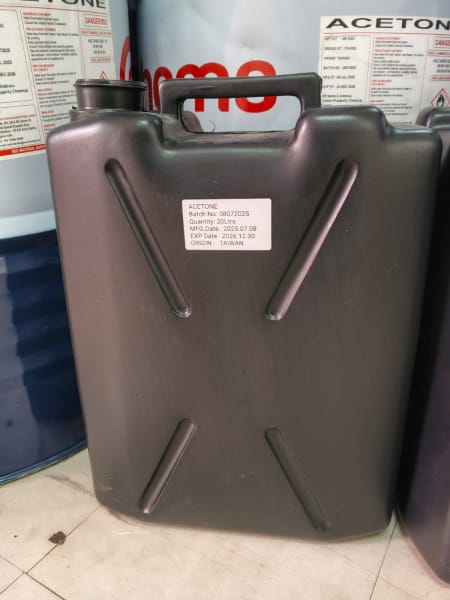
Acetone 20 Litres for Industrial and Commercial Use in Kenya
Industrial-grade Acetone in a convenient 20-litre heavy-duty HDPE jerrycan (99.5% min assay, CAS 67-64-1, UN 1090).…
CAS 67-64-1 · Industrial Solvent Grade (Virgin High-Purity) · Clear colourless volatile liquid
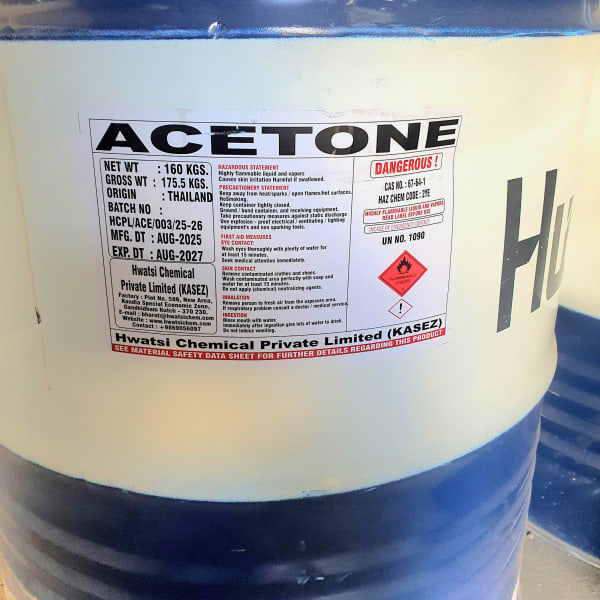
Acetone Industrial Solvent (Bulk 160kg Drums & Multi-Pack Supply)
High-purity virgin Acetone solvent (99.5% min assay, CAS 67-64-1, UN 1090) supplied in 160kg steel drums, 1,000L IBCs,…
CAS 67-64-1 · Industrial Solvent Grade (Virgin High-Purity) · Clear Colorless Volatile Liquid

ABS/LAS 80% for Industrial Use (ABS/LAS)
ABS/LAS (80%) supplied by Kiki's Industrial Chemicals Ltd in 25kg bags across Kenya and East Africa.
Technical Grade · Powder

ATMP (50%)
ATMP (50%) supplied by Kiki's Industrial Chemicals Ltd in 200kg drum. Ideal for Water treatment chemicals.
50% · Standard Packaging
Related Technical Guides & Insights
View all →What Is Acetone? Properties, Uses and Industrial Applications in Kenya
A comprehensive technical guide to acetone (propan-2-one, CAS 67-64-1): molecular structure, physical properties, solvency parameters, industrial applications, and procurement considerations for Kenyan manufacturers.
Buying GuideWhere to Buy Acetone in Nairobi, Kenya: A Practical Buyer's Guide
A practical procurement guide for sourcing industrial acetone in Nairobi, Kenya. Learn what specifications to verify, how to avoid contaminated recycled solvents, and how to evaluate suppliers.
Buying GuideAcetone 20 Litres: Who Needs This Pack Size and How to Order It in Kenya
Discover why the 20-litre acetone jerrycan is the preferred packaging for workshops, composite laminators, and maintenance teams in Kenya. Compare volume versus mass and learn how to order.
Industrial ApplicationsUsing Acetone for Fibreglass and Polyester Resin Tool Cleanup
Learn how to use industrial acetone safely and effectively for cleaning uncured polyester, vinyl ester, and gelcoat resins from fibreglass laminating tools, rollers, and spray equipment.