Industrial Acids in Kenya: Hydrochloric Acid 33% (Muriatic), Oxalic Acid & Formalin Guide
Source Hydrochloric Acid 33% (22° Bé), Oxalic Acid 99.6%, and Formalin 37% in Kenya. Technical guide to metal pickling, boiler descaling, and leather processing.
Quick Answer: Industrial Acids in Kenya: Hydrochloric Acid 33% (Muriatic), Oxalic Acid & Formalin Guide
Industrial acids form the chemical foundation of manufacturing, metallurgy, and water treatment across Kenya. The primary mineral workhorse is Hydrochloric Acid 33%–35% (Muriatic Acid, 22° Baumé, CAS 7647-01-0), used for steel pickling, borehole scale descaling, and ion exchange resin regeneration. For organic dicarboxylic applications, Oxalic Acid Dihydrate (min 99.6%, CAS 6153-56-6) provides powerful rust removal, wood bleaching, and leather tanning reduction (binding Fe³⁺ ions). In resin synthesis and biological preservation, Formalin 37% (Formaldehyde solution stabilized with 8%–12% methanol, CAS 50-00-0) serves as an essential cross-linking precursor for urea-formaldehyde wood adhesives.
Industrial acids comprise inorganic mineral acids and organic polyprotic carboxylic acids utilized as chemical intermediates, surface pickling agents, pH reducers, and heavy metal rust chelators across manufacturing facilities in Kenya.
Key Facts
- •The 22° Baumé Scale: 33%–35% concentrated hydrochloric acid corresponds to 22° Bé (specific gravity 1.17–1.18); it fumes aggressively in ambient air, forming corrosive white clouds of hydrogen chloride vapor that attack nearby structural steel and electronics.
- •Oxalic Acid Iron Chelation: Oxalic acid reacts with insoluble ferric iron oxide (rust, Fe2O3) to form soluble, bright-green iron tris-oxalato complexes ([Fe(C2O4)3]³⁻) that rinse away cleanly without pitting base metal.
- •Formalin 37% Stabilization: Pure formaldehyde gas polymerizes spontaneously into insoluble paraformaldehyde white sediment unless stabilized with 8% to 12% methanol; winter storage below 15°C accelerates polymerization.
- •Packaging Standards: Hydrochloric Acid in 30kg vented jerrycans, 250kg L-ring drums, and 1,000L IBCs; Oxalic Acid in 25kg woven bags; Formalin in 200L HDPE drums.
Along the perimeter fence of a heavy structural steel fabrication and hot-dip galvanizing plant in Athi River, the morning wind carries a faint, sharp, pungent vapor. Inside the galvanizing preparation bay, the plant maintenance superintendent shines a halogen inspection lamp into Pickling Tank 2.
The 15-meter-long rubber-lined pickling tank contains twenty thousand liters of acid bath. Suspended from the overhead gantry crane, five metric tonnes of heavy structural I-beams and welded transmission tower trusses have just been hoisted out of the liquid.
"Look at the mill scale on the lower flanges," the superintendent tells his chemical bath technician. "The beams have been submerged for ninety minutes. The mill scale should be completely stripped down to bare, chemically clean, etched steel. But the black iron oxide crust is still clinging to the welds. And look at the structural steel roof purlins right above the bath: the galvanized coating on the roof trusses is blistering and flaking off from acid fumes."
The technician checks his glass hydrometer float.
"We charged the tank last month with generic acid," the technician says. "The supplier invoiced it as Hydrochloric Acid 33% (22° Baumé). But when I float the Baumé hydrometer, the reading shows only 16° Bé—barely 25% acid! The supplier cut the acid with borehole water before delivery. Worse, because the bath was under-strength, the operators turned up the immersion heaters to 45 degrees Celsius to speed up the pickling. At 45 degrees, hydrochloric acid outgases choking hydrogen chloride fumes that are eating the factory roof while failing to strip the steel."
The superintendent taps the hydrometer cylinder.
"Lock out Pickling Tank 2. We neutralize this exhausted bath with hydrated lime and pump it to the effluent plant. From this morning, every tanker of acid delivered to this facility is quarantined at the weighbridge until our lab verifies Baumé gravity, iron content, and true titration assay. Here is the operational science of why industrial acids require uncompromising chemical precision."
---
The Chemical Backbone: How Industrial Acids Drive Manufacturing
Industrial acids are the primary chemical reactive workhorses of modern manufacturing. They cleave stubborn mineral scale, strip tough metallurgical oxides, regulate process pH, and act as fundamental reactive precursors in chemical synthesis.
However, each acid family possesses distinct thermodynamic, corrosive, and reactive properties that dictate where and how it must be deployed:
---
1. Hydrochloric Acid 33% (Muriatic Acid 22° Baumé): The Pickling Master
Hydrochloric Acid (HCl, CAS 7647-01-0) is an aqueous solution of hydrogen chloride gas in demineralized water. In commercial trade across Kenya, concentrated technical acid is supplied at 33.0% - 35.0% HCl by weight.
The 22° Baumé Scale & Specific Gravity
In heavy industry, acid concentration is measured using the Baumé gravity scale (°Bé):
Specific Gravity (SG) = (145) / (145 - °Bé)
A commercial grade of 22° Baumé corresponds to a specific gravity of approximately 1.178 g/cm^3 at 20°C, containing roughly 35.2% HCl by weight. A lower grade of 20° Bé corresponds to 1.160 SG (31.5% HCl).
Why Hot-Dip Galvanizers and Steel Mills Prefer HCl over Sulphuric Acid:
In steel pickling (removing mill scale—a composite layer of FeO, Fe₃O₄, and Fe₂O₃ formed during hot rolling):
- Operates at Ambient Temperatures: Unlike sulphuric acid (which requires bath heating to 60°C – 80°C to achieve acceptable reaction kinetics), hydrochloric acid dissolves iron oxides aggressively at room temperature (20°C – 25°C), saving millions of shillings in boiler fuel costs:
- Fe₂O₃ + 6HCl → 2FeCl₃ + 3H₂O
- FeO + 2HCl → FeCl₂ + H₂O
- Superior Surface Finish: Sulphuric acid aggressively attacks the underlying virgin base steel, causing "over-pickling" and hydrogen embrittlement. Hydrochloric acid preferentially attacks the iron oxide scale, leaving a smooth, silver-grey etched profile that delivers flawless zinc adhesion during hot-dip galvanizing.
- Borehole Descaling and Water Well Rehabilitation: In Kenya's high-mineral aquifers (Rift Valley, Machakos), submersible borehole pumps and slotted well screens become calcified with hard calcium carbonate scale. Pumping inhibited 15% muriatic acid downhole dissolves carbonate scale in minutes, restoring water yield without damaging stainless steel pump impellers.
At Kiki's Industrial Chemicals, our chemical engineering specialists work alongside steel fabricators, tanneries, and municipal borehole maintenance engineers across Kenya, validating acid concentrations and supplying lab-certified, water-white Hydrochloric Acid.
---
2. Oxalic Acid Dihydrate (99.6%): The Precision Iron Chelator
Oxalic Acid (C₂H₂O₄ · 2H₂O, CAS 6153-56-6, Molecular Weight 126.07 g/mol) is the simplest dicarboxylic acid, supplied as sparkling white monoclinic crystals containing a minimum of 99.6% active purity.
While mineral acids like hydrochloric acid dissolve metals through raw hydronium ion attack, oxalic acid works through coordination complexation (chelation):
Fe₂O₃ + 6H₂C₂O₄ → 2[Fe(C₂O₄)₃]^{3-} + 3H₂O + 6H⁺
Key Applications Across Kenyan Industry:
- Tannery Leather Processing (Athi River / Nairobi): In wet-blue leather production, hides often become discolored by dark iron stains leached from shaving machine blades and processing drums. Washing hides with a 1.5%-2.0% oxalic acid solution instantly strips iron blemishes, restoring a clean, uniform pastel blue surface ready for dyeing.
- Industrial Wood Bleaching & Timber Restoration: In high-end architectural joinery, hardwood timber (teak, mahogany, oak) darkens and develops black water stains when exposed to tannin-iron reactions. Oxalic acid bleaches the timber back to its natural golden color without lifting or weakening the wood grain.
- Radiator & Heat Exchanger Descaling: Cleans rusted automotive cooling passages and copper condenser coils where aggressive hydrochloric acid would dissolve the base metal.
---
3. Formalin 37%: Resin Synthesis & Cross-Linking Chemistry
Formalin 37% (HCHO, CAS 50-00-0) is an aqueous solution containing approximately 37.0% dissolved formaldehyde gas by weight, stabilized with 8.0% to 12.0% methanol.
The Methanol Stabilization Rule
Pure aqueous formaldehyde is thermodynamically unstable. The methylene glycol monomers rapidly condense into linear polymers, precipitating as insoluble, chalky white paraformaldehyde (left[CH₂O\right]n):
nHCHO + H₂O ⇌ HO-(CH₂O)n-H ↓ (Paraformaldehyde White Sludge)
To stop this polymerization, chemical manufacturers introduce methanol (CH₃OH), which caps the polymer chains as stable hemiformals. If formalin drums are stored below 15°C in cold highland regions, the stabilizing equilibrium breaks, creating a thick white sediment that drops the active aldehyde strength.
Industrial Applications:
- Urea-Formaldehyde (UF) and Melamine Resins: In Kenya's wood-processing sector (plywood, MDF, and particleboard manufacturing in Eldoret, Nakuru, and Ruiru), formalin is condensed with urea under controlled thermal and acidic conditions to synthesize heavy-duty wood glues and water-resistant laminating resins.
- Textile Finishing: Cross-links cellulose fibers in cotton fabric, imparting permanent wrinkle resistance and wash-and-wear properties.
---
Technical Specifications: Industrial Acids Comparison
| Chemical Parameter | Hydrochloric Acid 33% (22° Bé) | Oxalic Acid Dihydrate (99.6%) | Formalin 37% (Stabilized) |
|---|---|---|---|
| Active Chemical Assay | 33.0% - 35.0% HCl | ≥ 99.60% C₂H₂O₄ · 2H₂O | 37.0% ± 0.5% HCHO |
| Physical Appearance | Clear, colourless, fuming liquid | White monoclinic crystals | Clear, colourless, pungent liquid |
| Specific Gravity (20°C) | 1.165 - 1.180 g/cm^3 | N/A (Bulk Density 900 g/L) | 1.080 - 1.095 g/cm^3 |
| Methanol Content (Stabilizer) | N/A | N/A | 8.0% - 12.0% |
| Iron Content (Fe) | ≤ 5.0 mg/kg (Water-white grade) | ≤ 15.0 mg/kg | ≤ 1.0 mg/kg |
| Free Sulfuric Acid (H₂SO₄) | ≤ 0.01% (100 ppm) | ≤ 0.08% | N/A |
| Heavy Metals (as Pb) | ≤ 2.0 mg/kg | ≤ 5.0 mg/kg | ≤ 2.0 mg/kg |
| Standard Packaging | 30kg vented jerrycans, 250kg drums, 1,000L IBCs | 25kg woven PP bags with PE liner | 200L L-ring HDPE drums, 1,000L IBCs |
---
Corrosion Engineering & Materials of Construction
Deploying industrial acids without strict materials compatibility protocols leads to catastrophic pipe ruptures, structural failure, and chemical burns:
1. Hydrochloric Acid Material Law
- Strictly Incompatible: Carbon steel, cast iron, 304 and 316 stainless steel, copper, brass, and aluminium. Never use stainless steel bolts, valves, or pipes anywhere near HCl fumes; microscopic airborne chloride vapor causes severe stress corrosion cracking in weeks.
- Compatible Materials: High-density cross-linked polyethylene (XLPE), polypropylene (PP), PVDF (Kynar), PTFE (Teflon), and rubber-lined steel tanks.
2. Acid Storage Ventilation & Fume Scrubbing
Concentrated 33% HCl has a high vapor pressure. Ambient storage tanks must be vented through a water-scrubber column or packed alkaline bed to neutralize escaping hydrogen chloride gas, protecting electrical switchgear, overhead cranes, and personnel from corrosive acid fog.
---
From heavy structural pickling in Athi River to precision leather finishing and resin synthesis, industrial acids demand absolute certainty in chemical concentration, purity assay, and corrosion engineering.
Planning a bulk chemical delivery or need technical data sheets for industrial pickling acids? Request a technical bulk quote for Industrial Acids from Kiki's Industrial Chemicals Ltd.
Article Frequently Asked Questions
Chemicals Mentioned in This Guide

Hydrochloric Acid ( Muriatic Acid 31% - 35% )
Hydrochloric Acid ( Muriatic Acid 31% - 35% ) (Tech Grade Pickling & pH Control) supplied by Kiki's Industrial…
Tech Grade Pickling & pH Control · Standard Packaging
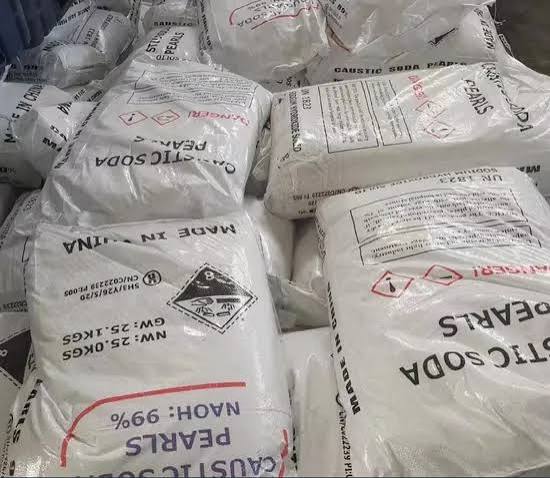
Caustic Soda Flakes /Pearls
Caustic Soda Flakes /Pearls (98.5/99% min) supplied by Kiki's Industrial Chemicals Ltd in 25kg bag. Ideal for Pulp &…
CAS 1310-73-2 · 98.5/99% min · Standard Packaging

Hydrochloric Acid 33%
High-concentration Hydrochloric Acid 33% (HCl) for water treatment, pH control, steel pickling, borehole…
CAS 7647-01-0 · Technical / Industrial Grade (33% Concentration) · Clear Fuming Yellowish Liquid

Hydrochloric acid (HCL) 33%
Hydrochloric acid (HCL) 33% supplied by KIKI'S Industrial Chemicals in 30kg jerrican for industrial, manufacturing, and…
Industrial Grade · Liquid
Related Technical Guides & Insights
View all →Mining Chemicals in Kenya: Flotation Xanthates (SIPX, SIBX, PAX) & Sulfide Mineral Extraction Guide
Source certified flotation xanthates (SIPX, SIBX, PAX) in Kenya. Technical guide to sulfide mineral extraction, collector selectivity, and gold ore recovery.
Food & Beverage IngredientsCommercial Baking Additives in Kenya: Leavening Chemistry, SAPP, Baking Soda & Food Additives Guide
Source wholesale Baking Soda, SAPP 28, Citric Acid, and food additives in Kenya. Technical guide to leavening rate of reaction (ROR) and bakery chemistry.
Food & Beverage IngredientsModified Starch in Kenya: Corrugated Carton Adhesives, Food Processing & Textile Sizing Guide
Source industrial and food-grade Modified Starch in Kenya. Technical guide to corrugated board adhesives, Stein-Hall starch gelatinization, and food texturizers.