How to Store and Handle Acetone Safely in a Workshop, Laboratory or Factory
Essential safety and storage guidelines for industrial acetone: Class 3 flammability management, heavy vapour control, container selection, earthing and bonding, secondary containment, and Kenyan OSHA compliance.

Quick Answer — How to Store and Handle Acetone Safely in a Workshop, Laboratory or Factory
Industrial acetone must be stored as a Class 3 Flammable Liquid (UN 1090, Packing Group II) in a cool, well-ventilated dedicated chemical store away from direct sunlight, radiant heat, and all ignition sources. Storage areas require impervious secondary containment (bunding sized to 110% of the largest container or 25% of total volume), low-level cross-ventilation to evacuate heavy vapours (vapour density 2.0 relative to air), conductive bonding and earthing during liquid transfer, and dedicated dry chemical or foam fire extinguishers. Containers must be certified heavy-duty HDPE or steel.
Acetone (propan-2-one, CAS 67-64-1, UN 1090) is an industrial ketone solvent supplied across Kenya by KIKI'S Industrial Chemicals Ltd in 20L HDPE jerrycans and 160kg steel drums.
Key Facts
- •Heavy Vapour Hazard: Acetone vapour is twice as heavy as ambient air, sinking into floor sumps and inspection pits where it forms explosive atmospheres.
- •Container Integrity: Store only in approved high-density polyethylene (HDPE) or steel containers; never use unrated plastics like PET, polystyrene, or PVC.
- •Static Dissipation: Ground and bond metal drums and decanting funnels during liquid transfer to prevent catastrophic static spark ignition.
- •Kenyan Regulatory Compliance: Storage facilities must adhere to the Occupational Safety and Health Act (OSHA 2007) and EMCA hazardous materials regulations.
Primary Use Cases
In any industrial workshop, factory, or laboratory, chemical safety is not merely a regulatory checkbox; it is the fundamental boundary between a productive shift and a catastrophic industrial accident. Acetone is one of the most volatile and flammable bulk solvents commonly stored on Kenyan commercial premises.
With a closed-cup flash point of -18°C, acetone produces flammable vapours even inside an air-conditioned room or during cool Nairobi mornings. Storing and transferring this solvent requires systematic engineering controls, proper storage vessels, and trained personnel.
Understanding the Flammability Chemistry of Acetone
Acetone is classified internationally as a Class 3 Flammable Liquid (UN 1090, Packing Group II). Understanding three physical characteristics is vital for safe facility design:
- Flash Point (-18°C / -0.4°F): The temperature above which liquid acetone gives off sufficient vapour to ignite when exposed to a spark. Because ambient temperatures across East Africa range from 15°C to over 35°C, acetone is continuously capable of ignition.
- Vapour Density (2.0 relative to air): Acetone vapour is twice as dense as atmospheric air. When a container is left open or decanted, vapours do not rise into the ceiling; they roll down the container sides, travel along the floor, and pool in trenches, drains, and low-lying spaces.
- Explosive Range (2.5% to 12.8% by volume): An acetone vapour-air concentration between 2.5% and 12.8% will detonate violently if ignited by a switch arc, electric motor brush spark, or cigarette.
Container Selection and Secondary Containment
Selecting the right storage container prevents catastrophic leaks and chemical contamination:
- Approved Containers: Store acetone in heavy-duty high-density polyethylene (HDPE) jerrycans equipped with anti-surge ribs (such as KIKI'S 20-litre packaging), 304/316 stainless steel vessels, or epoxy-lined carbon steel drums.
- Prohibited Containers: Never store acetone in PET beverage bottles, polystyrene jars, standard PVC carboys, or thin unlined tins that corrode from atmospheric humidity.
- Secondary Containment Bunding: Store bulk containers on chemical spill pallets or inside concrete bunds designed to hold at least 110% of the single largest container or 25% of the total stored volume, whichever is greater.
Earthing and Static Dissipation During Transfer
Decanting acetone generates electrostatic charge due to liquid friction against container walls and transfer pipes. In an ungrounded system, this static charge can discharge as a visible spark, igniting the surrounding vapour cloud.
- Bonding: Electrically connect the dispensing container and the receiving vessel with heavy-duty copper bonding cables fitted with sharp alligator clamps that penetrate paint and rust.
- Earthing: Ensure the dispensing drum is permanently connected to a verified factory earthing rod with an electrical resistance to ground of less than 10 ohms.
- Pouring Technique: Decant through conductive, grounded metal funnels. Avoid free-fall pouring; extend the dispensing tube to the bottom of the receiving container to reduce splashing and static generation.
Ventilation, Fire Fighting and Regulatory Compliance
Workshops must provide low-level mechanical exhaust ventilation or high-flow natural cross-ventilation to remove heavy solvent vapours before concentrations approach the lower explosive limit (2.5%).
Fire Protection: Position ABC dry chemical powder, carbon dioxide (CO2), or alcohol-resistant aqueous film-forming foam (AR-AFFF) extinguishers within 10 metres of the storage area. Never use a solid water jet on burning acetone; water will spread the burning solvent across the floor because the chemical is light and flammable.
Kenyan Regulatory Compliance: Storage facilities must comply with the Occupational Safety and Health Act (OSHA 2007) and the Environmental Management and Co-ordination Act (EMCA 1999/2015). Maintain printed copies of the manufacturer Safety Data Sheet (SDS) at the storage entrance, provide eyewash stations within 10 seconds walking distance, and ensure all chemical handlers receive certified solvent safety training.
Article Frequently Asked Questions
Related Categories
Chemicals Mentioned in This Guide
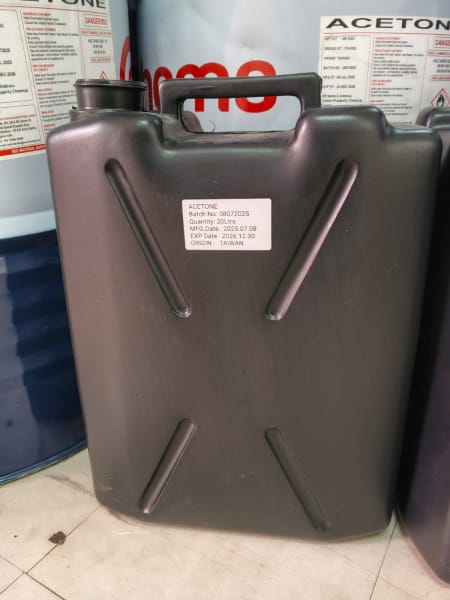
Acetone 20 Litres for Industrial and Commercial Use in Kenya
Industrial-grade Acetone in a convenient 20-litre heavy-duty HDPE jerrycan (99.5% min assay, CAS 67-64-1, UN 1090).…
CAS 67-64-1 · Industrial Solvent Grade (Virgin High-Purity) · Clear colourless volatile liquid
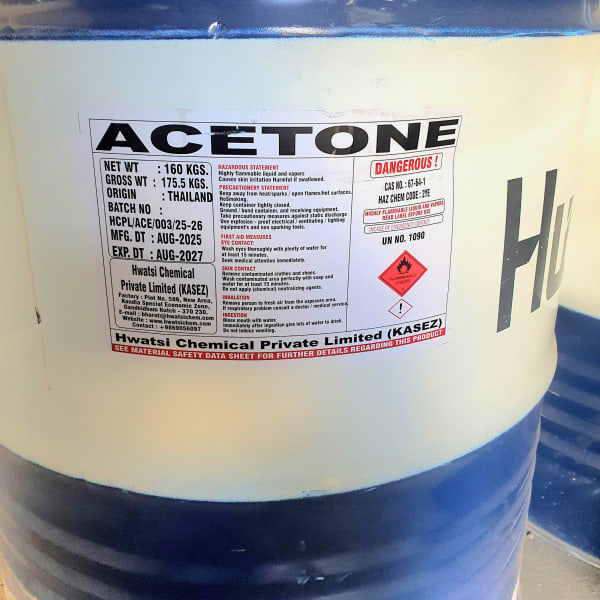
Acetone Industrial Solvent (Bulk 160kg Drums & Multi-Pack Supply)
High-purity virgin Acetone solvent (99.5% min assay, CAS 67-64-1, UN 1090) supplied in 160kg steel drums, 1,000L IBCs,…
CAS 67-64-1 · Industrial Solvent Grade (Virgin High-Purity) · Clear Colorless Volatile Liquid

ABS/LAS 80% for Industrial Use (ABS/LAS)
ABS/LAS (80%) supplied by Kiki's Industrial Chemicals Ltd in 25kg bags across Kenya and East Africa.
Technical Grade · Powder

ATMP (50%)
ATMP (50%) supplied by Kiki's Industrial Chemicals Ltd in 200kg drum. Ideal for Water treatment chemicals.
50% · Standard Packaging
Related Technical Guides & Insights
View all →What Is Acetone? Properties, Uses and Industrial Applications in Kenya
A comprehensive technical guide to acetone (propan-2-one, CAS 67-64-1): molecular structure, physical properties, solvency parameters, industrial applications, and procurement considerations for Kenyan manufacturers.
Buying GuideWhere to Buy Acetone in Nairobi, Kenya: A Practical Buyer's Guide
A practical procurement guide for sourcing industrial acetone in Nairobi, Kenya. Learn what specifications to verify, how to avoid contaminated recycled solvents, and how to evaluate suppliers.
Buying GuideAcetone 20 Litres: Who Needs This Pack Size and How to Order It in Kenya
Discover why the 20-litre acetone jerrycan is the preferred packaging for workshops, composite laminators, and maintenance teams in Kenya. Compare volume versus mass and learn how to order.
Industrial ApplicationsUsing Acetone for Fibreglass and Polyester Resin Tool Cleanup
Learn how to use industrial acetone safely and effectively for cleaning uncured polyester, vinyl ester, and gelcoat resins from fibreglass laminating tools, rollers, and spray equipment.