Fertilizer Inputs in Kenya: SOP vs. MOP, Soluble Calcium Nitrate & Greenhouse Fertigation Guide
Source soluble Potassium Sulphate (SOP), Calcium Nitrate, and specialty fertilizer inputs in Kenya. Technical guide to greenhouse fertigation and chloride toxicity.
Quick Answer: Fertilizer Inputs in Kenya: SOP vs. MOP, Soluble Calcium Nitrate & Greenhouse Fertigation Guide
Specialty fertilizer inputs in Kenya power the country's high-value export horticulture, floriculture (roses in Naivasha and Mount Kenya), and open-field agriculture. Formulators and commercial growers rely on high-purity water-soluble salts: Sulphate of Potash (SOP, 0-0-50+17S, potassium sulphate) for chloride-sensitive crops (roses, avocados, tomatoes, potatoes) to prevent leaf scorching; Muriate of Potash (MOP, potassium chloride, 0-0-60) for broadacre chloride-tolerant crops (sugarcane, maize); and fully soluble Calcium Nitrate (15.5-0-0+19Ca) for cell wall structural integrity and blossom-end rot prevention, managed via strict Tank A / Tank B separation to prevent insoluble gypsum (CaSO4) precipitation.
Fertilizer inputs are technical-grade, highly water-soluble inorganic mineral salts providing primary (N, P, K), secondary (Ca, Mg, S), and micronutrient elements engineered for precision fertigation, foliar spraying, and dry NPK compounding without clogging micro-irrigation emitters.
Key Facts
- •The Chloride Toxicity Threshold: MOP contains ~47% chloride (Cl⁻); on export roses, French beans, and Hass avocados, chloride accumulation exceeds root osmotic tolerances, causing marginal leaf necroses and flower rejection.
- •The Two-Tank Rule (Tank A vs. Tank B): Concentrated Calcium Nitrate must NEVER be mixed with Sulphates (SOP, Magnesium Sulphate) or Phosphates (MAP, MKP) in the same stock tank; they react instantaneously to form insoluble calcium sulphate (gypsum) that permanently blinds drip emitters.
- •Sulfur Synergism: SOP provides 17% to 18% sulfate-sulfur (SO4²⁻), directly enhancing essential amino acid synthesis (cysteine, methionine) and protein development in oilseeds and brassicas.
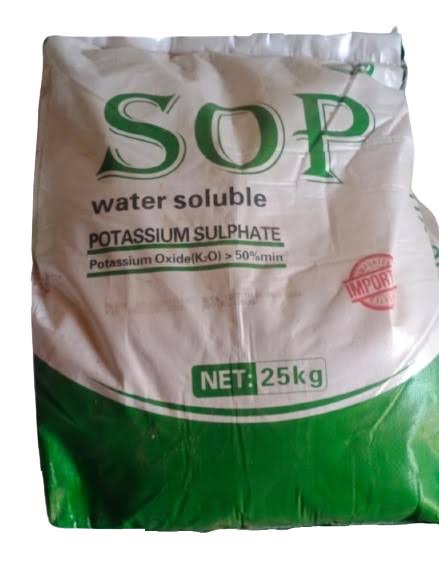
- •Packaging Standard: Delivered in 25kg and 50kg multi-wall woven polypropylene bags with inner polyethylene moisture barriers, stored on pallets in low-humidity dry stores.
At 7:00 AM across a 40-hectare commercial export rose greenhouse farm on the southern shores of Lake Naivasha, the morning sunlight filters through the polyethylene canopy. Outside, the morning mist still clings to the acacia trees; inside the fertigation control shed, the farm's head agronomist is staring at a row of pressure gauges on the primary drip manifold.
The line pressure on Sector B has spiked from 1.5 bar to 3.2 bar, while the flow meters are registering a 40% drop in delivered nutrient solution.
"Look at the inline screen filters on Block 4," the irrigation engineer says, unscrewing a 120-mesh disc filter housing. He pulls out the filter element and runs his thumb across the polypropylene rings. The grooves are choked with a dense, gritty, white crystalline paste. "The drip emitters down the lines are blinded. Half the flower beds received zero irrigation during yesterday's 2:00 PM pulse."
The agronomist walks into the adjacent fertilizer mixing hall and inspects the two 5,000-litre fiberglass stock tanks.
"Who mixed Tank A yesterday afternoon?" the agronomist asks.
A junior greenhouse attendant raises his hand hesitantly. "The SOP shipment arrived late from Nairobi. Tank B was already full with MAP and micronutrients. The stock card said Sector B needed extra potassium and calcium for stem elongation, so I dosed the Sulphate of Potash (SOP) into Tank A alongside the Calcium Nitrate."
The agronomist closes his eyes and exhales slowly.
"You poured concentrated potassium sulphate into concentrated calcium nitrate. In high school chemistry, that is the classic reaction to precipitate calcium sulphate—pure gypsum. You generated two hundred kilos of insoluble drywall plaster inside our dosing tank, pumped it straight through the injection manifold, and cemented every drip emitter in four hectares of export roses."
He tags the dosing pump with a red lockout notice.
"Stop all fertigation pumps. Strip and acid-wash the disc filters with dilute nitric acid. Flush the sector lines with clean water. And from this morning, no bag of fertilizer enters this mixing hall without the operator checking the incompatibility chart. Here is the operational chemistry of why fertilizer purity, carrier anions, and precision fertigation govern modern commercial agriculture."
---
The Chemical Architecture of Modern Fertilizer Inputs
Commercial high-value horticulture in Kenya—ranging from export-grade cut roses in Naivasha and Mount Kenya to greenhouse sweet peppers, Hass avocados in Murang'a, and drip-irrigated potatoes in Timau—cannot survive on generic, low-grade broadcast fertilizers.
High-frequency, low-concentration fertigation (delivering dissolved plant nutrients directly through micro-irrigation drip lines) demands chemical-grade, 100% water-soluble mineral salts with:
- Zero Insoluble Residues: Particulates larger than 80-100 µm instantly blind pressure-compensating drip emitters.
- Minimal Salt Index: Minimizes osmotic stress on roots in warm greenhouse microclimates.
- Low Electrical Conductivity (EC): Delivers maximum plant nutrition per unit of dissolved salinity.
- Predictable Carrier Anions: Avoiding toxic ion accumulation (specifically free chloride, sodium, and excess perchlorates).
---
The Potassium Divide: Sulphate of Potash (SOP) vs. Muriate of Potash (MOP)
Potassium (K⁺) is the master regulatory cation in plant physiology. It regulates stomatal opening and closing, drives photosynthetic carbohydrate transport from leaves to fruit or flowers, governs cell turgor, and directly determines fruit size, brix (sugar content), skin firmness, and post-harvest shelf life.
However, potassium never exists in isolation; it must be delivered with a counter-anion. The two primary global sources represent a massive agronomic and economic divide:
The Chloride Toxicity Hazard
While chloride (Cl⁻) is a micronutrient required in tiny trace amounts, high concentrations in irrigation water or soil are toxic to sensitive horticultural crops:
- Marginal Leaf Necrosis: Sensitive plants cannot store excess chloride in vacuoles. The ions transpire to leaf margins, where water evaporates, leaving toxic salt concentrations that scorch leaf tips and dry out flower petals. On export roses, a single burnt petal tip results in immediate rejection at Dutch flower auctions.
- Vase Life Collapse: In cut flowers, high tissue chloride causes premature ethylene sensitivity and petal drop, halving vase life.
- Nitrate Antagonism: The monovalent chloride anion (Cl⁻) directly competes with the essential nitrate anion (NO₃⁻) at the root membrane transport proteins, starving the plant of nitrogen even when nitrogen is abundant in the fertigation recipe.
For this reason, Kenyan export growers exclusively specify Soluble Technical-Grade SOP (0-0-50+17S). Beyond delivering safe potassium, the 17.5% sulfate-sulfur (SO₄²⁻) is immediately absorbed by roots to synthesize essential sulfur-bearing amino acids (cysteine and methionine), promoting dense chlorophyll synthesis and high aromatic terpene development.
---
The Non-Negotiable Two-Tank Fertigation Law: Tank A vs. Tank B
In commercial drip fertigation, high-concentration stock solutions (100× to 200× concentrate) are mixed in large tanks before being injected via proportional Venturi or automated dosing injectors into the main irrigation line.
The fundamental law of stock tank chemistry is: Calcium salts must never share a concentrated tank with Sulphates or Phosphates.
The Gypsum Disaster (Tank Cross-Contamination):
When Calcium Nitrate (Ca(NO₃)₂) meets Potassium Sulphate (K₂SO₄) in concentrated solution:
Ca²⁺(aq) + SO₄²⁻(aq) + 2H₂O → CaSO₄ · 2H₂O ↓ (Gypsum Precipitation)
Calcium Sulphate dihydrate has an extremely low solubility product (Ksp ≈ 3.1 × 10⁻5}). In dilute irrigation water (<200 ppm Ca and S), both ions remain in solution. But in a concentrated stock tank containing 100 kg of fertilizer per 1,000 litres, the ionic activity product violently exceeds Ksp, precipitating thick, crystalline gypsum that settles like wet cement inside tanks and permanently cements micro-drip emitters.
Similarly, mixing calcium with Monopotassium Phosphate (MKP) or Monoammonium Phosphate (MAP) precipitates insoluble Dicalcium Phosphate:
Ca²⁺ + HPO₄²⁻ → CaHPO₄ ↓
At Kiki's Industrial Chemicals, our technical team works alongside commercial greenhouse agronomists and large-scale blenders across Kenya, formulating high-solubility nutrient recipes and supplying certified, crystal-pure fertigation inputs.
---
Soluble Calcium Nitrate: The Structural Backbone of Export Produce
Calcium is the immobile structural cement of plant tissue. It binds with pectin molecules in the middle lamella to form calcium pectate, which glues plant cell walls together.
Why Field-Grade CAN Cannot Be Used in Fertigation:
Kenyan farmers are widely familiar with CAN (Calcium Ammonium Nitrate, 26% N), a popular granulated broadcast fertilizer. However, commercial CAN prills are coated with insoluble anti-caking oils and formulated with up to 20% crushed limestone or dolomite (CaCO₃) filler. If an operator attempts to dissolve broadcast CAN in a fertigation tank, the limestone filler settles as a thick grey sludge that ruins dosing pumps and blinds sand media filters.
Greenhouse fertigation demands 100% Water-Soluble Greenhouse-Grade Calcium Nitrate (typically 15.5% N + 19.0% Ca, molecular formula 5Ca(NO₃)₂ · NH₄NO₃ · 10H₂O):
- Prevents Blossom-End Rot: In greenhouse tomatoes and capsicums, rapid fruit expansion under hot Naivasha afternoons requires constant calcium delivery. Soluble calcium prevents the cellular collapse of blossom-end tissue.
- Eliminates Bitter Pit in Apples & Soft Noses in Mangoes: Ensures firm fruit flesh with high shipping durability.
- Thickens Rose Stems & Calyx Strength: Increases stem tensile strength, preventing "bent-neck" syndrome in long-stem export roses traveling by air freight from Jomo Kenyatta International Airport (JKIA) to European distribution hubs.
---
Technical Specifications: Fertigation-Grade Fertilizer Inputs
| Quality Parameter | Soluble Potassium Sulphate (SOP) | Soluble Calcium Nitrate (Fert Grade) | Analytical Method |
|---|---|---|---|
| Active Nutrient Assay | ≥ 50.0% K₂O / ≥ 17.5% S | ≥ 15.5% N / ≥ 19.0% Ca | Flame Photometry / Dumas Combustion |
| Physical Appearance | Fine, free-flowing white crystalline powder | Pure white, free-flowing prills/flakes | Visual Inspection |
| Solubility in Water (20°C) | ≥ 110 g/L (100% dissolvable) | ≥ 1,200 g/L (Extremely soluble) | Gravimetric Dissolution |
| Water Insoluble Matter | ≤ 0.10% (1,000 ppm max) | ≤ 0.05% (500 ppm max) | Gravimetric Membrane Filter (45 µm) |
| Chloride Content (Cl⁻) | ≤ 1.0% (Premium grade <0.5%) | ≤ 0.05% (500 ppm) | Potentiometric Argentometric Titration |
| pH (10% aqueous solution) | 2.5 - 4.5 (Acidic grade) or 6.0 - 8.0 | 5.5 - 6.5 | Digital Glass Electrode |
| Heavy Metals (as Pb) | ≤ 10 mg/kg | ≤ 5 mg/kg | ICP-OES / AAS |
| Arsenic (As) | ≤ 2.0 mg/kg | ≤ 1.0 mg/kg | Hydride Generation AAS |
| Cadmium (Cd) | ≤ 1.0 mg/kg | ≤ 0.5 mg/kg | ICP-OES |
| Sodium (Na) | ≤ 0.5% | ≤ 0.1% | Flame Photometry |
---
Operational Dissolution & Soil Acidification Management
To achieve complete, non-clumping dissolution in large fertigation tanks:
1. The Dissolution Sequence
- Always fill the stock tank to at least 70% volume with clean water before introducing solid fertilizer salts.
- Engage the mechanical propeller agitator or venturi air-sparger.
- Pour fertilizer slowly into the vortex.
- Note that dissolving technical SOP is an endothermic process; the water temperature can drop by 3°C – 5°C. In cold highland mornings (Limuru, Kericho), dissolution requires up to 20 minutes of continuous mixing to reach complete clarity.
2. Drip Line Maintenance and Acid Cleaning
Even with pristine Tank A/Tank B segregation, gradual bicarbonate and phosphate scaling can occur inside dripper labyrinths over months of operation:
- Continuous Maintenance: Dose technical-grade Phosphoric Acid (85%) or Nitric Acid (68%) to maintain irrigation water pH between 5.5 and 6.0, keeping all calcium and micronutrients completely soluble.
- Shock Cleaning: At the end of a crop cycle, pulse lines with a 0.5% nitric acid solution (pH 1.5-2.0), leave to stand in lines for 2 hours, and flush out through lateral flush valves to dissolve all mineral scale.
---
Commercial agriculture is an industrial manufacturing discipline where soil and water are the raw inputs, greenhouse enclosures are the factory floor, and high-yield, blemish-free produce is the finished product. By eliminating chloride stress with pure SOP and preventing precipitation through rigorous dual-tank discipline, commercial growers protect both their drip infrastructure and their export margins.
Looking to optimize your commercial fertigation recipes or source prime Technical SOP and Calcium Nitrate? Request a technical bulk quote for fertilizer inputs from Kiki's Industrial Chemicals Ltd.
Article Frequently Asked Questions
Chemicals Mentioned in This Guide
Potassium Sulphate (SOP)
Potassium Sulphate (S.O.P.) (50% min) supplied by Kiki's Industrial Chemicals Ltd in 50kg bags across Kenya and East…
Technical Grade · Powder

1,3-Dibromo-5,5-Dimethylhydantoin (DBDMH)
DBDMH (Tech Grade) supplied by Kiki's Industrial Chemicals Ltd in 25kg drum across Kenya and East Africa.
Technical Grade · Liquid

1-Bromo-3-Chloro-5,5-Dimethylhydantoin (BCDMH)
BCDMH (90% min) supplied by Kiki's Industrial Chemicals Ltd in 25kg drum across Kenya and East Africa.
Technical Grade · Liquid

1-Hydroxyethylidene-1,1-Diphosphonic Acid (HEDP)
HEDP (50% and 98%) supplied by Kiki's Industrial Chemicals Ltd in 250Kg drums, 25Kg bags across Kenya and East Africa.
Technical Grade · Liquid
Related Technical Guides & Insights
View all →Mono Ethylene Glycol (MEG) in Kenya: Industrial Chiller Coolants, Antifreeze Blending & Polyester Resins
Source high-purity Mono Ethylene Glycol (MEG 99.8%) in Kenya. Engineering guide to industrial chiller coolants, HVAC antifreeze, and polyester resin synthesis.
Solvents & Industrial AlcoholsIndustrial & Extra Neutral Ethanol in Kenya: Sourcing ENA 96%, Denatured Spirit, and Pharma Grade Solvents
Source high-purity Ethanol in Kenya. Compare Extra Neutral Alcohol (ENA 96%), Denatured Spirit, and Pharma Grade for cosmetics, sanitizers, and pharma.
Food & Beverage IngredientsFood-Grade BHA in Kenya: The Science of Halting Rancidity in Edible Oils, Fats & Packaged Snacks
Source certified Food-Grade BHA (E320) in Kenya. Prevent rancidity, peroxide spikes, and lipid oxidation in edible oils, frying fats, and commercial bakery.