Ferrous Sulphate in Textile Dyeing, Mordants and Leather Processing
Technical guide on using Ferrous Sulphate Heptahydrate as a metallic mordant in textile dyeing, a vegetable leather tannin shader, and a co-precipitant in textile effluent wastewater treatment.
Quick Answer — Ferrous Sulphate in Textile Dyeing, Mordants and Leather Processing
In textile dyeing and leather tanning, Ferrous Sulphate Heptahydrate serves three critical industrial roles: (1) Metallic Mordant ('Iron Liquor'): Fe²⁺ coordinates simultaneously with textile fiber functional groups (wool, cotton, silk) and natural/synthetic dye molecules, forming insoluble coordination complexes that fix color and dramatically increase wash- and light-fastness; (2) Leather Tannin Shading: In vegetable tanning operations, bivalent iron reacts with plant polyphenolic tannins (wattle/mimosa extract, quebracho) to produce deep, lightfast dark grey, navy, and jet black tones without synthetic aniline dyes; and (3) Dye Wastewater Decolorization: In effluent treatment plants, ferrous sulphate acts as a reducing coagulant, breaking azo dye bonds and precipitating residual dyes as dense ferric hydroxide flocs.
Iron mordanting and tannin coordination utilizes the polyvalent binding capacity of iron salts to fix dyes on textile fibers and darken vegetable-tanned hides.
Key Facts
- •Mordant Role: Coordinates between textile fibers and dye chromophores to lock in fastness
- •Colour Shifting: Characteristically 'saddens' or deepens natural colours into rich greys, olives, and blacks
- •Leather Chemistry: Forms stable black iron pyrogallate and pyrocatechol complexes with natural tannins
- •Fiber Protection: Dosing must not exceed 2% to 3% on weight of fabric (OWF) to avoid fiber tenderization
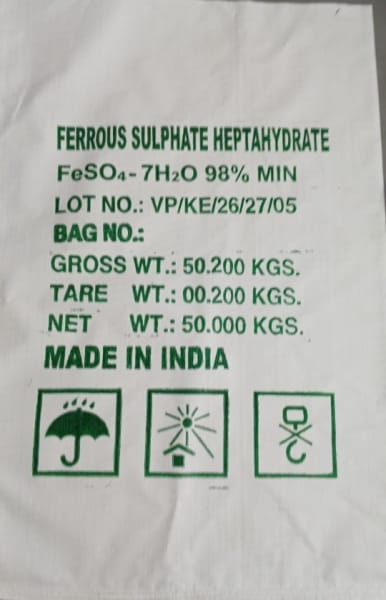
- •Packaging: 50 kg heavy-duty PE-lined bags (Kaiser Exports India, Lot VP/KE/26/27/05) stocked in Nairobi
Primary Use Cases
In East Africa's textile processing mills—centered in Thika, Eldoret, and Nairobi—and commercial tanneries in Athi River, Ferrous Sulphate Heptahydrate 98% Min (historically termed 'copperas' or 'iron vitriol') is an established process auxiliary. Its chemical value lies in the coordination chemistry of bivalent iron, which bonds strongly to natural polyphenolic tannins and textile fiber matrices.
1. Metallic Mordanting in Textile Dyeing
A mordant (from the Latin mordere, 'to bite') is a polyvalent chemical agent that fixes dyes to textile substrates by creating coordination bridges between the dye molecule and fiber polymer chains. Ferrous sulphate is classified as a 'saddening' metallic mordant because its coordination complexes shift dye shades toward darker, muted, and exceptionally lightfast tones (olives, charcoal greys, and deep blacks).
Mordanting Process and Application Guidelines
Dyed textiles are post-mordanted or pre-mordanted in a warm bath (50°C–60°C):
- Dosing Concentration: Typically 1.5% to 3.0% Ferrous Sulphate Heptahydrate on weight of fabric (OWF).
- Fiber Compatibility: Performs exceptionally on protein fibers (wool, silk) and cellulosic fibers (cotton, linen) pre-treated with natural tannins.
- Preventing Fiber Tenderization: Excessive iron concentrations (>4% OWF) or prolonged boiling baths can tenderize natural fibers due to trace acid hydrolysis. Dyebaths should be kept warm rather than boiled, and rinsed thoroughly with mild soap post-mordanting.
2. Leather Tanning and Tannin Shading Chemistry
In vegetable tanning operations utilizing Kenyan acacia/wattle (mimosa) bark extracts or chestnut tannins, hides acquire a natural pale tan or biscuit colour. To produce durable dark brown, grey, or jet black leather for footwear uppers, saddlery, and belts, tanners introduce Ferrous Sulphate Heptahydrate into the retanning drumming cycle:
Fe²⁺ + Polyphenolic Tannins (Wattle) → Insoluble Iron Tannate Complexes↓ (Jet Black)
Bivalent iron complexes with catechol and pyrogallol aromatic hydroxyl groups on the tannin molecules. When exposed to drum aeration, the complex oxidizes into deep black iron-tannate complexes that bond permanently inside the collagen fibril network, producing uniform black through-leather without surface dye bleed.
3. Textile Dye Washwater Decolorization
Textile finishing mills generate effluent with intense residual colour from unfixed reactive, disperse, and direct dyes. In wastewater treatment plants, ferrous sulphate performs a dual decolorization function:
- Chemical Azo Reduction: Fe²⁺ acts as a mild reducing agent that cleaves chromophoric azo bonds (-N=N-), breaking the dye's light-absorbing structure.
- Coagulation Flocculation: Hydrated iron oxidizes into dense ferric hydroxide flocs that physically adsorb and sweep residual dye particles from suspension into secondary clarifier sludge.
KIKI'S Industrial Chemicals supplies certified Ferrous Sulphate Heptahydrate 98% Min in 50 kg heavy-duty woven polypropylene bags with heat-sealed polyethylene inner moisture liners (Net Wt 50.000 kg, Kaiser Exports India, Lot VP/KE/26/27/05, marked NBO) with continuous inventory maintained in Nairobi.
Article Frequently Asked Questions
Related Categories
Related Industries
Related Applications
Chemicals Mentioned in This Guide
Ferrous Sulfate Heptahydrate 98% Min
Ferrous Sulphate Heptahydrate 98% Min (FeSO₄·7H₂O, CAS 7782-63-0) is an industrial-grade iron(II) salt supplied in 50…
CAS 7782-63-0 · Industrial Grade · Crystal

Caustic Soda (Flakes, Pearls) (99% min)
Caustic Soda (Flakes, Pearls) (99% min) supplied by Kiki's Industrial Chemicals Ltd in 25kg bag. Ideal for Textile…
CAS 1310-73-2 · 99% min · Standard Packaging

Ferrous sulphate monohydrate Fe: 30%min 25kg bags Technical Grade for Industrial & Commercial Use (Ferrous sulphate monohydrate Fe: 30%min 25kg bags)
Ferrous sulphate monohydrate Fe: 30%min 25kg bags (Technical Grade) supplied by Kiki's Industrial Chemicals Ltd in 25kg…
Technical Grade · Powder
Related Technical Guides & Insights
View all →Ferrous Sulphate Uses: 50 Applications and Where They Make Commercial Sense
Comprehensive industrial reference categorizing 50 applications of Ferrous Sulphate Heptahydrate across water treatment, agriculture, cement manufacturing, chemical synthesis, and metallurgy in East Africa.
Guides & How-TosFerrous Sulphate Heptahydrate 98%: What Buyers in Kenya Need to Know Before Ordering
A comprehensive procurement guide for industrial chemical buyers in Kenya. Understand the difference between 98% compound purity and elemental iron, packaging standards, COA parameters, and regional sourcing options.