Ferrous Sulphate as a Soil Amendment: Correcting High pH and Alkaline Soils
Chemical and agronomic guide on using Ferrous Sulphate Heptahydrate to acidify alkaline, calcareous, and sodic soils across the Kenyan Rift Valley, unlocking immobilized phosphorus and micronutrients.
Quick Answer — Ferrous Sulphate as a Soil Amendment: Correcting High pH and Alkaline Soils
Ferrous Sulphate Heptahydrate acidifies alkaline and calcareous soils through two sequential chemical reactions: (1) Hydrolysis of dissolved Fe²⁺ in soil water releases hydronium ions: Fe²⁺ + 2H₂O → Fe(OH)₂ + 2H⁺; followed by (2) Microbial and atmospheric oxidation of ferrous hydroxide into ferric hydroxide: 4Fe(OH)₂ + O₂ + 2H₂O → 4Fe(OH)₃. This overall reaction generates two moles of hydrogen ions (H⁺) per mole of ferrous sulphate applied, rapidly neutralizing free carbonate alkalinity, lowering rhizosphere pH from 8.0–8.5 toward the optimal 6.0–6.8 range, and solubilizing tied-up phosphorus, zinc, manganese, and iron.
Soil acidification with ferrous sulphate is a chemical remediation practice used to counteract high soil pH and excess carbonates in agricultural soils, improving nutrient bioavailability.
Key Facts
- •Acidification Stoichiometry: Each mole of FeSO₄ generates 2 moles of H⁺ ions upon complete hydrolysis
- •Rapidity: Acts much faster than elemental sulphur, which requires warm microbial oxidation over months
- •Nutrient Mobilization: Releases tied-up soil phosphorus, manganese, and zinc by dissolving calcium carbonates
- •Application Rates: 200 to 500 kg per hectare for broadcast field incorporation; 20 to 50 g/m² for beds
- •Kenyan Context: Extensively used in alkaline volcanic soils of Nakuru, Naivasha, Baringo, and Kajiado
Primary Use Cases
In agricultural districts throughout the Great Rift Valley of Kenya—encompassing parts of Naivasha, Nakuru, Gilgil, Baringo, and Kajiado—farmers frequently contend with alkaline soils having pH values ranging from 7.8 to 8.6. These soils are often classified as calcareous or sodic, characterized by high concentrations of free calcium carbonate (CaCO₃) and exchangeable sodium. At soil pH levels above 7.5, phosphorus precipitates as insoluble calcium phosphates, and essential cationic micronutrients (iron, manganese, zinc, copper) become tightly immobilized, leading to severe multi-nutrient deficiencies.
Chemical Hydrolysis and Acid Generation
While elemental sulphur is traditionally used for soil acidification, it requires soil temperatures above 20°C and several months of active microbial oxidation by Thiobacillus bacteria before sulphuric acid is produced. Ferrous Sulphate Heptahydrate (FeSO₄·7H₂O), by contrast, acts rapidly via direct chemical hydrolysis:
Step 1 (Hydrolysis): Fe²⁺ + 2H₂O → Fe(OH)₂ + 2H⁺
Step 2 (Oxidation): 4Fe(OH)₂ + O₂ + 2H₂O → 4Fe(OH)₃↓
As demonstrated by the net stoichiometric equation:
4FeSO₄ + O₂ + 10H₂O → 4Fe(OH)₃↓ + 4H₂SO₄
Every mole of ferrous sulphate applied generates one equivalent of sulphuric acid (two moles of H⁺), immediately neutralizing soil carbonate and bicarbonate ions:
2H⁺ + CaCO₃ → Ca²⁺ + H₂O + CO₂↑
This reaction converts insoluble calcium carbonate into soluble calcium ions, improving soil structure while driving rhizosphere pH downward into the bioavailable zone (pH 6.2–6.8).
Application Rates and Soil Buffering Capacity
The exact quantity of Ferrous Sulphate Heptahydrate required depends directly on soil texture and carbonate buffering capacity:
- Sandy to Light Loam Soils (Low Buffering): Apply 150 to 250 kg per hectare (15 to 25 g/m²) to lower soil pH by approximately 0.5 units.
- Clay Loam to Volcanic Soils (High Buffering): Apply 350 to 600 kg per hectare (35 to 60 g/m²) to overcome strong carbonate reserves.
- Orchard Tree In-Furrow Application: Mix 200 g to 500 g with organic compost per tree planting hole during establishment.
Best Management Practices in the Field
For optimal results, broadcast dry ferrous sulphate crystals uniformly across tilled soil, lightly disc or rototill into the top 10–15 cm of the root zone, and apply irrigation immediately. Applying the material alongside organic compost or well-rotted animal manure enhances performance: organic humic and fulvic acids chelate the newly generated Fe²⁺ ions, preventing premature re-precipitation and sustaining prolonged micronutrient availability.
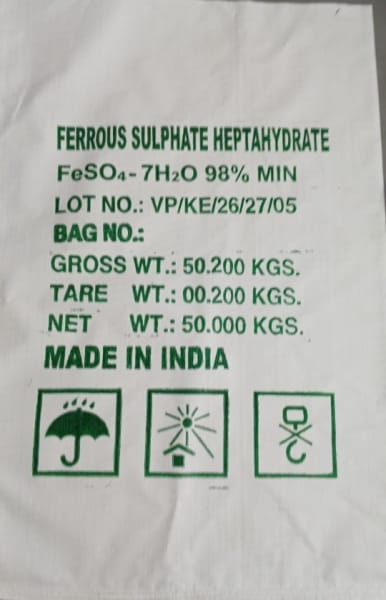
KIKI'S Industrial Chemicals supplies bulk Ferrous Sulphate Heptahydrate 98% Min in 50 kg heavy-duty woven polypropylene bags with heat-sealed polyethylene inner moisture liners (Net Wt 50.000 kg, Kaiser Exports India, Lot VP/KE/26/27/05) from our central warehouse on Enterprise Road, Nairobi.
Article Frequently Asked Questions
Related Categories
Related Industries
Related Applications
Chemicals Mentioned in This Guide
Ferrous Sulfate Heptahydrate 98% Min
Ferrous Sulphate Heptahydrate 98% Min (FeSO₄·7H₂O, CAS 7782-63-0) is an industrial-grade iron(II) salt supplied in 50…
CAS 7782-63-0 · Industrial Grade · Crystal

Ferrous sulphate monohydrate Fe: 30%min 25kg bags Technical Grade for Industrial & Commercial Use (Ferrous sulphate monohydrate Fe: 30%min 25kg bags)
Ferrous sulphate monohydrate Fe: 30%min 25kg bags (Technical Grade) supplied by Kiki's Industrial Chemicals Ltd in 25kg…
Technical Grade · Powder

ABS/LAS 80% for Industrial Use (ABS/LAS)
ABS/LAS (80%) supplied by Kiki's Industrial Chemicals Ltd in 25kg bags across Kenya and East Africa.
Technical Grade · Powder

ATMP (50%)
ATMP (50%) supplied by Kiki's Industrial Chemicals Ltd in 200kg drum. Ideal for Water treatment chemicals.
50% · Standard Packaging
Related Technical Guides & Insights
View all →Ferrous Sulphate Uses: 50 Applications and Where They Make Commercial Sense
Comprehensive industrial reference categorizing 50 applications of Ferrous Sulphate Heptahydrate across water treatment, agriculture, cement manufacturing, chemical synthesis, and metallurgy in East Africa.
Guides & How-TosFerrous Sulphate Heptahydrate 98%: What Buyers in Kenya Need to Know Before Ordering
A comprehensive procurement guide for industrial chemical buyers in Kenya. Understand the difference between 98% compound purity and elemental iron, packaging standards, COA parameters, and regional sourcing options.