Ferrous Sulphate in Cement Manufacturing: Hexavalent Chromium (Cr VI) Reduction
Technical compliance guide for cement plant chemists on using Ferrous Sulphate Heptahydrate to reduce water-soluble hexavalent chromium (Cr VI) below 2 ppm, complying with KS EAS 18-1 and international standards.
Quick Answer — Ferrous Sulphate in Cement Manufacturing: Hexavalent Chromium (Cr VI) Reduction
In Portland cement manufacturing, raw clinker contains trace chromium from kiln raw meals and refractory bricks that oxidizes at 1450°C into toxic, water-soluble hexavalent chromium (Cr VI). Standards including KS EAS 18-1 (Kenya/East African Standard) and European Directive 2003/53/EC strictly mandate that water-soluble Cr(VI) in hydrated cement mortar must not exceed 2 mg/kg (2 ppm) to prevent severe allergic contact dermatitis (cement eczema) among construction workers. Ferrous Sulphate Heptahydrate is dosed into cement clinker grinding ball mills or blending silos at 0.3% to 0.8% by weight (3 to 8 kg per metric ton of cement). When water is added on the construction site, bivalent iron instantly reduces toxic chromate to trivalent chromium: 3Fe²⁺ + CrO₄²⁻ + 8H⁺ → 3Fe³⁺ + Cr³⁺ + 4H₂O, which precipitates permanently as insoluble chromium(III) hydroxide within the alkaline cement matrix.
Chromium reduction in cement is a mandatory regulatory chemical treatment whereby reducing agents convert water-soluble allergenic hexavalent chromium into insoluble, non-hazardous trivalent chromium.
Key Facts
- •Regulatory Limit: Water-soluble Cr(VI) must be < 2.0 ppm (mg/kg) under KS EAS 18-1 and EU 2003/53/EC
- •Health Hazard Prevented: Allergic contact dermatitis and occupational ulcerations among masons
- •Reaction Stoichiometry: 3 moles of Fe²⁺ reduce 1 mole of Cr(VI) to insoluble Cr(III)
- •Dosing Rate: 3 to 8 kg of Ferrous Sulphate Heptahydrate per metric ton of clinker (0.3%–0.8%)
- •Key East African Production Centers: Athi River, Bamburi (Mombasa), Kaloleni, Tororo, and Tanga
Primary Use Cases
In the construction chemistry and cement manufacturing sectors of Kenya and East Africa—centered around major industrial production clusters in Athi River, Bamburi (Mombasa), Kaloleni, and Tororo—controlling soluble hexavalent chromium is both a critical occupational safety priority and a mandatory legal compliance standard. Portland cement clinker produced in rotary kilns at 1450°C contains naturally occurring trace chromium derived from raw limestone, clay, bauxite, and kiln refractory linings. In the highly oxidizing, alkaline kiln atmosphere, a portion of this chromium oxidizes into water-soluble hexavalent chromate (CrO₄²⁻, Cr VI).
The Occupational Health Problem: Cement Eczema
When construction workers, masons, and plasterers mix cement with water on job sites, soluble hexavalent chromium dissolves into the wet mortar pore solution. Because Cr(VI) readily penetrates human skin, it acts as a potent sensitizer and allergen, causing severe chronic allergic contact dermatitis—known throughout the construction industry as 'cement eczema' or chrome dermatitis—as well as deep, painful chemical ulcerations.
Regulatory Standards: KS EAS 18-1 and Global Directives
To protect building workers, international and regional building standards enforce a strict ceiling:
- East African Standard KS EAS 18-1: Adopts regional limits mandating that water-soluble Cr(VI) must not exceed 2.0 mg/kg (2 ppm) of the dry mass of cement when hydrated.
- European Directive 2003/53/EC (transposed into EN 196-10): Prohibits the placing on the market of cement containing more than 2 ppm of soluble Cr(VI).
Redox Chemistry of Chromium Reduction
Ferrous Sulphate Heptahydrate 98% Min is the globally established, most cost-effective reducing agent used by cement plants to achieve compliance. Bivalent iron acts as a targeted three-electron donor:
3Fe²⁺ + CrO₄²⁻ + 4H₂O → 3Fe³⁺ + Cr(OH)₃↓ + 5OH⁻
In the acidic pore environment of the initial reaction, stoichiometric reduction proceeds:
3Fe²⁺ + CrO₄²⁻ + 8H⁺ → 3Fe³⁺ + Cr³⁺ + 4H₂O
Trivalent chromium (Cr³⁺) is non-toxic, non-allergenic, and completely insoluble at cement pore pH (> 12.0), precipitating permanently as chromium hydroxide (Cr(OH)₃) or incorporating stably into hydrated calcium silicate hydrate (C-S-H) and ettringite mineral structures, where it cannot leach onto workers' skin.
Industrial Dosing in Clinker Grinding Circuits
Cement plants introduce dry Ferrous Sulphate Heptahydrate directly into the finish grinding mill circuit alongside gypsum:
- Dosing Point: Ball mill inlet feed chute or vertical roller mill (VRM) weigh feeder.
- Dosing Proportion: Typically 0.3% to 0.8% by weight (3 to 8 kg of FeSO₄·7H₂O per metric ton of cement), depending on raw clinker native Cr(VI) content (typically 5 to 25 ppm).
- Thermal Management: In ball mills, exhaust temperatures should ideally be maintained below 105°C to prevent excessive dehydration of heptahydrate to monohydrate, preserving active reducing capacity.
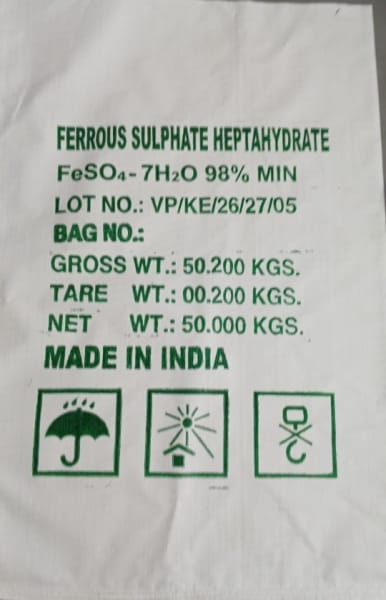
KIKI'S Industrial Chemicals supplies bulk Ferrous Sulphate Heptahydrate 98% Min in 50 kg heavy-duty woven polypropylene bags with heat-sealed polyethylene inner moisture liners (Net Wt 50.000 kg, Gross Wt 50.200 kg, Kaiser Exports India, Lot VP/KE/26/27/05, marked NBO) with continuous inventory maintained in Nairobi for same-day dispatch to cement plants in Athi River and coastal industrial belts.
Article Frequently Asked Questions
Related Categories
Related Industries
Related Applications
Chemicals Mentioned in This Guide
Ferrous Sulfate Heptahydrate 98% Min
Ferrous Sulphate Heptahydrate 98% Min (FeSO₄·7H₂O, CAS 7782-63-0) is an industrial-grade iron(II) salt supplied in 50…
CAS 7782-63-0 · Industrial Grade · Crystal

Ferrous sulphate monohydrate Fe: 30%min 25kg bags Technical Grade for Industrial & Commercial Use (Ferrous sulphate monohydrate Fe: 30%min 25kg bags)
Ferrous sulphate monohydrate Fe: 30%min 25kg bags (Technical Grade) supplied by Kiki's Industrial Chemicals Ltd in 25kg…
Technical Grade · Powder

ABS/LAS 80% for Industrial Use (ABS/LAS)
ABS/LAS (80%) supplied by Kiki's Industrial Chemicals Ltd in 25kg bags across Kenya and East Africa.
Technical Grade · Powder

ATMP (50%)
ATMP (50%) supplied by Kiki's Industrial Chemicals Ltd in 200kg drum. Ideal for Water treatment chemicals.
50% · Standard Packaging
Related Technical Guides & Insights
View all →Ferrous Sulphate Uses: 50 Applications and Where They Make Commercial Sense
Comprehensive industrial reference categorizing 50 applications of Ferrous Sulphate Heptahydrate across water treatment, agriculture, cement manufacturing, chemical synthesis, and metallurgy in East Africa.
Guides & How-TosFerrous Sulphate Heptahydrate 98%: What Buyers in Kenya Need to Know Before Ordering
A comprehensive procurement guide for industrial chemical buyers in Kenya. Understand the difference between 98% compound purity and elemental iron, packaging standards, COA parameters, and regional sourcing options.