Caustic Soda in Kenya: The Definitive Industrial Guide to Flakes, Pearls, and Liquid Lye Across Manufacturing
Complete engineering guide to Caustic Soda (Sodium Hydroxide) in Kenya. Compare 99% flakes, micro-pearls, and 50% liquid across soap, pulp, CIP, and effluent.
Quick Answer: Caustic Soda in Kenya: The Definitive Industrial Guide to Flakes, Pearls, and Liquid Lye Across Manufacturing
Caustic Soda (Sodium Hydroxide, NaOH, CAS 1310-73-2) is Kenya’s most widely consumed industrial alkali, supplied in three primary commercial formats: 99% Flakes (ideal for high-temperature saponification in soap pans), 99% Micro-Pearls (dust-free spherical prills for automated screw dosing and chemical synthesis), and 50% Membrane-Grade Liquid Lye (pre-dissolved solution that eliminates on-site exothermic mixing hazards in beverage CIP and municipal effluent neutralization).
Caustic Soda is a strongly alkaline, highly corrosive inorganic base consisting of sodium cations (Na+) and hydroxide anions (OH-). It is highly soluble in water, produces an intensely exothermic heat of dissolution (-44.5 kJ/mol), and actively hydrolyzes organic fats, proteins, and acidic compounds across industrial manufacturing.
Key Facts
- •Exothermic Hazard: Dissolving dry caustic soda in water generates immense thermal energy; unagitated addition of water onto solid caustic causes flash steam explosions and violent caustic geysers.
- •Hygroscopic Degradation: Dry NaOH absorbs atmospheric water vapor and carbon dioxide (CO2) within hours of exposure, degrading into inactive sodium carbonate (Na2CO3) crust.
- •Packaging Standard: Solid product is shipped in 25kg multi-layer woven polypropylene (PP) bags with internal heat-sealed polyethylene (PE) moisture-barrier liners; liquid lye is transported in road tankers or 1,000L composite IBCs.
- •Primary Consuming Industries in Kenya: Commercial laundry bar and toilet soap manufacturing (45%), dairy and brewery CIP sanitation (25%), industrial effluent and water pH adjustment (15%), and textile mercerizing and pulp processing (15%).
At 7:00 AM on a Tuesday along Commercial Street in Nairobi’s Industrial Area, an eighteen-wheeler flatbed truck reverses into a chemical consolidation depot. Across the bed are twenty shrink-wrapped wooden pallets, each stacked with forty pristine 25kg bags displaying the stark, diamond-shaped Class 8 Corrosive hazard placard.
Inside those bags is the lifeblood of East African manufacturing: Sodium Hydroxide (NaOH), known across every workshop floor and board room simply as Caustic Soda.
By midday, five pallets of 99% Flakes will be offloaded at a legacy soapery in Thika to boil three tonnes of palm fatty acid distillate into laundry bars.
Four pallets of dust-free 99% Micro-Pearls will turn onto the expressway toward an Athi River polymer plant to feed automated chemical synthesis hoppers.
Meanwhile, a dedicated 10,000-litre rubber-lined tanker of 50% Liquid Lye will discharge directly into the automated chemical cellar of a commercial beverage bottling plant off Baba Dogo Road.
No other single chemical raw material touches so many diverse industrial sectors in Kenya. Yet few commodity chemicals generate as much confusion regarding physical grades, dissolution physics, safety liabilities, and pricing disparities. When procurement leads order "Caustic Soda" without specifying flake thickness, iron content, or packaging integrity, production lines stall, operators suffer chemical burns, and process yields plummet.
---
The Chemical Molecule: Identity and Fundamental Properties
Sodium Hydroxide is an inorganic ionic compound consisting of a sodium cation and a hydroxide anion:
NaOH ⇌ Na⁺ + OH⁻ (pH of 1% solution ≈ 13.0–13.5)
It is manufactured globally via the chlor-alkali electrolysis process, where purified aqueous sodium chloride brine (NaCl + H2O) is decomposed using membrane electrolytic cells:
2 NaCl + 2 H2O —[Electricity]→ 2 NaOH + Cl2 ↑ + H2 ↑
The resulting high-purity membrane cell liquor contains approximately 30% to 50% active NaOH, which is either marketed directly as 50% Liquid Caustic Soda or evaporated, melted at 350°C, and mechanically formed into solid Flakes or Micro-Pearls.
---
Physical Formats Compared: Flakes vs. Pearls vs. Liquid Lye
Choosing the wrong physical grade of caustic soda can cost an industrial facility hundreds of thousands of shillings in maintenance downtime and operator sick leave.
| Feature | Caustic Soda 99% Flakes | Caustic Soda 99% Pearls | 50% Liquid Lye (Membrane) |
|---|---|---|---|
| Physical Form | Flat, irregular chips | Uniform spherical beads | Viscous clear solution |
| Average Size | 0.5 – 1.5 mm thick | 0.7 – 1.2 mm diameter | Liquid (Specific Gravity: 1.52) |
| Active Assay | 99.0% NaOH min | 99.0% – 99.5% NaOH min | 48.0% – 50.5% NaOH |
| Flowability | Moderate (prone to caking) | Excellent (pours like sand) | Pumpable liquid |
| Dust Generation | High alkaline dust | Extremely low / Dust-free | Zero dust |
| Dissolution Rate | Rapid in warm water | High in agitated water | Instantaneous dispersion |
| Primary Kenya Application | Soap manufacturing, batch effluent, textile | Automated dosing, dry chemical blending, CIP | Large-scale effluent, dairy CIP, power plants |
1. Caustic Soda 99% Flakes: The Soap Maker's Workhorse
- Why it dominates: Flakes have a high surface-area-to-volume ratio. When tipped into a boiling kettle with agitated hot water, they dissolve with exceptional speed. For batch soap plants in Nairobi, Thika, and Kisumu operating steam-jacketed boiling pans, flakes are the universal standard.
- The drawback: Flakes fracture during manual transit and handling, producing sharp, irritating alkaline dust that inflames respiratory tracts and burns skin if operators lack full PPE. If stored in humid environments, flakes stick together and form rock-hard slabs inside the bags.
2. Caustic Soda 99% Micro-Pearls: The Engineering Choice
- Why it dominates: Manufactured by spraying molten anhydrous NaOH down a cooling tower (prilling), pearls are uniform, dense, spherical granules. They pour smoothly like dry beach sand, generating virtually zero airborne dust.
- The engineering advantage: Pearls will not bridge or jam inside automated hopper cones, screw feeders, or chemical pneumatic conveying lines. For dry-blended cleaning chemical manufacturers and facilities prioritizing modern occupational health (DOSHS compliance), pearls are the premium benchmark.
3. 50% Membrane Liquid Lye: Zero-Dissolution Efficiency
- Why it dominates: Eliminates the physical labor, dust inhalation hazards, and dangerous exothermic heat spikes associated with dissolving solid dry bags on site. It can be metered directly into process lines using electronic diaphragm dosing pumps.
- The logistical requirement: Because liquid lye contains 50% water, buyers pay freight on water. It requires dedicated bulk chemical storage (carbon steel or cross-linked high-density polyethylene tanks) fitted with secondary containment bunds and heated trace lines during cold Nairobi mornings (50% NaOH freezes at 12°C–14°C!).
---
Major Industrial Applications Across Kenya
Our commercial manufacturing clients across Nairobi, Thika, and Athi River rely on Kiki's Industrial Chemicals to maintain continuous buffer stocks of both 99% flakes and micro-pearls, ensuring high-volume soap lines and CIP operations never face downtime during regional port delays.
1. Commercial Soap Manufacturing (Saponification)
The primary industrial consumption of caustic soda in Kenya remains soap production. In hot-process soap kettles, caustic soda cleaves triglyceride molecules derived from crude palm oil, palm fatty acid distillate (PFAD), or tallow into sodium carboxylate soaps:
Triglyceride + 3 NaOH —[Δ]→ Glycerol + 3 R-COONa (Soap)
(C57H104O6 + 3 NaOH → C3H5(OH)3 + 3 C17H33COONa)
- Stoichiometric Precision: Soap formulators must calculate the exact Saponification Value (SAP value). Under-dosing caustic leaves unreacted free fat that turns the soap bar soft and rancid within weeks. Over-dosing leaves dangerous unreacted free caustic (> 0.05% free alkali), causing severe skin irritation to consumers and violating KEBS KS EAS 31:2013.
2. Clean-In-Place (CIP) in Dairy & Beverage Plants
- In creameries across Naivasha, Nakuru, and Eldoret, and beverage bottling plants in Nairobi, 1.5% to 2.0% caustic soda solutions are circulated at 75°C to clean stainless steel pasteurizers, pipes, and fermenters.
- Caustic hydrolyzes stubborn whey proteins and saponifies butterfats into soluble soaps that flush down the drain.
3. Effluent Treatment Plants (ETP) & Heavy Metal Precipitation
- Textile mills, electroplating workshops, and battery recyclers generate acidic effluent with a pH between 1.0 and 3.0. Under NEMA standards, water cannot be discharged into public sewers or rivers below pH 6.5 or above pH 8.5.
- Dosing caustic soda rapidly neutralizes sulfuric, hydrochloric, or nitric acids:
- H2SO4 + 2 NaOH → Na2SO4 + 2 H2O
- Furthermore, caustic precipitates toxic dissolved heavy metals as insoluble metal hydroxides that can be coagulated and filtered:
- Cu²⁺ + 2 OH⁻ → Cu(OH)2 ↓ (Blue Insoluble Sludge)
4. Cotton Mercerization (Textile Mills in Athi River EPZ)
- When raw woven cotton yarn is bathed in concentrated caustic soda (20% to 25% NaOH) under mechanical tension at room temperature, the flat, twisted cellulose fibers swell and transform into round, smooth cylinders.
- Mercerized cotton exhibits a lustrous, silk-like sheen, 25% higher tensile strength, and dramatically improved dye absorption, making it a cornerstone process for apparel manufacturers targeting US and European export markets under AGOA.
---
Thermodynamic Reality: The Dangerous Exotherm of Dissolution
The single greatest safety error made by factory floor operators in Kenya is failing to respect the heat of solution of Sodium Hydroxide.
When solid NaOH dissolves in water, the crystal lattice breaks apart and the ions become strongly hydrated, releasing immense thermodynamic heat:
NaOH_{(s)} —[H2O]→ Na⁺_{(aq)} + OH⁻_{(aq)} (Δ H = -44.5 kJ/mol)
To put this in perspective: if an operator dumps four 25kg bags (100 kg) of caustic flakes into a 200-litre uncooled plastic drum of water without rapid mechanical agitation:
- The water temperature will surge from ambient (20°C) to over 95°C in less than 4 minutes.
- If water is poured onto a pile of solid flakes, the localized water instantly flashes into steam.
- The expanding steam ejects boiling, concentrated, 50% caustic liquid into the air—a catastrophic event known in chemical plants as a caustic thermal geyser.
THE GOLDEN DISSOLUTION RULE:
ALWAYS ADD SOLID CAUSTIC SODA SLOWLY INTO A LARGE VOLUME OF COLD WATER UNDER CONTINUOUS MECHANICAL AGITATION.
NEVER POUR WATER ONTO SOLID CAUSTIC SODA.
---
Storage, Handling & Chemical Degradation in Kenyan Warehouses
1. Atmospheric Carbonation (Deliquescence)
Solid Sodium Hydroxide is intensely hygroscopic and deliquescent. It has such a strong affinity for water that if a bag has a pinhole leak, the flakes will pull moisture directly out of Nairobi’s air and dissolve into a puddle.
Simultaneously, the caustic reacts with atmospheric carbon dioxide (CO2):
2 NaOH_{(s)} + CO2(g)} → Na2CO3(s)} + H2O
This converts active, valuable sodium hydroxide into inactive Sodium Carbonate (Soda Ash), visible as a hard, chalky white crust inside damaged bags. Always reject bags that feel hard, compacted, or crusted.
2. Warehouse Pallet Hygiene
- Never store caustic soda bags directly on concrete floors. Rising ground dampness will penetrate the outer polypropylene weave.
- Stack bags maximum two pallets high on sound wooden or plastic skids raised at least 15 cm off the floor.
- Keep caustic soda segregated from mineral acids (Hydrochloric, Sulfuric, Nitric) by a physical firewall or dedicated distance. A breach of both containers on the same warehouse floor causes an explosive neutralization reaction with boiling acid spatter.
---
Technical Sourcing Specifications: What to Demand on the COA
When procuring bulk Caustic Soda in East Africa, your technical procurement team should verify:
| Specification Parameter | Test Standard | Flakes (Membrane Grade) | Pearls (Prilled Grade) | 50% Liquid Lye |
|---|---|---|---|---|
| Sodium Hydroxide (Assay) | Acid-Base Titration | ≥ 99.0% | ≥ 99.5% | 49.0% – 50.5% |
| Sodium Carbonate (Na2CO3) | Volumetric Gas/Titration | ≤ 0.4% | ≤ 0.3% | ≤ 0.2% |
| Sodium Chloride (NaCl) | Argentometric Titration | ≤ 0.02% (200 ppm) | ≤ 0.015% (150 ppm) | ≤ 0.01% |
| Iron Content (Fe) | Spectrophotometric | ≤ 5 ppm | ≤ 3 ppm | ≤ 4 ppm |
| Sulphates (SO4) | Turbidimetric | ≤ 0.01% | ≤ 0.008% | ≤ 0.005% |
| Packaging Specification | Physical Standard | 25kg multi-layer woven PP + PE inner liner | 25kg PE/PP valve bags with moisture seal | 1000L IBC / Dedicated road tanker |
Why does Iron (Fe) matter? High iron content (> 15 ppm) turns caustic solutions pale yellow or brown, ruining the color of white toilet soap and staining textiles during mercerization.
The 20 pallets on the truck along Commercial Street are cleared by 9:30 AM. In Thika, the soap pans are loaded; in Athi River, the screw hoppers run smoothly; and in Baba Dogo, the liquid lye line operates without a single cloud of dust.
---
Need immediate delivery of certified Caustic Soda 99% Flakes, Micro-Pearls, or 50% Liquid Lye to Nairobi, Thika, Athi River, or Mombasa? Request a competitive bulk quotation from Kiki's Industrial Chemicals.
Article Frequently Asked Questions
Chemicals Mentioned in This Guide
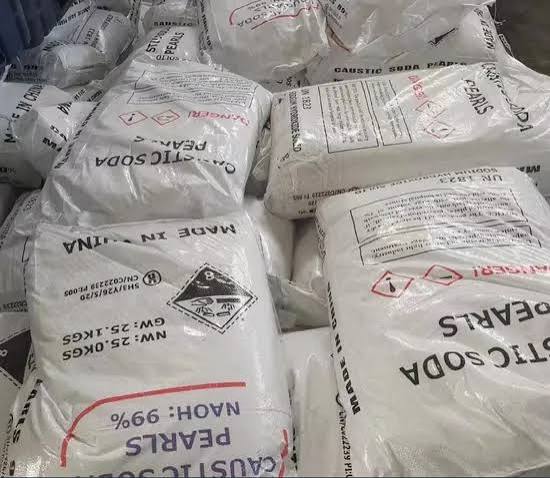
Caustic Soda Flakes /Pearls
Caustic Soda Flakes /Pearls (98.5/99% min) supplied by Kiki's Industrial Chemicals Ltd in 25kg bag. Ideal for Pulp &…
CAS 1310-73-2 · 98.5/99% min · Standard Packaging

Hydrochloric Acid ( Muriatic Acid 31% - 35% )
Hydrochloric Acid ( Muriatic Acid 31% - 35% ) (Tech Grade Pickling & pH Control) supplied by Kiki's Industrial…
Tech Grade Pickling & pH Control · Standard Packaging
Soda Ash Dense / Light
Mild alkaline powder used for water softening, glass manufacturing, detergent blending and gentle pH adjustment.
CAS 497-19-8 · Industrial Grade · Powder

Potassium Hydroxide ( Caustic Potash Flakes 90% min )
Potassium Hydroxide ( Caustic Potash Flakes 90% min ) (Tech / Soap Grade) supplied by Kiki's Industrial Chemicals Ltd…
Tech / Soap Grade · Standard Packaging
Related Technical Guides & Insights
View all →Understanding Chemical Safety Data Sheets (SDS) & KEBS Regulatory Compliance in Kenya
How to read GHS 16-section Safety Data Sheets (SDS) and ensure KEBS, NEMA, and DOSHS statutory chemical compliance in Kenyan industrial facilities.
Guides & How-TosCalcium Carbonate (Limestone Powder): Grade Selection for Animal Feed, Paints & PVC Compounds
How to select Calcium Carbonate mesh grades in Kenya for animal feed (80-120 mesh), paint extender (325-400 mesh), and coated PVC filler (800-1250 mesh).
Industrial ApplicationsHydrogen Peroxide 50%: Industrial Bleaching, Oxidizing & Eco-Friendly Sanitation Applications
Technical guide to Hydrogen Peroxide 50% in Kenya. Industrial cotton bleaching, aseptic beverage packaging, effluent treatment, storage, and safety.