Hydrogen Peroxide 50%: Industrial Bleaching, Oxidizing & Eco-Friendly Sanitation Applications
Technical guide to Hydrogen Peroxide 50% in Kenya. Industrial cotton bleaching, aseptic beverage packaging, effluent treatment, storage, and safety.
Quick Answer — Hydrogen Peroxide 50%: Industrial Bleaching, Oxidizing & Eco-Friendly Sanitation Applications
Hydrogen Peroxide 50% (H2O2, CAS 7722-84-1) is a powerful, chlorine-free industrial oxidizing agent utilized in Kenya for three major applications: (1) Continuous textile bleaching of natural cotton and knitted fabrics in Thika and Nairobi, (2) Vaporized sterilant for aseptic beverage and dairy packaging cartons, and (3) Advanced oxidation and cyanide detoxification in industrial effluent and gold mining extraction. It is prized for decomposing into completely harmless byproducts: pure water (H2O) and oxygen gas (O2).
Hydrogen Peroxide 50% is a concentrated, clear aqueous solution of hydrogen peroxide stabilized with trace phosphonates to prevent premature catalytic decomposition during storage and transport.
Key Facts
- •Hydrogen Peroxide is an eco-friendly oxidant that generates zero Absorbable Organic Halogens (AOX) or toxic chlorinated byproduct residues in effluent discharges.
- •Contact with transition metals (iron, copper, brass, manganese) or organic dust causes rapid, autocatalytic exothermic decomposition, generating intense oxygen pressure and steam.
- •Commercial 50% H2O2 drums and IBC containers must always be equipped with special breathable microporous pressure-relief vented caps.
Across East Africa's industrial landscape, from the large textile spinning and weaving mills in Thika to modern aseptic juice packaging facilities in Nairobi and mineral recovery sites in Western Kenya, Hydrogen Peroxide 50% (H_2O_2) is the oxidant of choice.
What makes Hydrogen Peroxide unique in the chemical world is its clean environmental chemistry.
When chlorine-based oxidizers (such as chlorine gas or sodium hypochlorite) complete their reaction, they leave behind corrosive chloride salts, chlorinated phenols, and hazardous absorbable organic halides (AOX) in factory wastewater.
When Hydrogen Peroxide completes its oxidizing reaction, it breaks down into only two substances: pure water (H_2O) and oxygen gas (O_2).
$$2H_2O_2 \xrightarrow{Oxidation} 2H_2O + O_2 \uparrow$$
---
1. Key Industrial Applications in Kenya & East Africa
A. Textile Pre-Treatment & Cotton Fabric Bleaching
In textile manufacturing, raw natural cotton contains natural yellow-brown pectin, waxes, and seed shell motes.
- Combined Scouring & Bleaching: In modern mills, hydrogen peroxide operates under alkaline conditions (pH 10.5–11.5 using Caustic Soda) at 85°C–95°C alongside specialty organic stabilizers (such as sodium silicate or phosphonates).
- The Advantage: Provides a brilliant, permanent white base with excellent wettability, ready for vibrant reactive dyeing, without causing the fiber brittleness associated with hypochlorite bleaching.
B. Aseptic Beverage & Dairy Packaging Sterilization
High-speed automated carton filling lines (such as aseptic juice, long-life milk, and drinking yogurt packaging) utilize specialized food-grade hydrogen peroxide.
Mechanism: Packaging laminate foil passes through a heated 35%–50% H₂O₂ bath at 70°C, followed by sterile air drying.
Result: Achieves complete 6-log destruction of resistant bacterial spores (Bacillus subtilis) in under 3 seconds, leaving zero toxic chemical residues inside the food container.
C. Advanced Effluent Oxidation & Cyanide Destruction
Wastewater Treatment: Destroys persistent organic pollutants, phenols, and color pigments through Fenton's reaction (H₂O₂ + Fe²⁺ \to · OH), creating ultra-reactive hydroxyl radicals.
Mining Industry: Gold recovery facilities utilize hydrogen peroxide (the Degussa process) to rapidly oxidize toxic cyanides (CN⁻) in tailings slurries into harmless cyanate (OCN⁻) and carbonate:
CN⁻ + H₂O₂ → OCN⁻ + H₂O
---
2. Technical Grade Classifications
Specification — Technical Industrial Grade — Aseptic Food / Packaging Grade
H_2O_2 Concentration ($w/w$) — 50.0% – 51.5% — 35.0% – 50.0%
Appearance — Clear, colorless liquid — Water-white, sparkling clear
Density (at 20°C) — $1.196 - 1.200 g/cm^3$ — $1.196 - 1.200 g/cm^3$
Non-Volatile Residue — $< 0.10%$ — $< 0.005%$ (Ultra-low residue)
Heavy Metals (as Pb) — $< 10 ppm$ — $< 1 ppm$
Stability (100°C, 24h) — $ge 97.0%$ retention — $ge 98.5%$ retention
Primary Use Cases — Textiles, wastewater, paper, mining — Dairy/Juice packaging lines, food sanitization
---
3. Storage Compatibility & The "Vented Cap" Rule
Concentrated 50% Hydrogen Peroxide is a Class 5.1 Oxidizer (UN 2014). It does not burn on its own, but releases massive amounts of pure oxygen gas that can accelerate any surrounding fire into an uncontrollable blaze.
The Catalytic Contamination Hazard:
Hydrogen peroxide is chemically stable when pure and stored in approved containers. However, contact with even microscopic traces of catalytic contaminants (iron rust, copper, brass, manganese, dirt, or organic grease) triggers rapid, runaway exothermic decomposition:
$$Runaway Decomposition \Longrightarrow Intense Heat (100^circC+) + Steam + Oxygen Gas Overpressure$$
Critical Storage Rules:
1. Always Maintain Breathable Vented Caps: All drums (30kg/250kg) and 1000L IBC totes are equipped with specialized microporous membrane caps. Never replace a vented cap with a standard solid plug, as natural oxygen off-gassing will over-pressurize and rupture the container.
2. Approved Materials of Construction: High-Density Polyethylene (HDPE), Ultra-High Molecular Weight Polyethylene (UHMWPE), PTFE, and passivated 316L Stainless Steel.
3. Strictly Prohibited Materials: Mild carbon steel, copper, bronze, brass, zinc, and standard natural rubber hoses.
4. Dedicated Transfer Equipment: Never use a chemical transfer pump or bucket that has been previously used for other chemicals. Once a foreign molecule enters a peroxide container, runaway decomposition can begin within hours.
---
4. Operational Handling & Worker Safety
- Concentrated 50% Hydrogen Peroxide is a strong skin oxidizer and severe eye hazard.
- Skin Contact: Causes immediate white bleaching of the skin (transient epidermal oxygen bubbling) accompanied by sharp stinging. Wash immediately with copious running water for 15 minutes.
- Required PPE: Chemical splash goggles, full-face protective shield, heavy neoprene/PVC chemical gauntlet gloves, rubber boots, and chemical apron.
- Emergency Fire Response: In case of adjacent fire, deluge with vast volumes of water. Do not use chemical powder or carbon dioxide extinguishers alone, as peroxide supplies its own continuous stream of oxygen to the fire.
---
5. Summary: Precision Oxidizing for Modern Industry
Hydrogen Peroxide 50% combines powerful oxidizing strength with the cleanest environmental footprint of any industrial chemical.
Keep containers sealed with their factory vented caps, store them away from heat sources and combustible organics in a dedicated bunded store, and use clean, dedicated HDPE dispensing equipment.
Article Frequently Asked Questions
Chemicals Mentioned in This Guide
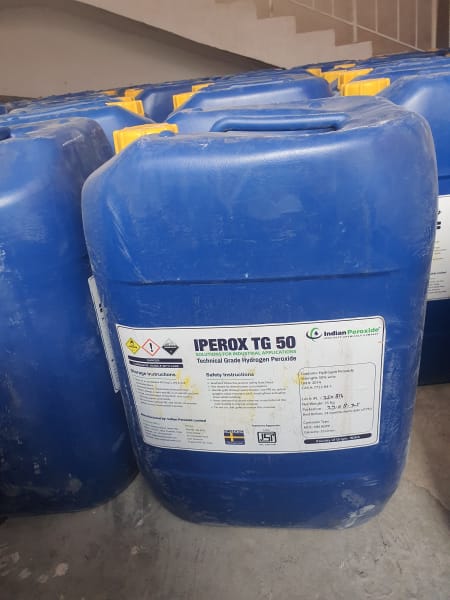
Hydrogen Peroxide 50% Solution (Textile Bleaching Peroxide)
Industrial-grade Hydrogen Peroxide 50% solution for textile bleaching, effluent water treatment, disinfection, and…
CAS 7722-84-1 · Technical Grade · Liquid

Caustic Soda (Flakes, Pearls) (99% min)
Caustic Soda (Flakes, Pearls) (99% min) supplied by Kiki's Industrial Chemicals Ltd in 25kg bag. Ideal for Textile…
CAS 1310-73-2 · 99% min · Standard Packaging

Sodium Hypochlorite ( Liquid Chlorine 10% - 15% ) (Water Bleaching & Disinfection)
Sodium Hypochlorite ( Liquid Chlorine 10% - 15% ) (Water Bleaching & Disinfection) supplied by Kiki's Industrial…
Water Bleaching & Disinfection · Standard Packaging

Sulfuric Acid ( Sulphuric Acid 98% ) (Tech / Battery Grade 98% min)
Sulfuric Acid ( Sulphuric Acid 98% ) (Tech / Battery Grade 98% min) supplied by Kiki's Industrial Chemicals Ltd in 35kg…
CAS 7664-93-9 · Technical Grade · Liquid
Related Technical Guides & Insights
View all →Industrial Hydrochloric Acid (HCl 33%): Applications, Steel Pickling, Water Treatment & Sourcing
Technical guide to Industrial Hydrochloric Acid (HCl 33%) in Kenya. Sourcing specifications, steel pickling chemistry, pH adjustment, storage, and safety.
Cleaning & SanitationCIP Chemicals in Kenya: The Clean-In-Place Protocol That Stops Milk Spoilage Before It Starts
Master dairy and beverage CIP chemical protocols in Kenya. Formulate 1.5-2.0% caustic wash, 1.0% nitric acid descaling, and PAA sanitation to eliminate milkstone and spoilage bacteria.
Water TreatmentPotable Water Disinfection: Calcium Hypochlorite vs Sodium Hypochlorite vs TCCA 90
Compare Calcium Hypochlorite 65-70%, Sodium Hypochlorite 10-15%, and TCCA 90 tablets for potable water chlorination, food plants, and commercial treatment in Kenya.