Buying Acetone in Bulk vs 20-Litre Packs: A Practical Procurement Guide
Evaluate unit price, handling ergonomics, decanting losses, capital lockup, and warehouse fire insurance limits when choosing between 20L jerrycans and 160kg bulk drums of acetone.

Quick Answer — Buying Acetone in Bulk vs 20-Litre Packs: A Practical Procurement Guide
When procuring acetone for Kenyan manufacturing, choosing between 20-litre HDPE containers and 160kg bulk steel drums depends on monthly consumption volume, site material handling equipment, and decanting infrastructure. While 160kg drums offer a lower nominal price per kilogram, 20-litre packs eliminate the need for forklift trucks, rotary drum pumps, and drum bunds, while drastically reducing evaporative decanting losses and workplace vapour release. Facilities consuming under 400 litres monthly typically achieve lower total cost of ownership using 20-litre containers.
Acetone (propan-2-one, CAS 67-64-1, UN 1090) is an industrial ketone solvent supplied across Kenya by KIKI'S Industrial Chemicals Ltd in 20L HDPE jerrycans and 160kg steel drums.
Key Facts
- •Handling Ergonomics: A 20-litre pack weighs approximately 17.1 kg gross, enabling safe single-operator transport without mechanical hoists or forklift trucks.
- •Evaporative Decanting Losses: Decanting from 200L drums in warm climates without vapour-recovery pumps can lose 3% to 7% of product to ambient evaporation.
- •Insurance and Storage Caps: Commercial warehouse fire policies often restrict Class 3 flammable liquids to small quantities unless equipped with dedicated foam suppression.
- •Working Capital Agility: 20-litre packs allow precise inventory management and shorter reorder cycles, freeing cash flow compared to multi-drum stocking.
Primary Use Cases
For procurement officers and factory owners across Nairobi, Kisumu, Eldoret, and Mombasa, the purchase order for industrial solvents usually comes down to a straightforward comparison: price per unit. When looking at acetone quotations, a 160kg steel drum invariably displays a lower unit price per kilogram than eight individual 20-litre jerrycans.
However, savvy procurement professionals evaluate total cost of ownership (TCO) rather than raw invoice price alone. When you account for the hidden costs of drum decanting losses, forklift operational expenses, manual handling injuries, and insurance compliance, smaller 20-litre containers frequently emerge as the more profitable, flexible choice.
Physical Specifications: 20L Pack vs 160kg Drum
Understanding the exact physical dimensions and weights helps procurement teams match chemical packaging to their floor logistics:
- 20-Litre Heavy-Duty HDPE Pack (KIC-SOL-012): Contains 20 litres of liquid chemical. With an acetone density of approximately 0.791 g/mL at 20°C, the net liquid weight is 15.82 kg. Adding the heavy-duty container tare weight (~1.3 kg), the total gross weight is approximately 17.1 kg. Equipped with a molded carry handle and anti-surge ribs, a single operator can lift and pour safely.
- 160kg Net Steel Drum (KIC-SOL-009): Contains approximately 202.2 litres of liquid acetone. Gross weight with the heavy steel drum shell is approximately 178 to 182 kg. Moving this container requires heavy drum trolleys, forklift attachments, or overhead hoists.
Hidden Operational Costs of Bulk Drum Handling
When a factory purchases 160kg drums of acetone, several secondary expenses inevitably arise:
Evaporative Product Loss: Acetone has an exceptionally high vapour pressure (24 kPa at 20°C) and boils at 56°C. Every time a 2-inch drum bung is opened to insert a manual siphon pump, a rush of saturated solvent vapour escapes. In hot workshops, factories lose between 5 and 15 litres of acetone per drum simply through ambient evaporation and pump drips during shift transfers.
Spill Risks and Equipment Requirements: Tipping or decanting from a 180kg drum without dedicated drum cradles and earthing lines invites spill incidents. Storing drums requires certified secondary containment pallets that occupy significant floor space.
Residual Drum Heel: Mechanical pumps rarely reach the very bottom corner of a horizontal or vertical steel drum. Typically, 2 to 4 litres of chemical remain trapped in the bottom heel of every empty drum, which is discarded with the empty container.
When 20-Litre Packs Deliver Maximum ROI
The 20-litre container is the optimal commercial choice under the following operating conditions:
- Multi-Station Workshops: If solvent is used across multiple assembly benches or maintenance stations, distributing separate 20L containers directly to work cells eliminates hazardous internal chemical transport across the shop floor.
- Facilities Without Forklifts: Small to medium enterprises (SMEs) can offload and stage 20L jerrycans by hand, avoiding costly pallet jack or forklift rentals during delivery.
- Modest Monthly Volume: Workshops using between 40 and 400 litres per month avoid tying up significant working capital in bulk inventory that sits evaporating in storage.
- Direct Pour Precision: Fitted with dedicated pour spouts, 20L jerrycans allow precise liquid transfer into cleaning baths or spray canisters without spillage.
When Bulk Drums Make Economic Sense
Conversely, bulk 160kg drums represent the best commercial procurement strategy when:
Monthly consumption exceeds 600 to 1,000 litres, your facility features closed automated fluid transfer piping with permanent conductive grounding, and your chemical warehouse possesses full fire-suppression sprinklers and certified drum bunding.
Supply Chain Flexibility: KIKI'S Industrial Chemicals supports Kenyan industry across every scale of production. We maintain deep inventory of both 20-litre heavy-duty HDPE packs (SKU KIC-SOL-012) and 160kg sealed steel drums (SKU KIC-SOL-009) for immediate collection or dispatch from our Nairobi central warehouse.
Article Frequently Asked Questions
Related Categories
Chemicals Mentioned in This Guide
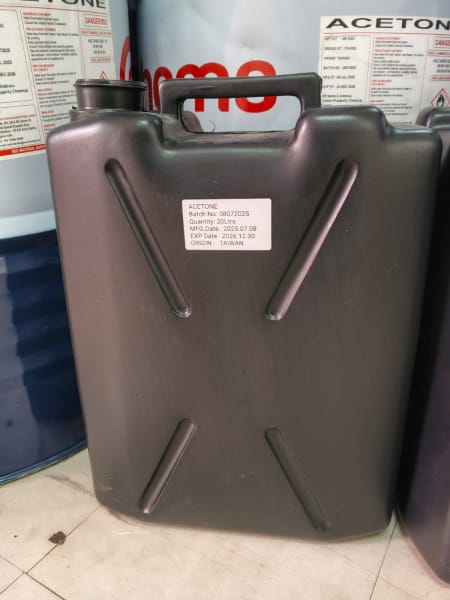
Acetone 20 Litres for Industrial and Commercial Use in Kenya
Industrial-grade Acetone in a convenient 20-litre heavy-duty HDPE jerrycan (99.5% min assay, CAS 67-64-1, UN 1090).…
CAS 67-64-1 · Industrial Solvent Grade (Virgin High-Purity) · Clear colourless volatile liquid
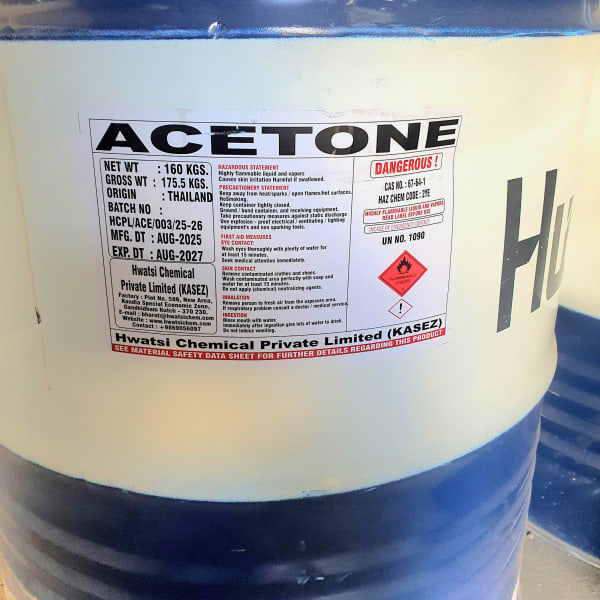
Acetone Industrial Solvent (Bulk 160kg Drums & Multi-Pack Supply)
High-purity virgin Acetone solvent (99.5% min assay, CAS 67-64-1, UN 1090) supplied in 160kg steel drums, 1,000L IBCs,…
CAS 67-64-1 · Industrial Solvent Grade (Virgin High-Purity) · Clear Colorless Volatile Liquid

ABS/LAS 80% for Industrial Use (ABS/LAS)
ABS/LAS (80%) supplied by Kiki's Industrial Chemicals Ltd in 25kg bags across Kenya and East Africa.
Technical Grade · Powder

ATMP (50%)
ATMP (50%) supplied by Kiki's Industrial Chemicals Ltd in 200kg drum. Ideal for Water treatment chemicals.
50% · Standard Packaging
Related Technical Guides & Insights
View all →What Is Acetone? Properties, Uses and Industrial Applications in Kenya
A comprehensive technical guide to acetone (propan-2-one, CAS 67-64-1): molecular structure, physical properties, solvency parameters, industrial applications, and procurement considerations for Kenyan manufacturers.
Buying GuideWhere to Buy Acetone in Nairobi, Kenya: A Practical Buyer's Guide
A practical procurement guide for sourcing industrial acetone in Nairobi, Kenya. Learn what specifications to verify, how to avoid contaminated recycled solvents, and how to evaluate suppliers.
Buying GuideAcetone 20 Litres: Who Needs This Pack Size and How to Order It in Kenya
Discover why the 20-litre acetone jerrycan is the preferred packaging for workshops, composite laminators, and maintenance teams in Kenya. Compare volume versus mass and learn how to order.
Industrial ApplicationsUsing Acetone for Fibreglass and Polyester Resin Tool Cleanup
Learn how to use industrial acetone safely and effectively for cleaning uncured polyester, vinyl ester, and gelcoat resins from fibreglass laminating tools, rollers, and spray equipment.