Acetone in Paints and Coatings: Uses, Formulation Compatibility and Precautions
Explore the role of acetone in paint formulation, lacquer thinning, spray equipment flushing, and VOC management for Kenyan coating manufacturers and professional finishers.

Quick Answer — Acetone in Paints and Coatings: Uses, Formulation Compatibility and Precautions
In the paint and coatings industry, acetone serves as a powerful, fast-evaporating active solvent and equipment cleaner. It exhibits exceptional solvency for nitrocellulose, acrylics, epoxies, and polyester resins, sharply reducing formulation viscosity without adding excessive volume. However, because of its rapid flash-off (boiling point 56.05°C), formulators must blend acetone with medium and slow-evaporating solvents (such as butyl acetate, glycol ethers, and xylene) to prevent paint blushing, pinholing, and orange peel defects under high humidity.
Acetone (propan-2-one, CAS 67-64-1, UN 1090) is an industrial ketone solvent supplied across Kenya by KIKI'S Industrial Chemicals Ltd in 20L HDPE jerrycans and 160kg steel drums.
Key Facts
- •High Active Solvency: Hansen solubility parameters enable acetone to dissolve stubborn synthetic resins, chlorinated rubber, and nitrocellulose polymers.
- •Viscosity Reduction: Efficiently cuts high-solid resins to sprayable viscosity with minimal solvent volume, aiding VOC reduction programs.
- •Blush Prevention: Fast evaporative chilling requires careful solvent balancing with slower tail-solvents during warm, humid weather.
- •Equipment Flushing: The premier solvent for clearing hardened paint lines, automated spray nozzles, and fluid delivery manifolds.
Primary Use Cases
The paint and coating manufacturing sector in Kenya, centered around industrial hubs in Nairobi, Ruiru, and Mombasa, produces decorative emulsions, automotive refinishes, industrial wood lacquers, and heavy-duty protective marine coatings. In this diverse sector, solvent selection directly determines product flow, leveling, drying time, film strength, and final surface gloss.
Acetone occupies a unique position in coating formulation chemistry: it delivers maximum resin solvency with an exceptionally fast evaporation profile. Understanding how to harness its power while avoiding application defects is vital for paint chemists and finishing professionals alike.
Acetone's Role as an Active Solvent in Coatings
Solvents in paint formulations are classified as active solvents, latent solvents (co-solvents), and diluents. Acetone functions predominantly as a true active solvent for many binder chemistries:
- Nitrocellulose Wood Lacquers: Acetone rapidly dissolves nitrocellulose ester polymers, allowing rapid drying on furniture production lines.
- Acrylic Resins: Thermoplastic and thermoset acrylic binders dissolve readily in acetone, yielding crystal-clear solutions with low solution viscosity.
- Epoxy Primers and Topcoats: Acetone dissolves both liquid bisphenol-A epoxy resins and polyamine curing agents prior to chemical cure.
- Unsaturated Polyester Gelcoats: Acts as a primary viscosity modifier and thinning agent for gelcoat repairs and laminating sprays.
The Evaporation Balance: Why Solvent Blending is Essential
A coating formulated exclusively with acetone would dry too fast to allow proper film leveling. As the atomized spray droplet travels from the spray gun nozzle to the substrate, a large portion of the acetone flashes off in mid-air. When the paint hits the surface, there is insufficient wet time for the droplets to flow together into a smooth, mirror-like film, creating a rough texture known as orange peel.
Furthermore, rapid acetone evaporation cools the wet paint film below the ambient dew point. In humid environments, water droplets condense directly into the wet lacquer. As the water becomes trapped within the drying polymer matrix, it causes a milky, opaque haze called blushing.
Formulation Principle: Paint chemists balance acetone's high flash-off speed by blending it with medium-boiling esters (like n-butyl acetate) and slow-evaporating glycol ethers (like butyl glycol / 2-butoxyethanol). The acetone provides immediate atomization viscosity, while the slower tail solvents ensure flow, leveling, and blush-free cure.
Cleaning and Flushing Industrial Spray Equipment
Beyond active paint formulation, acetone is the premier flushing and purge solvent for paint shops. When changing colours on an automated finishing line or shutting down a manual HVLP spray gun, flushing with acetone achieves three critical objectives:
- Rapid Binder Liquefaction: It cuts through drying paint films on the fluid needle, air cap, and internal fluid passages before polymer cross-linking sets.
- Residue-Free Dry: Because it flashes off completely in minutes, no oily solvent residues remain inside the fluid passages to contaminate the next batch of paint.
- Prevention of Color Cross-Contamination: High solvent power clears dark pigments and heavy metallics cleanly from fluid lines, preventing ghosting in subsequent light-coloured coats.
Safety Protocols in Paint Spray Booths
Because of acetone's low flash point of -18°C and wide flammable range (2.5% to 12.8%), spray booth operations must enforce rigorous fire prevention measures:
All electrical fittings, ventilation motors, and booth lighting must carry ATEX or explosion-proof certifications. Operators must bond and ground paint spray pressure pots and conductive hoses to prevent static discharge sparks. Personnel must wear organic vapour cartridge respirators and eye protection to prevent corneal chemical burns from accidental solvent splash.
Article Frequently Asked Questions
Related Categories
Chemicals Mentioned in This Guide
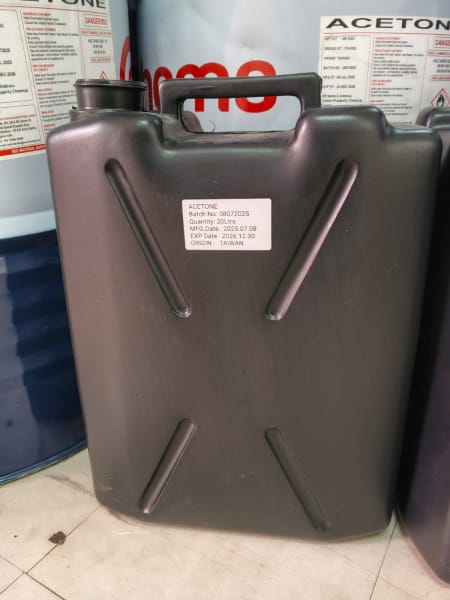
Acetone 20 Litres for Industrial and Commercial Use in Kenya
Industrial-grade Acetone in a convenient 20-litre heavy-duty HDPE jerrycan (99.5% min assay, CAS 67-64-1, UN 1090).…
CAS 67-64-1 · Industrial Solvent Grade (Virgin High-Purity) · Clear colourless volatile liquid
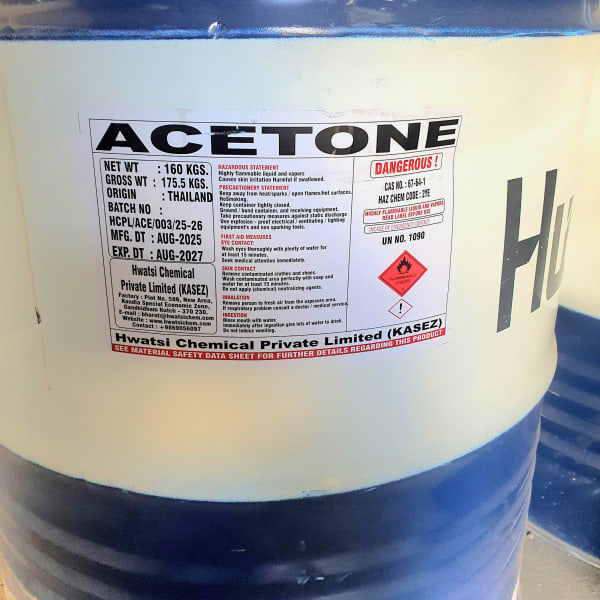
Acetone Industrial Solvent (Bulk 160kg Drums & Multi-Pack Supply)
High-purity virgin Acetone solvent (99.5% min assay, CAS 67-64-1, UN 1090) supplied in 160kg steel drums, 1,000L IBCs,…
CAS 67-64-1 · Industrial Solvent Grade (Virgin High-Purity) · Clear Colorless Volatile Liquid

ABS/LAS 80% for Industrial Use (ABS/LAS)
ABS/LAS (80%) supplied by Kiki's Industrial Chemicals Ltd in 25kg bags across Kenya and East Africa.
Technical Grade · Powder

ATMP (50%)
ATMP (50%) supplied by Kiki's Industrial Chemicals Ltd in 200kg drum. Ideal for Water treatment chemicals.
50% · Standard Packaging
Related Technical Guides & Insights
View all →What Is Acetone? Properties, Uses and Industrial Applications in Kenya
A comprehensive technical guide to acetone (propan-2-one, CAS 67-64-1): molecular structure, physical properties, solvency parameters, industrial applications, and procurement considerations for Kenyan manufacturers.
Buying GuideWhere to Buy Acetone in Nairobi, Kenya: A Practical Buyer's Guide
A practical procurement guide for sourcing industrial acetone in Nairobi, Kenya. Learn what specifications to verify, how to avoid contaminated recycled solvents, and how to evaluate suppliers.
Buying GuideAcetone 20 Litres: Who Needs This Pack Size and How to Order It in Kenya
Discover why the 20-litre acetone jerrycan is the preferred packaging for workshops, composite laminators, and maintenance teams in Kenya. Compare volume versus mass and learn how to order.
Industrial ApplicationsUsing Acetone for Fibreglass and Polyester Resin Tool Cleanup
Learn how to use industrial acetone safely and effectively for cleaning uncured polyester, vinyl ester, and gelcoat resins from fibreglass laminating tools, rollers, and spray equipment.