Essential Chemicals for Industrial Water Treatment in Kenya: Process Stages, Sourcing & Quality Standards
Complete engineering guide to industrial water treatment chemicals in Kenya. Covers coagulants, flocculants, pH adjusters, biocides, and antiscalants.
Quick Answer — Essential Chemicals for Industrial Water Treatment in Kenya: Process Stages, Sourcing & Quality Standards
Industrial water treatment in Kenya is structured into four sequential chemical treatment stages: (1) Clarification using inorganic coagulants (Polyaluminium Chloride or Aluminium Sulphate) and organic polyacrylamide flocculants, (2) pH adjustment using Sodium Hydroxide or Hydrochloric Acid, (3) Disinfection using Calcium Hypochlorite, Sodium Hypochlorite, or Chlorine Dioxide, and (4) Conditioning using antiscalants (ATMP/HEDP) and oxygen scavengers for boiler and RO systems.
Industrial water treatment chemicals are engineered specialty and commodity chemical formulations used to clarify, disinfect, neutralize, and demineralize process water, utility feeds, and factory effluent.
Key Facts
- •Raw water sources in East Africa vary from high-turbidity surface river water in rainy seasons to high-alkalinity, high-fluoride borehole water in the Rift Valley.
- •Overdosing inorganic coagulants lowers water pH and increases residual dissolved aluminum, which violates KEBS drinking water standards and fouls RO membranes.
- •Proper chemical water treatment reduces boiler tube scaling by up to 98%, saving massive fuel costs in factory steam generation.
A plant engineer in Thika once described water treatment as "the most deceptive process in the factory."
From the outside, it looks simple: raw water enters the intake basin, chemicals are added, the water clarifies, and it moves into production.
Then the rainy season hits. The river turns the color of strong milk tea within three hours. Turbidity climbs from 25 NTU to 850 NTU. The regular chemical dose that produced crystal-clear water yesterday is suddenly leaving a cloudy, colloidal haze in the clarifier weir. Downstream, the reverse osmosis pre-filters clog in forty minutes, and the boiler blowdown rate triples.
- In Kenya and East Africa, industrial water sources vary dramatically:
- Surface water (rivers and dams in Central Kenya and Western Kenya) fluctuates wildly with seasonal silt, clay colloids, and organic humic acids.
- Borehole water (Nairobi basin, Athi River, Naivasha, Nakuru) is crystal clear but loaded with dissolved calcium bicarbonate, magnesium, silica, and high total dissolved solids (TDS).
Managing these sources reliably requires understanding the four core chemical treatment stages.
---
Stage 1: Clarification — Coagulation & Flocculation
Raw water turbidity is caused by microscopic suspended colloidal particles (clays, silts, organic matter). These particles carry negative electrostatic surface charges (zeta potential), causing them to repel one another and remain suspended indefinitely.
$$Colloids^- + Repulsion^- \Longrightarrow Stable Turbid Suspension$$
1. Primary Coagulants (Charge Neutralization)
Primary coagulants are positively charged trivalent metallic salts that rapidly compress the electrical double layer, neutralizing particle charges so they can collide and agglomerate into micro-flocs:
- Polyaluminium Chloride (PAC 30% Powder / Liquid):
- The modern standard across Kenya. Because PAC is pre-hydrolyzed ($[Al_n(OH)_mCl_{3n-m}]_x$), it works across a wide pH range (5.0–9.0), forms denser, faster-settling flocs than traditional alum, consumes less water alkalinity, and reduces residual dissolved aluminum.
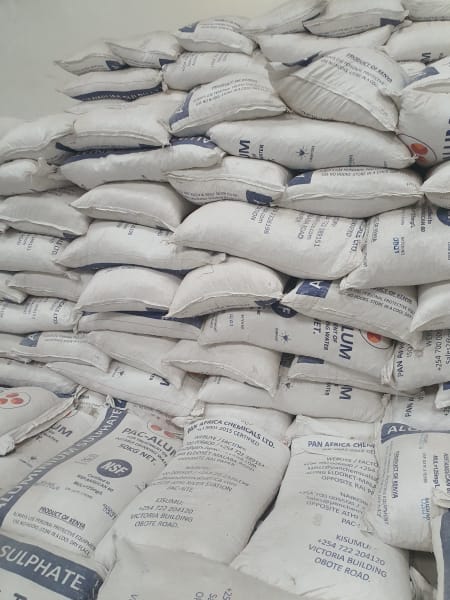
- Aluminium Sulphate (Alum 17% Non-Ferric):
- The traditional, economical coagulant. Highly effective in moderate turbidity and warm water, but consumes significant natural alkalinity, dropping treated water pH and requiring secondary caustic neutralization.
- Ferric Chloride (FeCl_3) & Polyferric Sulphate:
- Iron-based coagulants that perform exceptionally well in heavy industrial effluent and low-temperature waters, particularly where heavy color or hydrogen sulfide odors must be precipitated.
2. Polymer Flocculants (Bridging & Floc Growth)
After primary coagulation creates micro-flocs, Polyacrylamide (PAM) flocculants act like molecular fishing nets. Long polymer chains bind micro-flocs together into heavy, macro-floc aggregates that settle rapidly by gravity.
- Anionic PAM: Ideal for mineral suspensions, stone cutting washwater, and clay clarification.
- Cationic PAM: Required for municipal sewage sludges, organic food processing wastewater, and biological sludge dewatering in belt filter presses.
---
Stage 2: pH Adjustment & Alkalinity Balancing
Every downstream utility—from cooling towers to boilers and RO membranes—has a precise operating pH window:
Utility System — Target pH Window — Primary Alkaline Chemical — Primary Acidic Chemical
Clarified Potable Water — 6.5 – 8.5 (KEBS KS EAS 12) — Sodium Hydroxide / Soda Ash — Hydrochloric Acid 33%
Cooling Tower Circulating Water — 7.8 – 8.8 — Sodium Hydroxide 99% — Sulfuric Acid 98% / HCl 33%
Low-Pressure Steam Boilers — 10.5 – 11.5 — Caustic Soda / Tri-Sodium Phosphate — N/A (Maintained Alkaline)
Reverse Osmosis Permeate — 6.8 – 7.4 — Food Grade Sodium Bicarbonate — CO2 / Food Grade Acid
---
Stage 3: Disinfection & Microbial Control
Destroying pathogenic bacteria, algae, and biofilm is mandatory for food processing safety and industrial cooling efficiency.
1. Calcium Hypochlorite 65%–70% Granules
The most widely used solid disinfectant for borehole wells, rural municipal schemes, and remote factory sites across East Africa. Stable dry storage, long shelf-life, and high active chlorine density.
2. Sodium Hypochlorite (10%–15% Industrial Liquid Chlorine)
Delivered in 25L jerrycans or 1000L IBCs. Completely water-soluble with zero calcium residue. The preferred biocide for commercial water bottling facilities and automated dosing plants where calcium scaling in injection quills must be avoided.
3. Stabilized Chlorine Dioxide (ClO₂) & Isocyanurates
Non-chlorine oxidizers that do not form harmful trihalomethanes (THMs) in high-organic waters, remaining potent biocides even in alkaline cooling towers above pH 8.0.
---
Stage 4: Scale & Corrosion Conditioning for Utilities
When water enters boilers and cooling circuits, thermal concentration causes dissolved minerals to exceed their solubility limits, precipitating rock-hard scale on heat exchange surfaces.
- Organophosphonate Antiscalants (ATMP, HEDP, DTPMPA):
- Threshold inhibitors that distort the crystal lattice of Calcium Carbonate and Calcium Sulfate, preventing scale formation on Reverse Osmosis membranes and heat exchangers at dosages as low as 2–5 ppm.
- Oxygen Scavengers (Sodium Metabisulphite & Hydrazine Alternatives):
- Chemically react with dissolved oxygen in boiler feedwater, preventing devastating pitting corrosion on carbon steel boiler economizers and steam drums.
---
5. Summary: The Operational Rule of Water Treatment
Water treatment is never a static formula; it is a continuous dynamic response to changing raw water chemistry.
Testing water regularly with on-site jar tests, maintaining calibrated metering pumps, and sourcing verified-assay coagulants and biocides protects factory equipment, ensures regulatory compliance, and keeps plant operations running smoothly year-round.
Article Frequently Asked Questions
Related Industries
Related Applications
Chemicals Mentioned in This Guide

Polyaluminium Chloride 28%/30% min for Industrial Use (Polyaluminium Chloride)
Polyaluminium Chloride (28%/30% min) supplied by Kiki's Industrial Chemicals Ltd in 25kg bag across Kenya and East…
Technical Grade · Powder
Aluminium Sulphate ( Alum Flakes / Powder / Granular ) (16-17% Al2O3 Water Coagulant)
Aluminium Sulphate ( Alum Flakes / Powder / Granular ) (16-17% Al2O3 Water Coagulant) supplied by Kiki's Industrial…
16-17% Al2O3 Water Coagulant · Standard Packaging

Sodium Hypochlorite ( Liquid Chlorine 10% - 15% ) (Water Bleaching & Disinfection)
Sodium Hypochlorite ( Liquid Chlorine 10% - 15% ) (Water Bleaching & Disinfection) supplied by Kiki's Industrial…
Water Bleaching & Disinfection · Standard Packaging

Pool Chlorine 70% (Calcium Hypochlorite) for Swimming Pools & Water Disinfection
High-test Calcium Hypochlorite 70% chlorine granules for municipal water chlorination, swimming pool shock treatment,…
CAS 7778-54-3 · Water Treatment / Swimming Pool Grade (Sodium Process High Test) · White / Off-White Granules
Related Technical Guides & Insights
View all →Commercial n-Hexane vs Pure Hexane: Boiling Range 65–70°C, Isomer Blends, and Solvent Residue Control
Understand the chemical distinction between pure analytical n-hexane and commercial extraction-grade hexane: distillation parameters, isomer distribution, and non-polar solvency.
Process EngineeringStein-Hall Corrugator Adhesive Formulation: Corn Starch Slurry, Gelatinisation Temperature, and Green Bond Strength
Master the technical chemistry of Stein-Hall corrugator paste: carrier starch cooking, caustic soda dosing, borax complexation, and raw starch gelatinisation kinetics on high-speed corrugating machines.
RegulatoryFood Grade Corn Starch Specifications: Moisture, Protein, Ash Limits, and KeBS/EAC Compliance in Kenya
Review mandatory technical parameters, microbiological thresholds, and regulatory compliance standards for food grade corn starch imported and distributed across East Africa.