Carbomer 940 (Cosmetic / Technical Grade)
Carbomer 940 supplied by KIKI'S Industrial Chemicals in 20 kg box for industrial, manufacturing, and commercial…
CAS 9007-20-9 · Cosmetic / Technical Grade · Powder

Formulating commercial shampoos, liquid hand washes, and body washes in Kenya requires controlling micellar rheology using electrolyte salt curves and non-ionic thickeners like CDEA. KIKI'S supplies cosmetic-grade surfactants, thickeners, and pH balancing acids across East Africa.
For liquid soap & shampoo thickener applications, KIKI'S Industrial Chemicals supplies documented industrial-grade raw materials and specialty formulation chemicals. We provide consistent chemical inputs and technical documentation to commercial operators across Kenya and the East African market.
Liquid soap and shampoo thickeners comprise secondary surfactants, non-ionic alkanolamides, and electrolyte salts that promote worm-like micelle entanglement to build viscosity in personal care cleansing products.
Key Facts
Primary Use Cases
In commercial toiletries, hand soaps, and hair shampoos, physical thickness is the primary sensory signal of product quality. However, creating a thick, luxurious body wash is fundamentally an exercise in colloidal physics and micellar geometry.
In dilute aqueous solutions, anionic surfactants like Sodium Lauryl Ether Sulfate (SLES 70%) assemble into tiny spherical micelles that flow with the viscosity of water. To build viscosity, formulators add electrolyte salts (pure Sodium Chloride). The sodium cations (Na+) screen the electrostatic repulsion between negatively charged surfactant headgroups, causing spherical micelles to grow into elongated, flexible, 'worm-like' micelles.
Above a critical salt concentration, these worm-like micelles entangle into a continuous three-dimensional viscoelastic mesh that traps water and skyrockets solution viscosity (from ~50 cPs to >4,000 cPs). Incorporating non-ionic thickeners like Cocamide DEA (CDEA 86%) or PEG distearates broadens this salt response curve, providing temperature stability and preventing product thinning or cloudiness during cold highland weather.

Cellulose ethers, PEG esters, and electrolyte-responsive thickeners for viscosity modification in shampoos and liquid soaps.
Primary Surfactant Dilution & Temperature Check
Dissolving SLES 70% into warm demineralized water (35–40°C) under low-shear paddle agitation.
CDEA Secondary Thickener Addition
Adding 2.0–3.0% Cocamide DEA to expand micellar growth and lower the electrolyte concentration threshold.
pH Adjustment to Skin-Acidic Baseline
Titrating 50% citric acid solution to bring batch pH to 5.5–6.5, optimizing clarity and preservative activity.
Incremental Salt Brine Titration
Slowly adding 20% refined vacuum salt brine in 0.25% increments while testing Brookfield viscosity.
Peak Viscosity Verification & De-Aeration
Halting salt addition just before the curve peak (~2,500–4,000 cPs) to avoid salting out, and allowing foam to clear.
Showing 1–3 of 3 catalogued products
Carbomer 940 supplied by KIKI'S Industrial Chemicals in 20 kg box for industrial, manufacturing, and commercial…
CAS 9007-20-9 · Cosmetic / Technical Grade · Powder
Cetostearyl alcohol CSA supplied by KIKI'S Industrial Chemicals in 25kg bag for industrial, manufacturing, and…
CAS 67762-27-0 · Technical / Cosmetic Grade · Flakes
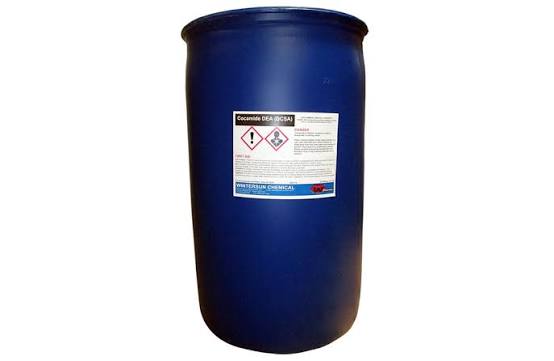
Premium Cocodiethanolamine (CDEA 86%) non-ionic foam booster, thickener, and emulsifier for shampoos, liquid soaps, and…
CAS 68603-42-9 · Cosmetic & Industrial Detergent Grade · Viscous Amber Yellow Liquid
Builds rich, elegant shear-thinning rheology that dispenses cleanly from pump bottles without stringiness.
Secondary non-ionic thickeners prevent shampoo from turning watery on warm days or cloudy in cold weather.
Controlled thickening maintains crystal clarity in transparent liquid soaps without haziness or sediment.
Utilizes optimized salt curves to achieve premium consumer viscosity at minimal active raw material cost.
COMMERCIAL & TECHNICAL GUIDANCE
Technical and process guidance for liquid soap & shampoo thickener in Kenya and East Africa.
The salt curve graphs viscosity against salt concentration. Viscosity rises to a peak as micelles elongate and entangle. If you pass the peak, excess salt breaks the micelle network ('salting out'), causing viscosity to crash rapidly and the product to turn cloudy and watery.