n-Hexane Commercial Grade (Aliphatic Extraction Solvent)
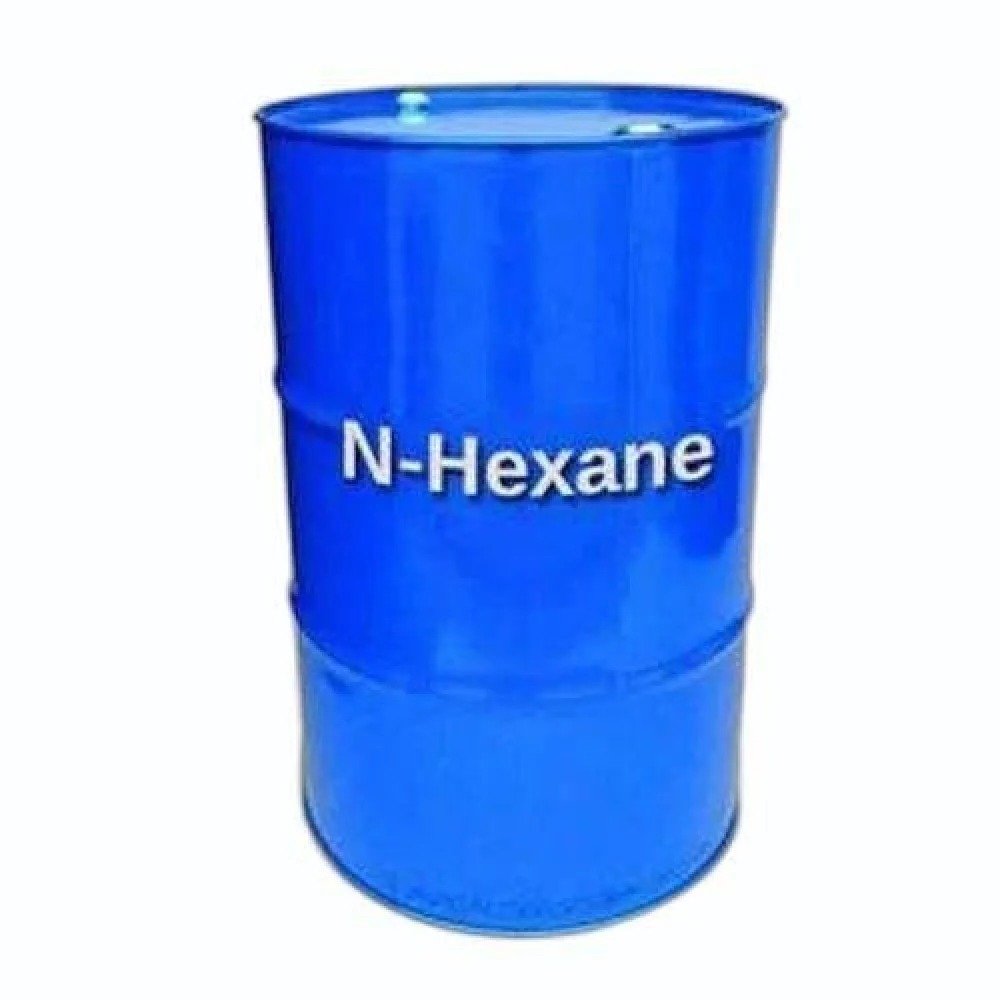
Commercial n-Hexane (CAS 110-54-3, UN 1208) supplied in 154kg and 160kg steel drums by KIKI'S Industrial Chemicals for…
CAS 110-54-3 · Industrial Extraction Grade · Liquid
Continuous counter-current solvent extraction extracting over 99% of vegetable oils from prepared soybean, sunflower, canola, and cottonseed flakes.
Commercial n-Hexane (boiling range 65-70°C) is used in continuous counter-current extractors to recover over 99% of vegetable oil from prepared seed flakes, leaving less than 1.0% oil in animal feed meal and less than 1 ppm residual solvent in refined oil.
Vegetable oil solvent extraction is the solid-liquid separation process that uses volatile non-polar hydrocarbons to dissolve crude triglycerides from crushed seed flakes.
Key Facts
Primary Use Cases
In large-scale continuous oil mills, solvent extraction is integrated across four sequential operations:
Cleaned oilseeds are cracked, dehulled, conditioned to 60°C - 65°C, and passed through hydraulic flaking rolls to produce thin flakes (0.25 mm to 0.35 mm). Thin flaking ruptures cellular walls, exposing microscopic oil droplets directly to solvent contact.
In continuous rotary (Rotocel) or loop extractors, prepared flakes move counter-currently against cascading washes of commercial n-hexane. Fresh, pure hexane washes the most exhausted flakes just before discharge, while the concentrated miscella (hexane-oil solution, 25% to 30% oil) is pumped from the fresh flake inlet stage.
Liquid miscella passes through two falling film evaporators operating under light vacuum, boiling off the bulk of the volatile hexane at 65°C to 75°C. The concentrated oil enters a final disc-and-doughnut vacuum stripping column where direct live sparge steam strips residual solvent traces down to under 1.0 ppm (mg/kg), meeting strict KeBS food standards.
The solvent-laden spent meal (containing ~30% hexane) enters the Desolventiser-Toaster-Dryer-Cooler (DTDC). Direct and indirect steam heating vaporizes the solvent into surface condensers, while controlled cooking deactivates anti-nutritional factors (trypsin inhibitors in soybean meal) to create high-protein animal feed.
KIKI'S Industrial Chemicals supplies extraction-grade Commercial n-Hexane in 154 kg and 160 kg drums with guaranteed ultra-low benzene (<10 ppm) and non-volatile residues <10 ppm.
Seed Flaking Preparation
Condition cracked seeds and roll into 0.3 mm flakes to expose lipid cells to solvent percolation.
Counter-Current Hexane Percolation
Wash flakes with commercial n-hexane in continuous extractor to produce 25-30% oil miscella.
Vacuum Miscella Distillation
Evaporate hexane across falling film columns and strip with live steam to achieve <1 ppm residual solvent.
Meal Desolventising & Toasting
Recover solvent from wet meal in DTDC tower and toast to produce high-protein livestock feed meal.
Showing 1–1 of 1 catalogued products
Commercial n-Hexane (CAS 110-54-3, UN 1208) supplied in 154kg and 160kg steel drums by KIKI'S Industrial Chemicals for…
CAS 110-54-3 · Industrial Extraction Grade · Liquid
Reduces residual oil in spent meal from 8% down to under 1.0%, maximizing mill profitability.
Latent heat of 335 kJ/kg requires significantly less boiler steam than other extraction solvents.
Stripping systems achieve residual hexane <1 ppm in refined cooking oils, meeting KeBS and EAC standards.
COMMERCIAL & TECHNICAL GUIDANCE
Technical and process guidance for vegetable seed & grain oil solvent extraction in Kenya and East Africa.
Hexane is chemically non-polar, selectively dissolving neutral triglycerides while leaving water-soluble proteins and starches in the meal, boiling off cleanly below 70°C.