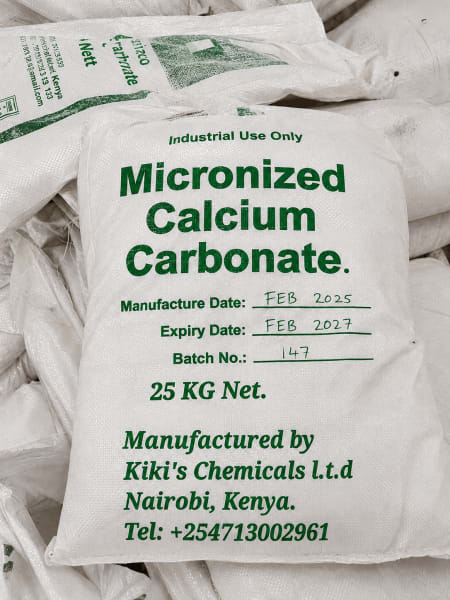
Micronized Calcium Carbonate (Ultra-Fine Powder 2 Micron / 1250 Mesh)
Ultra-fine micronized calcium carbonate powder (2-5 micron) engineered for high-performance plastics, premium coatings,…
CAS 471-34-1 · Technical Grade · Powder

Polymer masterbatches, high-speed plastic extrusion, and premium flexographic inks require functional mineral extenders that disperse rapidly without shear agglomeration. KIKI'S supplies stearic acid-coated and micronized calcium carbonate extenders delivering high dispersibility and low melt torque across East Africa.
For high-dispersibility pigment extension applications, KIKI'S Industrial Chemicals supplies documented industrial-grade raw materials and specialty formulation chemicals. We provide consistent chemical inputs and technical documentation to commercial operators across Kenya and the East African market.
High-dispersibility pigment extension is the application of surface-modified, hydrophobic mineral extenders that disperse seamlessly into non-polar polymer melts, paints, and inks without shear agglomeration.
Key Facts
Primary Use Cases
In modern thermoplastic compounding, cable insulation manufacturing, and masterbatch production in Kenya, adding inorganic mineral extenders into hydrophobic polymer resins presents severe interfacial challenges. Untreated calcium carbonate possesses high surface energy and hydrophilic hydroxyl groups that naturally repel non-polar polymer melts (polyethylene, polypropylene, PVC).
Without surface modification, uncoated mineral particles clump into rigid agglomerates inside the extruder barrel, causing excessive machine torque, screw wear, screen pack clogging, and mechanical weak spots in finished plastics. High-dispersibility extenders solve this via a precision chemical surface coating of saturated fatty acid (Stearic Acid). The polar carboxyl group of the stearate molecule chemically anchors onto the calcium ion sites of the calcite crystal, projecting a hydrophobic aliphatic hydrocarbon tail outwards.
This hydrophobic monolayer lowers mineral surface energy from ~70 mN/m down to ~30 mN/m, matching the surface tension of molten polymer. During high-speed compounding in twin-screw extruders or high-shear mixers, the coated particles wet out instantly, dispersing down to their primary 1 to 2 micron size. Furthermore, the external fatty acid layer acts as an internal processing lubricant, lowering melt viscosity and allowing compounding loadings up to 40–50% without torque overload.

Pre-dispersed pigment concentrates, surface-modified minerals, and wetting additives for smooth, streak-free coatings.
Precision Calcite Micronization
Ultra-fine dry ball milling of white calcite to a steep particle size distribution centered at 1.5 to 2.5 microns.
Vaporized Stearic Acid Coating
Injecting vaporized triple-pressed stearic acid in high-speed coating pin-mills at 100–120°C to achieve a uniform monolayer.
Active Coating Efficiency Testing
Conducting water floatation tests to verify >99.5% hydrophobic surface activation without unbound free acid.
High-Speed Polymer Compounding
Blending coated mineral with polymer resin and processing aids in twin-screw compounding extruders.
Extrusion Strand Pelletizing & QC
Water-cooling extruded polymer strands and pelletizing, testing filter pressure value (FPV) to confirm zero agglomerates.
Showing 1–1 of 1 catalogued products
Ultra-fine micronized calcium carbonate powder (2-5 micron) engineered for high-performance plastics, premium coatings,…
CAS 471-34-1 · Technical Grade · Powder
Hydrophobic surface chemistry allows complete, uniform particle dispersion in polymer melts within seconds.
Surface stearate monolayer acts as an internal lubricant, reducing motor amps and barrel wear.
Enables plastic compounders to achieve 30% to 50% filler loading while preserving impact and tensile strength.
Eliminates surface die lines, pinholes, and rough spots in blown films and extruded pipe walls.
COMMERCIAL & TECHNICAL GUIDANCE
Technical and process guidance for high-dispersibility pigment extension in Kenya and East Africa.
Blown film dies have narrow gaps (typically <1.0 mm). Uncoated calcium carbonate agglomerates instantly choke die lips, causing film tearing, bubble instability, and pinholes. Stearic acid-coated extenders disperse fully down to sub-2-micron primary particles, ensuring flawless bubble stability.